A loading bay barrier that fails under punishing operational cycles doesn’t just stall distribution; it silently bleeds conditioned air, drives up utility overhead, and invites abrasive desert sand directly onto sensitive inventory. When evaluating warehouse doors Dubai/Abudhabi/UAE/Oman/Qatar logistics managers often ask which specific door configuration delivers the ultimate combination of structural security, cycle endurance, and thermal insulation. You already know how frustrating it is when substandard rolling shutter motors overheat and cause sudden, expensive distribution bottlenecks.
You shouldn’t have to choose between robust physical protection and streamlined loading dock efficiency. In this comprehensive guide, you will discover how to select, engineer, and maintain high-performance industrial warehouse doors tailored for extreme operational durability and thermal efficiency. We preview the critical engineering standards, high-speed automated systems, and turnkey maintenance practices you need to eliminate climate infiltration and keep your facility moving safely without interruption.
Key Takeaways
- Understand how to balance perimeter security and temperature regulation by matching loading bays with heavy-duty GI rolling shutters, insulated double-skin profiles, or high-speed systems.
- Learn how correctly engineered warehouse doors Dubai/Abudhabi/UAE/Oman/Qatar eliminate severe cooling loss and block sand infiltration across busy logistics hubs.
- Identify the core engineering parameters, including wind-load resistance and full perimeter sealing, required to avoid curtain blowout along wide structural spans.
- Master the site survey process to accurately calculate critical dimensions such as headroom, sideroom, and internal vehicle clearance before custom fabrication.
- Discover the operational advantages of turnkey manufacturing, electrostatic powder-coating, and structured annual maintenance contracts for eliminating unexpected mechanical failure.
Warehouse Doors: Operational Demands and Environmental Challenges
Industrial portals are the most vulnerable structural boundaries in any logistics facility. Specifying resilient warehouse doors Dubai/Abudhabi/UAE/Oman/Qatar supply chains rely on requires balancing uncompromising perimeter security with aggressive environmental defense. Loading bays face relentless exposure to extreme outdoor temperatures and airborne grit while securing high-value inventory against unauthorized entry. Without robust structural engineering, a primary doorway quickly becomes an operational bottleneck and a constant drain on overhead.
Thermal Regulation and Dust Suppression in High-Traffic Facilities
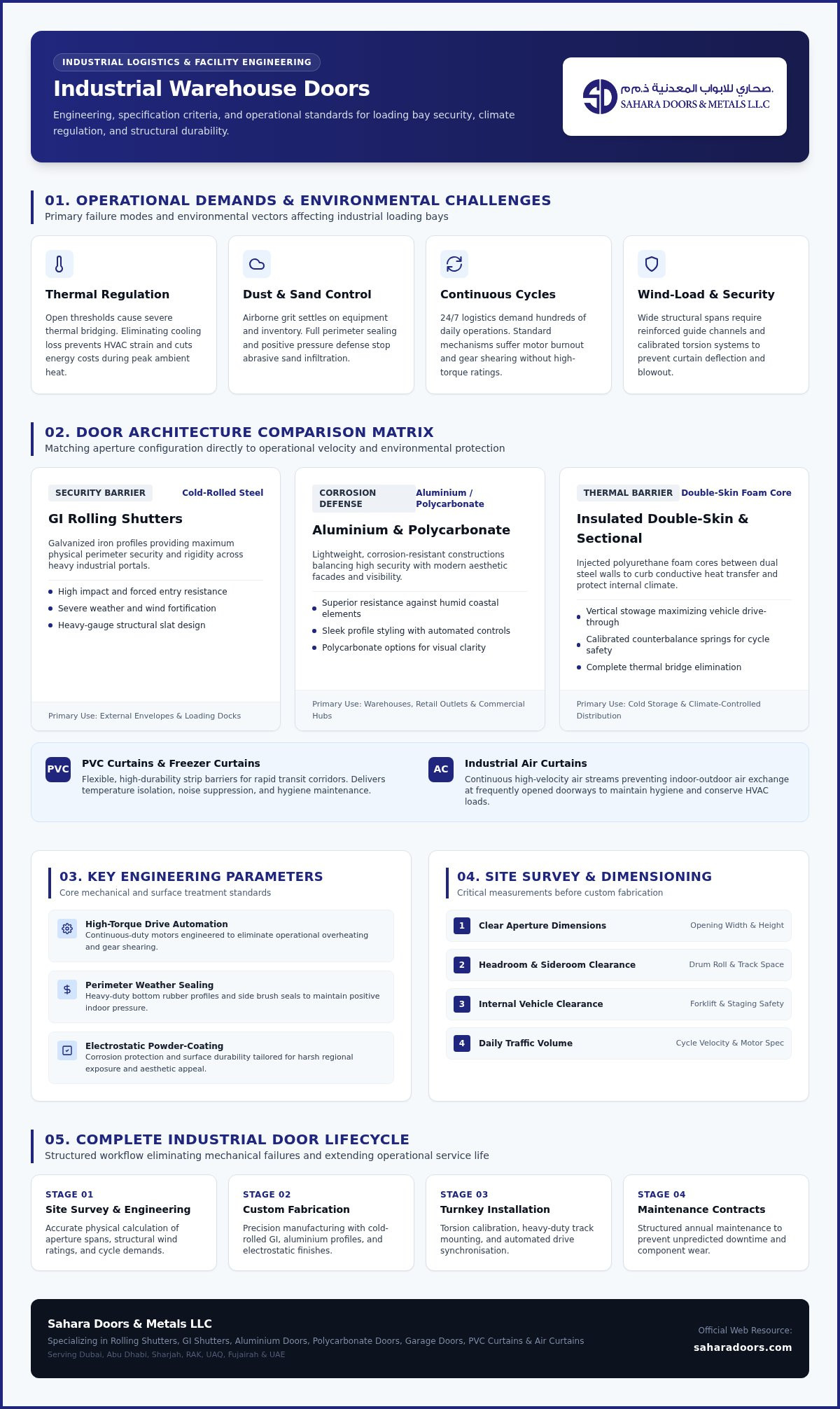
Unconditioned air rushing through unsealed loading docks drastically increases facility cooling expenditures. When ambient heat spikes, central HVAC systems work overtime to offset constant thermal bridging across open thresholds. Airborne dust and fine sand also infiltrate unsealed gaps, settling on equipment and damaging sensitive inventory. Installing secondary environmental seals and heavy-duty bottom rubber profiles preserves positive indoor air pressure, keeping thermal energy stable and airborne particulates firmly outside.
Cycle Frequency Demands and Structural Mechanical Fatigue
Modern distribution hubs operate round the clock, running loading bay barriers through hundreds of continuous cycles every shift. Standard commercial mechanisms fail quickly under this level of stress, suffering gear shearing and motor burnout. Investing in heavy-duty drive systems, such as the high-torque automatic doors Dubai industrial hubs demand, ensures dependable continuous-duty operation without sudden logistical delays.
Mechanical longevity depends directly on correct assembly and balance. Heavy-gauge industrial Roller shutter doors built with reinforced guide channels and calibrated torsion systems absorb mechanical vibration and resist track deflection during continuous operation. Selecting the right specifications for warehouse doors Dubai/Abudhabi/UAE/Oman/Qatar ensures components withstand intense daily wear, protecting your building envelope from structural fatigue.
Industrial Warehouse Door Types: Comparing Shutters, Sectionals, and High-Speed Systems
Selecting the right entryway requires matching aperture dimensions directly to traffic volume and environmental exposure. Facilities evaluating warehouse doors Dubai/Abudhabi/UAE/Oman/Qatar must weigh physical resistance against operational velocity. Rather than relying on generic product catalogs, modern facility managers use a clear operational framework to select between single-skin barriers, insulated curtains, and high-speed cycle systems.
Galvanized Iron (GI) and Aluminium Rolling Shutters for Security
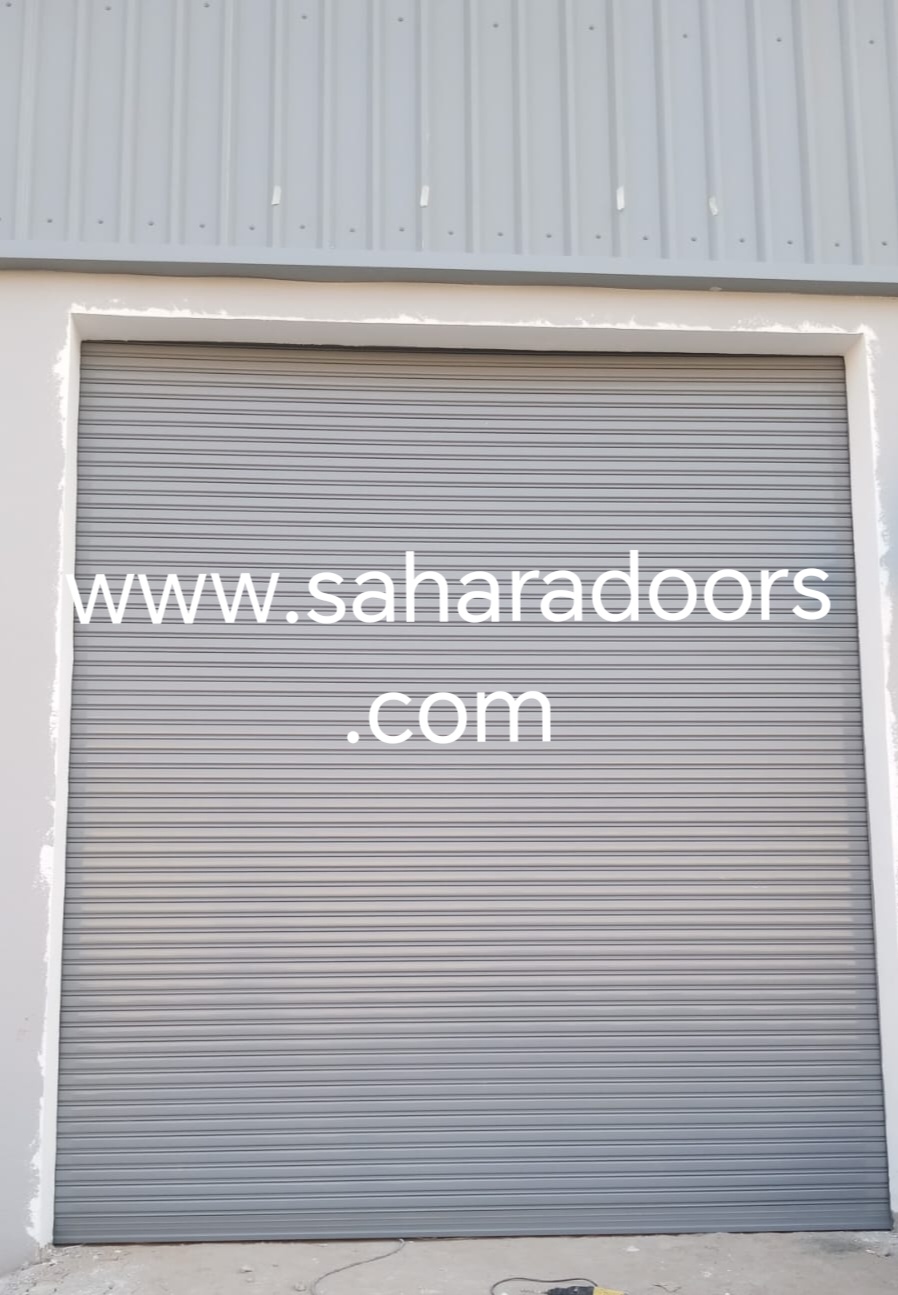
Single-skin GI rolling shutters deliver reliable physical perimeter protection against forced entry and severe weather. Cold-rolled galvanized steel slats provide outstanding structural rigidity, making them ideal for external boundary envelopes. For facilities prioritizing corrosion resistance or modern facade aesthetics, aluminium rolling shutters provide a lightweight, durable alternative. Installing heavy-gauge GI rolling shutters ensures large industrial loading bays remain fortified against mechanical impacts and intense outdoor exposure.
Insulated Double-Skin Shutters and Sectional Overhead Doors
Cold storage facilities and climate-controlled distribution hubs require continuous thermal barriers across exterior portals. Insulated double-skin shutters feature rigid polyurethane foam cores injected between dual steel walls, curbing conductive heat transfer through the curtain. Sectional overhead doors open vertically and stow compactly along the roofline, maximizing drive-through height. Adhering to recognized benchmarks like OSHA cargo door safety standards ensures heavy counterbalance springs and track hardware protect personnel during intensive loading cycles.
Rapid Roll-Up High-Speed Doors for Fast Logistics Transit
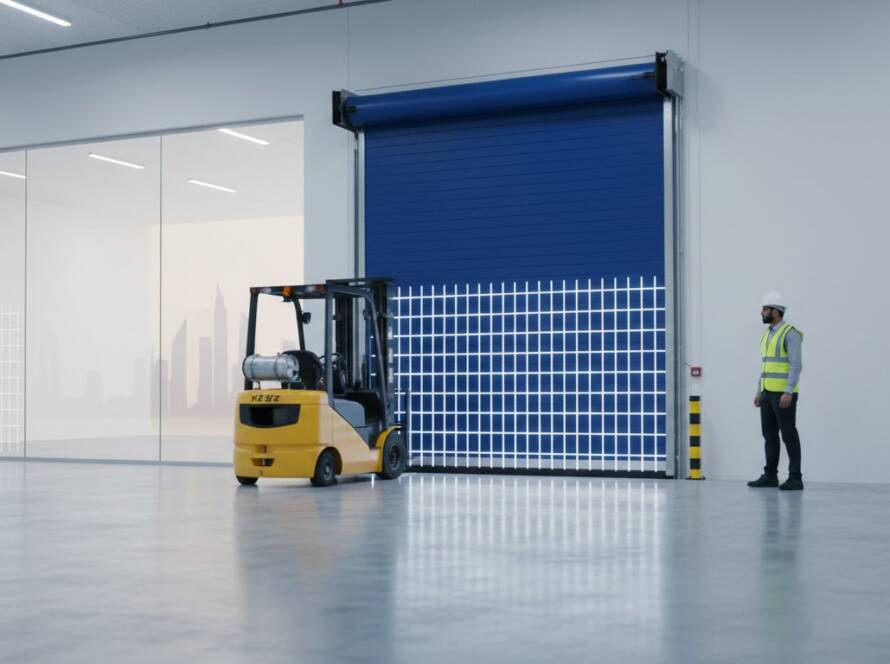
Forklift thoroughfares require maximum operating speed. Rapid roll-up high-speed doors utilize reinforced PVC curtains and high-frequency variable-speed drives to clear apertures at speeds exceeding one meter per second. This rapid movement drastically restricts the duration of outdoor air infiltration between interior zones. Many high-speed systems feature self-repairing side guides; if a forklift dislodges the curtain, the door resets into its tracks on the next cycle without maintenance intervention. To match the right system to your building plan, review custom layout options at Sahara Doors & Metals.
Key Engineering Criteria: Security, Insulation, and Operating Speed
Engineering dependable warehouse doors Dubai/Abudhabi/UAE/Oman/Qatar logistics hubs demand means looking well beyond surface dimensions. Long-term operational reliability rests on precise metallurgy, matched motor duty ratings, and intelligent automation safety. When these three engineering pillars align, loading docks operate efficiently under the toughest industrial workloads.
Wind-Load Engineering and Heavy-Gauge Guide Track Systems
High winds exert massive lateral pressure across wide external bay openings. When severe gusts hit an expansive portal, curtains flex violently. Heavy-duty structural steel guide channels, deep engagement depths, and steel wind locks prevent curtain dislodgement under intense pressure. A reinforced structural bottom bar keeps the curtain rigid across uneven loading dock thresholds, stopping wind draft and sand infiltration. Industry professionals reference the DASMA Technical Data Sheets to evaluate structural deflection limits and wind-load performance guidelines across varied door spans.
Motor Drive Automation, Duty Cycles, and Manual Overrides
Motor selection dictates whether an entrance functions smoothly or suffers constant thermal failure. High-tonnage rolling shutters require direct-drive, three-phase industrial motors designed to produce high starting torque without drawing excessive amperage. Specifying continuous-duty motors prevents thermal overload switches from tripping during peak shipping intervals. In addition, integrated manual hand-chain overrides ensure warehouse personnel can operate heavy curtains during power cuts, preventing expensive transport delays.
Industrial Automation and Sensor Integration for Fast Access
High-volume logistics require seamless vehicle passage. Automated activation systems such as radar motion detectors, floor induction loops, and pull cords allow material handling equipment to trigger cycles without requiring the operator to stop. Upgrading facility portals with automated drive mechanisms through specialized automatic doors delivers hands-free logistics transit. Integrated safety systems, including dual through-beam photo-eyes and wireless pneumatic bottom edges, stop and reverse closing cycles instantly upon detecting an obstruction, ensuring strict workplace protection across busy loading bays.
Warehouse Door Specification and Site Survey Checklist
Precision measurement during the initial site survey prevents severe installation setbacks. When ordering warehouse doors Dubai/Abudhabi/UAE/Oman/Qatar project teams must thoroughly audit the building envelope, traffic patterns, and mechanical tolerances. A thorough engineering survey ensures the door fits cleanly, aligns with internal vehicle workflows, and handles electrical demands without risking premature structural failure.
Structural Dimensioning: Headroom, Sideroom, and Header Clearances
Surveyors must verify structural clearances across multiple parameters before fabrication:
- Clear Opening Dimensions: Measure exact width and finished floor-to-lintel height to ensure the aperture accommodates maximum transport truck and pallet heights.
- Headroom Capacity: Verify adequate overhead clearance between the header and roof trusses to house coiled shutter barrels or sectional tracking curves.
- Sideroom Clearance: Check vertical wall space on both sides for guide channel anchor plates, direct-drive motor housings, and manual chain assemblies.
- Structural Lintel Integrity: Ensure supporting steel lintels or reinforced masonry can safely bear the combined static and dynamic load of heavy curtains.
Traffic Flow Evaluation and Access Control Specification
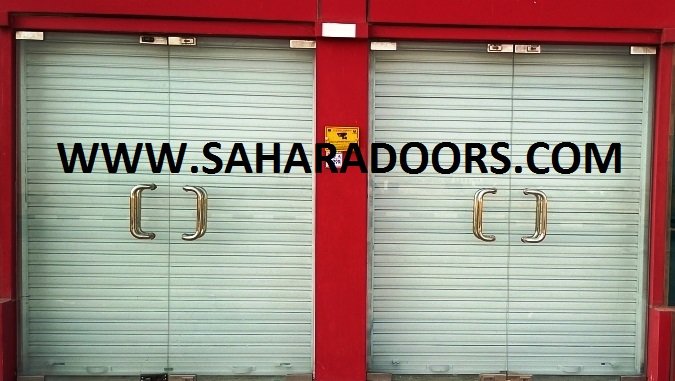
Facility operations dictate automated access control. Corridors handling reach trucks require motion sensors, while restricted bays benefit from RFID card readers or localized push-button panels. Where operators need exterior line-of-sight before operating high-speed cycles, installing polycarbonate rolling shutters or integrated vision lites provides impact resistance alongside natural visibility, minimizing cross-traffic collision risks inside congested staging bays.
Integrating Secondary Environmental Barriers and PVC Curtains
External doors frequently stay open during busy pallet loading. Hanging durable PVC strip curtains immediately behind the primary door curtain preserves interior climate control. These flexible synthetic barriers prevent outdoor thermal rush while allowing forklifts to pass through without resistance. They also block grit, insects, and humidity, ensuring temperature-sensitive goods remain protected within cold storage facilities.
Custom Fabrication, Turnkey Installation, and Maintenance Contracts
Procuring durable warehouse doors Dubai/Abudhabi/UAE/Oman/Qatar facilities rely on requires seamless coordination from raw manufacturing to long-term site support. Off-the-shelf shutter assemblies rarely match unusual industrial openings or complex vehicle movements. Partnering directly with an established manufacturer guarantees that structural steel components, high-torque drive units, and localized architectural coatings are engineered specifically for your building’s operational reality.
In-House Engineering, Fabrication, and Protective Powder Coating
Complete in-house manufacturing gives facility engineers total control over slat gauges, structural barrel diameters, and wind-lock bracing. Custom fabrication accommodates non-standard structural spans, overhead crane clearances, and low-headroom loading bays without structural compromises. In-house electrostatic powder-coating facilities apply thick, bonded polymer finishes over steel and aluminium surfaces, delivering long-lasting resistance against coastal corrosion, UV degradation, and abrasive sandblasting.
Turnkey Installation, Safety Commissioning, and Staff Training
Improper installation ruins even the finest mechanical doors. Turnkey project delivery includes dedicated site preparation, mechanical plumb alignment, and precise limit switch calibration. Certified technicians verify that safety photo-eyes, obstacle-sensing bottom bars, and manual chain overrides work instantly under operational conditions. Thorough handover protocols train local operations teams on daily inspection checks, control panel operation, and manual emergency disengagement procedures to prevent accidental operator error.
Preventative Maintenance (AMC) and 24/7 Emergency Support
Mechanical wear accelerates quickly under continuous round-the-clock logistics cycles. A structured Annual Maintenance Contract (AMC) is the most reliable defense against catastrophic bay closures. Regular technical service visits include:
- Drive Train Inspection: Checking gear alignment, roller chain tension, and electric motor brake pad clearances.
- Balancing & Guides: Lubricating high-load bearings, verifying torsion balance, and inspecting guide tracks for forklift scrapes.
- Curtain Alignment: Examining individual interlocking slats, end locks, and bottom weather seals for signs of deflection.
When unexpected collisions or mechanical faults occur, access to dedicated 24/7 emergency response teams ensures fast on-site recovery. Industrial facilities, cold storage complexes, and high-throughput distribution hubs achieve reliable operational uptime for warehouse doors Dubai/Abudhabi/UAE/Oman/Qatar logistics demand by building a lasting partnership with Sahara Doors & Metals LLC.
Optimize Your Industrial Facility with Engineered Perimeter Protection
Operating a modern distribution hub requires zero compromise on perimeter durability and thermal performance. Mastering warehouse doors Dubai/Abudhabi/UAE/Oman/Qatar facilities depend on comes down to aligning heavy-duty metallurgy, motor duty ratings, and perimeter weatherseals with your daily workflow demands. From curbing utility expenses with insulated double-skin profiles to stopping sand ingress with tight guide tolerances, proper door engineering protects valuable inventory while eliminating unexpected operational downtime.
Delivering end-to-end reliability requires an experienced partner. With comprehensive in-house fabrication, dedicated powder-coating facilities, and 24/7 emergency repair support backed by structured Annual Maintenance Contracts, Sahara Doors & Metals LLC provides proven performance demonstrated on flagship developments like the Amazon Facility and the 31 Warehouses Complex in Jebel Ali.
Equip your loading docks with durable entry systems designed to safeguard your personnel, preserve conditioned air, and keep your distribution network moving without disruption.
Frequently Asked Questions
Which warehouse door type is best for temperature-controlled cold storage facilities?
Insulated double-skin rolling shutters paired with secondary PVC strip curtains offer the best thermal barrier for cold storage facilities. The double-skin polyurethane core stops heat transfer, while flexible freezer curtains prevent chilled air escape during pallet loading. Selecting the right warehouse doors Dubai/Abudhabi/UAE/Oman/Qatar cold logistics facilities rely on maintains consistent interior temperatures and protects frozen perishables from costly thermal degradation.
Can high-speed fabric doors provide adequate physical security against break-ins?
No, high-speed fabric doors are engineered for climate separation and rapid vehicle transit rather than perimeter burglary protection. Facilities combine a rapid-acting PVC curtain inside the bay with a heavy-duty galvanized iron (GI) rolling shutter mounted on the outer perimeter. The outer steel door stays locked during non-operational hours, while the inner high-speed curtain manages interior traffic and dust suppression during work shifts.
What electrical power supply is required for industrial motorized rolling shutters?
Most heavy industrial motorized rolling shutters require a three-phase 380V to 415V electrical supply operating at 50Hz. This power configuration delivers the high starting torque needed to smoothly hoist heavy steel barrels without overheating the motor windings. Smaller commercial shutters or light garage systems might operate on single-phase 220V power, but continuous high-cycle distribution centers depend on robust three-phase installations with dedicated circuit isolation.
How often should industrial warehouse doors undergo professional safety inspections?
High-throughput industrial doors should undergo professional safety inspections at least twice a year, or quarterly for 24-hour distribution facilities. Regular evaluations examine spring tension, drive chains, motor brakes, and guide alignment under structured Annual Maintenance Contracts (AMC). Frequent inspections identify mechanical wear before it causes costly distribution shutdowns, ensuring all safety sensors, manual chain overrides, and emergency stops comply with industrial facility safety guidelines.
What safety features prevent a motorized warehouse door from closing on vehicles or staff?
Motorized industrial doors use a combination of optoelectronic through-beam safety eyes and wireless bottom sensing edges to protect personnel and vehicles. The through-beam sensors project an infrared light line across the bay entrance, halting curtain travel if broken. Bottom safety edges detect contact with any obstruction instantly, reversing door movement within fractions of a second to prevent crush injuries and avoid forklift impact damage.
Is it possible to automate an existing manual warehouse rolling shutter?
Yes, manual warehouse doors can easily be converted to motorized operation through external side-drive or central barrel motor retrofits. Professional technicians verify curtain balance, inspect guide rails for straightness, and install a motorized drive assembly alongside required electrical safety controls. This upgrade modernizes older warehouse doors Dubai/Abudhabi/UAE/Oman/Qatar facilities operate, increasing daily dispatch efficiency and eliminating manual physical strain on warehouse personnel.
How do insulated double-skin rolling shutters reduce facility electricity bills?
Insulated double-skin rolling shutters feature high-density polyurethane cores sealed between dual metal slats to minimize thermal conductivity across large apertures. By blocking conductive exterior heat and preventing air leakage with heavy perimeter brush and bottom rubber seals, these doors significantly lower cooling loads on building HVAC chillers. This thermal barrier prevents conditioned air loss, delivering lower monthly power bills across refrigerated and climate-controlled storage hubs.