A smooth, dependable polycarbonate sliding door starts with the right track, accurate opening measurements, and a panel layout suited to the space. For polycarbonate sliding doors, assess how the existing track runs, measure the opening at several points, and consider how the door’s edges meet the frame to help manage air and water entry.
Appearance matters, but a door that does not fit the opening or slide smoothly can be frustrating to use. Choose a solution from Sahara Doors & Metals LLC that balances access, appearance, and the details that affect how it operates and fits your property.
This guide explains how to assess tracks and measure an existing opening, compare customization choices, and evaluate air and water tightness. You’ll also learn what to consider when selecting a sliding-door solution for a home or business in the UAE, so you can plan the next step with greater confidence.
Key Takeaways
- Inspect the existing track for smooth movement and signs of wear before planning a replacement or new installation.
- Measure the opening carefully at multiple points so the door can be planned around the space and its existing frame.
- Compare panel, finish, and automation choices based on how the entrance will be used and the look you want.
- Assess how the door meets the frame and floor to understand its ability to limit air and water entry.
- Regular track care and door inspections can help maintain smooth operation over time.
Floor tracks and maintenance
For exterior sliding doors in Dubai, permit or approval requirements depend on the property and the proposed alteration. Before changing an exterior opening, check the applicable requirements with building management and the relevant local authority.
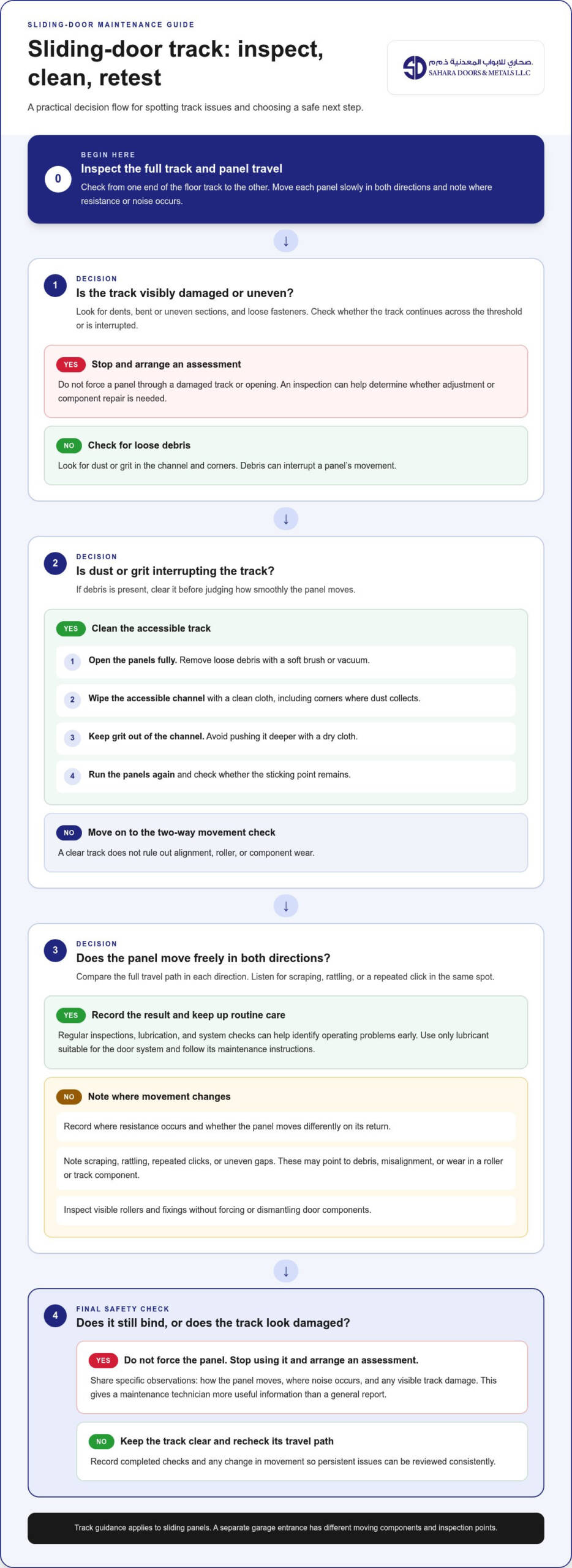
Inspect the full floor track, from one end of the opening to the other. Look for dust, grit, loose fasteners, dents, or uneven sections. Debris can interrupt a sliding panel, while a bent track can make it move roughly. Check whether the track continues across the threshold or is interrupted, as this affects the panel’s travel.
Move each panel slowly along its full travel path. Listen for scraping, rattling, or a repeated click in the same spot. These signs may point to debris, misalignment, or wear in a roller or track component. Note where resistance occurs and compare movement in both directions. If the panel moves freely one way but catches on its return, alignment may be the issue.
Use this inspection sequence before cleaning or arranging maintenance:
- Open the panels fully and remove loose debris from the track with a soft brush or vacuum.
- Wipe the accessible channel with a clean cloth, then check corners where dust collects.
- Run the panels again and note any sticking, unusual noise, or uneven gaps.
- Inspect visible rollers and fixings without forcing or dismantling the door components.
- Use only a lubricant suitable for the door system, following its maintenance instructions.
Keep the track clear after cleaning, and avoid pushing grit deeper into the channel with a dry cloth. Dust may be the main issue indoors, while windblown debris can collect near an exterior threshold. Recheck the panel’s travel path to see whether the sticking point remains.
Regular inspections, lubrication, and system checks can help identify operating problems early. Record how the panel moves, where any noise occurs, and any visible track damage. Specific observations give a maintenance technician more useful information than a general report that the door is difficult to use.
Floor-track guidance applies to sliding panels, not every entrance mechanism. For a separate garage entrance, a garage door system has different moving components and maintenance points. Keep its inspection separate from the sliding track review.
If a panel still binds after debris is removed, or the track appears damaged, do not force it through the opening. An inspection can help determine whether cleaning, adjustment, or component repair is needed.
Avoid forcing the panel if resistance persists; stop using it and arrange an assessment rather than risking further damage. If a replacement or additional track is being considered, confirm what the installation includes before work begins. Sahara Doors & Metals LLC notes that a floor track, if required, is usually charged extra, depending on site conditions and the installer’s assessment.
Maintain automatic sliding doors with routine inspections, lubrication, and system checks. Keep a record of completed checks and any persistent change in movement, and share it with the maintenance provider. This supports a consistent review of the system without assuming the track is the only component that may need attention.
Installation, measurement, and existing openings
Accurate measurements begin with the opening, not the door panel. For an existing doorway in Dubai, inspect the frame, floor, and upper support before recording dimensions. A crooked jamb or sloping threshold can affect panel travel, even when the opening looks square at first glance.
Measure the clear width at the top, middle, and bottom of the opening, and record each reading. Then measure the height at the left side, centre, and right side. Differences show whether the frame or floor varies across the opening.
Use this sequence to create a useful measurement record:
- Clear furniture and loose items from the doorway so the full opening is accessible.
- Measure the inside width and height at the points described, keeping the tape level and straight.
- Record the location of existing tracks, frames, handles, and any fixed panels.
- Check the floor beneath the opening for a raised threshold, slope, or change in surface.
- Photograph the opening from inside and outside, including corners and track ends.
If the top width differs from the bottom width, record both values and note where each was taken. Do not average them into one measurement. The variation may affect frame preparation, panel layout, and the space needed for smooth movement. A photograph with notes can show details that a single measurement cannot.
Assess the existing frame and surrounding wall. Look for loose sections, visible cracks, damaged sealant, or finishes that project into the opening. Check whether the floor can support the planned track position. If the doorway has a sill or raised threshold, record its height and shape.
Plan for how the panels will move. A sliding panel needs clear travel space, so note nearby walls, cabinets, furniture, and corners. Decide whether it should move left, right, or in both directions. This affects where panels stack and how much of the opening remains clear.
Before fabrication, compare the recorded dimensions with the actual opening and frame. The panel arrangement, track position, and operating clearance all affect the final fit. A careful site survey helps avoid assumptions about standard dimensions, particularly when an opening has been altered or finished unevenly.
Keep the measurement sheet, photographs, and notes together. That record gives the installation team clear information about the opening, obstructions, and existing surfaces, helping them plan the work with fewer assumptions.
Supplier locations and contact details
The UAE sliding doors directory lists 179 results, so location helps narrow the search. Start with the property’s emirate and neighbourhood, such as Dubai, Abu Dhabi, Sharjah, or Fujairah. A directory address identifies a business location, but doesn’t necessarily show where project work is carried out. Keep the property address and type ready when reviewing contact details.
Separate a business address from its stated working area. For example, a Dubai address doesn’t by itself establish coverage for a property in Ras Al Khaimah. Read each listing’s location and product description carefully. For a UAE project, focus on the specific emirate and property location rather than assuming that a nearby city’s listing represents the entire country.
Prepare a brief project note before making an enquiry. This gives the discussion practical context instead of relying on a general product description:
- Write the emirate and neighbourhood, such as a villa in Dubai or a retail unit in Sharjah.
- Describe whether the opening is an interior partition or an exterior entrance.
- State whether the project involves a new opening or an existing doorway.
- Note the current door arrangement, track condition, and preferred panel direction.
- Include clear photographs of the full opening, frame, threshold, and nearby space.
Use contact details that belong to the relevant business listing or its own website. A phone number supports a direct conversation, while email or an enquiry form can carry project notes and photographs. Keep the business name, location, and contact information together. If you review multiple UAE directory entries, save each record separately to avoid mixing addresses or product descriptions.
Make your enquiry specific to the project’s next step. State whether the opening needs a site measurement before a proposal, and include any dimensions already recorded, labelled as preliminary. An uneven frame or altered threshold may affect the assessment. A shop entrance with a fixed side panel, for example, needs a different review from a clear opening inside a home.
For an exterior entrance in Dubai, include a photograph of the outside approach and nearby obstructions. For a commercial unit in Abu Dhabi, note any access restrictions that affect a site visit. These details help connect the property location with the practical requirements of the project.
Keep replies, drawings, photographs, and the property address in one project file. That record makes it easier to track which opening details relate to each UAE property, particularly when planning work across locations such as Dubai, Sharjah, or Fujairah.
Air and water tightness
Air and water tightness depends on how a sliding panel meets its frame, threshold, and adjoining panel. Check the top, sides, centre meeting point, and floor edge separately. A visible gap at one corner can matter more than a close fit elsewhere. In Dubai, assess the exterior side as well as the interior, because the entrance faces different conditions on each side.
Automatic sliding doors can help regulate indoor temperatures by minimizing air leakage, provided the door closes and aligns correctly. A panel that stops short of its jamb leaves a path for air, even if the rest of the frame appears snug. Check the closing position and contact points, including any fitted seals or brush strips.
Use a simple visual inspection before arranging any water check:
- Close each panel fully and look for daylight around the perimeter.
- Compare the gaps at the top, bottom, and meeting stile.
- Check whether seals, if fitted, sit continuously against the adjoining surface.
- Look for damaged sealant or openings around the frame and wall junction.
- Record where a draft or visible gap occurs, such as the lower corner.
For water entry, identify the likely route first. Water may pass beneath a raised or uneven threshold, through a frame junction, or between panels. Check the outside surface after ordinary rain and note where moisture appears. Water at the sill differs from water tracking down a jamb, so record its exact location.
A controlled water check should focus on the exterior perimeter, without forcing water into the doorway. Apply a gentle flow to one small area at a time, then inspect the corresponding interior edge. Do not aim a concentrated stream at seals or joints. Stop if water enters, note the test location, and inspect the frame and threshold for an obvious opening.
Distinguish condensation from direct water penetration. Moisture on a cool interior surface may form differently from rainwater entering at a joint. Note the time, weather conditions, and exact surface affected. These details can help distinguish a perimeter gap from moisture forming on the room-facing surface.
During a site review, ask how the proposed door is designed to fit at the frame edges, meeting stile, and threshold. Compare those details with the actual opening, especially if the floor slopes or the frame has uneven corners. Keep expectations practical: the door’s fit, installation, and closing alignment all affect how well it limits air and water passage.
Customization of materials, finishes, and automation
Polycarbonate sliding doors can be planned around different panel arrangements, finishes, and operating needs. In Dubai and across the UAE, the right configuration depends on the opening, available space, and how people use the doorway. Begin with the function, then compare the design choices that support it.
Common layouts include one sliding panel or multiple panels that travel along a track. A single panel needs clear wall space beside the opening. Multiple panels can divide movement across the doorway, but their stacking positions need planning. Decide which way each panel should travel and how much access must remain when the door is open.
Polycarbonate and glass are different materials, so compare the complete door rather than judging the panel alone. Review the stated construction, frame, intended use, and performance details. Cost depends on the opening, panel arrangement, material, frame, finish, and operating method; a price is provided after a quote request.
Insulation depends on the complete assembly, including the panel, frame, seals, and installation. The material alone doesn’t establish how well a door limits heat transfer. For a Dubai home exposed to direct sun, consider the opening’s orientation and surrounding shade alongside the selected panel and frame.
UV resistance also depends on the particular panel construction and any protective treatment. Review the stated UV performance rather than assuming every polycarbonate panel provides the same protection. For a UAE property, consider how heat exposure, the frame, seals, and fitting affect the door’s operation and closing position.
Choose a finish that suits the setting. A clear panel can preserve visibility between spaces, while a less transparent finish can provide visual separation. Frame colour and hardware also shape the overall appearance. Compare finish samples in the room’s actual lighting, as daylight and indoor lighting can change how a surface looks.
Automation may suit an entrance that sees frequent use or needs powered movement. A manual system offers straightforward operation, while a motorized system is powered. Consider who will use the entrance, how often it opens, and where controls can be placed accessibly. Plan how people will operate the door if power is interrupted.
Compare the main choices before settling on a configuration:
- Panel layout, travel direction, and stacking space.
- Material performance, finish, and visibility needs.
- Frame, seals, and exposure at the opening.
- Manual or motorized operation and user access.
The options described include single-panel and multiple-panel sliding doors, clear or less-transparent finishes, and manual or motorized operation. Plan the panel layout, travel direction, and stacking space around the opening.
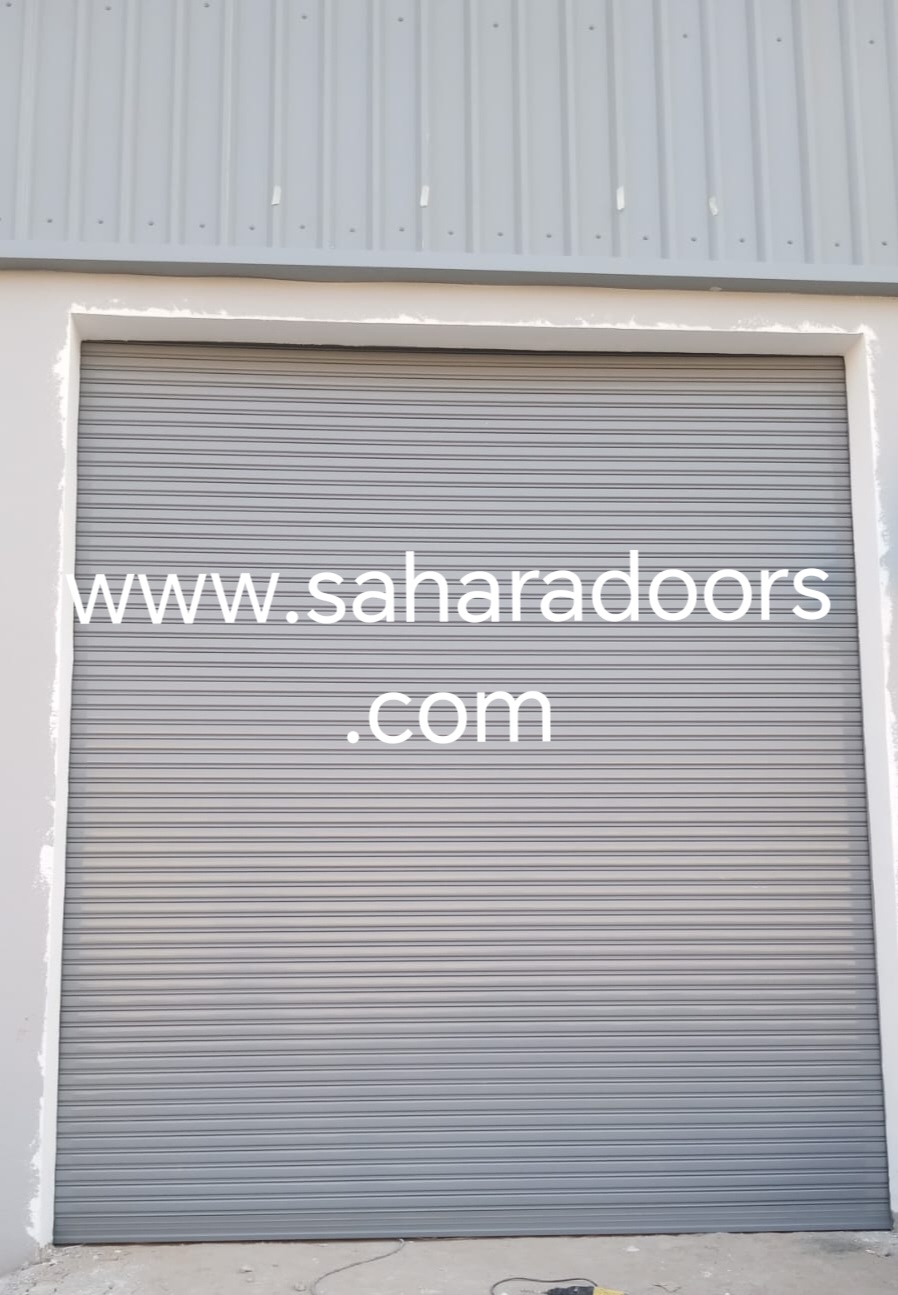
Sahara Doors & Metals: GI Rolling Shutter
Sahara Doors & Metals manufactures and installs entrance solutions suited to the opening and its purpose. A sliding door supports convenient passage, while a rolling shutter may suit a shopfront or another opening that needs a closing barrier. Consider a GI Rolling Shutter when securing the entrance is a priority. A Motorized Rolling Shutter provides powered operation, while Polycarbonate Rolling Shutters and Perforated Rolling Shutters offer additional options for different frontage requirements.
Share the opening type, intended use, and preferred operation when discussing your project. These details help identify a suitable shutter category rather than treating every entrance alike. For a sliding-door project, use your measurements and site observations to guide the next decision.
Contact Sahara Doors & Metals or visit saharadoors.com to discuss your entrance requirements.
Plan the Right Entrance for Your Space
Your next step is to turn your priorities into a clear project brief. Decide whether the entrance needs to improve visibility, control access, or make everyday movement easier. For polycarbonate sliding doors in Dubai, relate those priorities to the property’s use and how people move through the opening.
Bring together the opening details, preferred appearance, and operating needs before moving forward. This gives the discussion a practical starting point and keeps the focus on a solution suited to your space. Sahara Doors & Metals LLC can also discuss rolling shutter options where a separate entrance needs a closing barrier.
A well-planned entrance supports the way your property works every day. Take the next step by shaping a solution around your space.
Frequently Asked Questions
Which supplier can provide polycarbonate door systems for projects in Qatar?
Sahara Doors & Metals LLC supplies and installs polycarbonate rolling shutters for customers in Qatar. Its listed polycarbonate product is a rolling shutter, so confirm whether this format suits your opening before requesting a quote. For a sliding configuration, describe the required movement and application when you contact the company at +971 55 5680048. This helps clarify the appropriate product and arrange a technical discussion for your project.
Can I customize the size, color, thickness, and frame of a polycarbonate sliding door?
Polycarbonate rolling shutters can be customized for specific openings and are offered in various sizes, finishes, and colours. Share the opening dimensions and intended use with the technical team so the specification can be assessed for your project. A shopfront, for example, may need a different configuration from an internal partition. Ask for the proposed materials and finish to be recorded in the project details.
What warranty, maintenance, and lifespan should I expect?
Ask for the warranty terms in writing with your project proposal, including what the coverage includes and any maintenance conditions. Rolling shutters are designed for low maintenance and long service life, but no single lifespan applies to every installation. Keep the operating path clear, clean accessible surfaces with a soft cloth, and arrange support if movement becomes uneven. Sahara Doors & Metals LLC provides installation and maintenance support. Contact the team to discuss your shutter requirements.
Polycarbonate sliding door suppliers in Dubai, UAE
The UAE sliding doors directory lists 179 results. Narrow the search by emirate and neighbourhood, and check each listing’s location, product description, and stated working area.