When researching a Saudi Crawford doors factory, separate the company’s identity from its contact details and factory information. Treat these as distinct parts of the search so a general company reference is not mistaken for a factory record.
Finding useful business details takes more than matching a name. Each detail should clearly relate to the company or facility you are researching.
This guide explains how to research Saudi Crawford Doors Factory contact details and factory information. It also shows how to distinguish company references from operational and location details, so you can keep your findings organized and relevant.
Key Takeaways
- Keep the business identity, factory location, and activity linked to a site as separate research details.
- Separate contact information from factory details when researching the business, so each piece of information serves a clear purpose.
- Learn how Frank Achterbosch’s account of the ERP project adds context to Saudi Crawford’s operational history.
- Compare factory background with the specific door or shutter requirements of your project before deciding what information matters most.
- For rolling-shutter needs in the UAE, explore Sahara Doors & Metals LLC’s GI, motorized, polycarbonate, and perforated options.
Company contact details
Start by separating corporate identity from contact information. “Saudi Crawford” links the Crawford name with a Saudi business context, but a contact record should identify the business it represents. Look for an official company page, corporate directory entry, or current company document. Record the business name alongside its contact channel. A Crawford product reference may identify a brand rather than a Saudi company office, and a group contact may differ from a direct factory contact.
Use a name-first process. Search for the exact business name, then compare results with Crawford and ASSA ABLOY references. Check whether each source provides a phone number, email address, or location, and note whether it relates to a company office, group team, or factory. Don’t combine details from separate records without a clear connection. A matching name is useful, but the source must support the contact’s purpose.
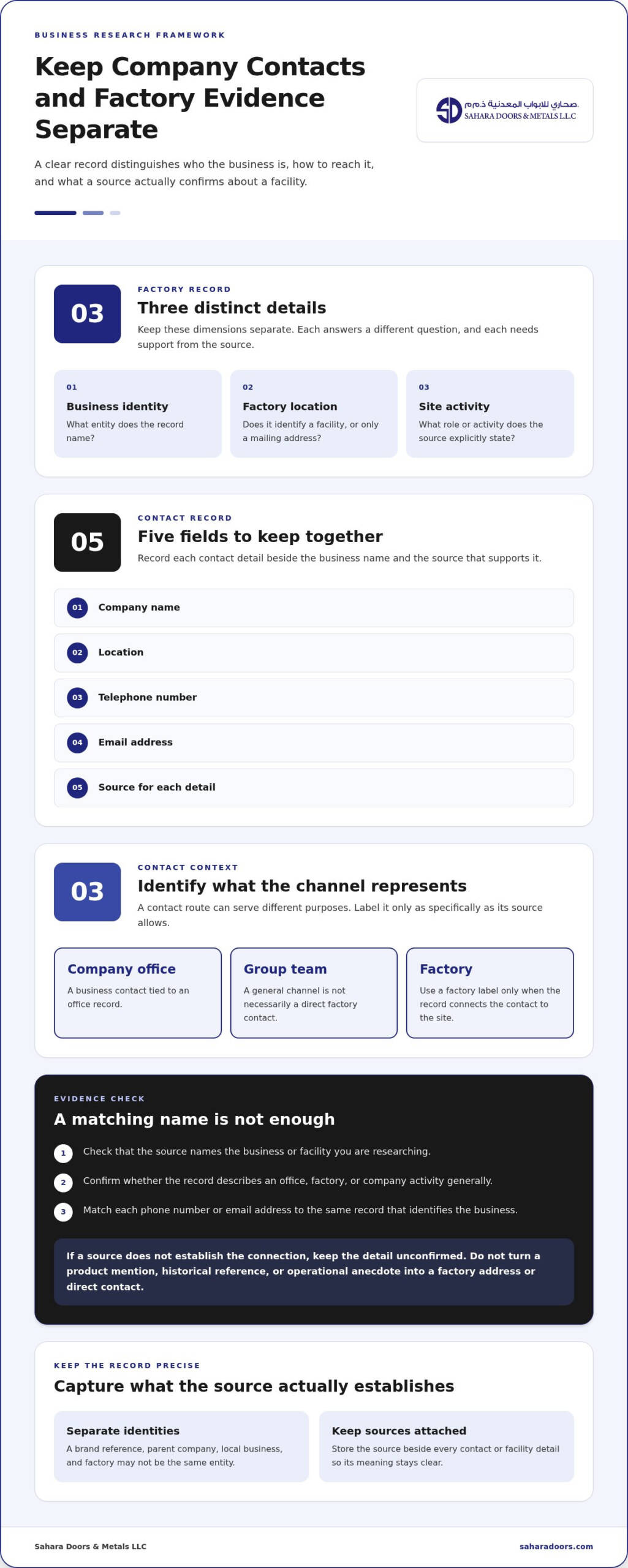
Keep contact details in separate fields. A useful record includes the company name, location, telephone number, email address, and source for each detail. Add the date you accessed the source to make mismatches easier to spot. If a directory names Crawford while a company document uses another legal entity, keep the names separate. The difference could reflect a brand, parent company, factory, or local business name.
Case: tracing a contact channel
Situation: A reader finds Crawford references but needs Saudi company contacts. Action: They search for the exact business name and compare results with official Crawford and ASSA ABLOY materials, recording each contact channel beside the matching company name. Result: The contact trail is easier to interpret. A group mailbox remains distinct from a direct factory contact, and a brand reference does not become an office listing.
Before using a phone number, compare its country context with the company’s location. A UAE mobile number, for example, should not automatically be labelled as a Saudi factory contact. Match the number to the same official record that names the business, and apply the same check to email addresses. A general group mailbox may help route a request, but it is not necessarily a direct factory contact. Save the source beside each detail.
Case: placing an operational reference
Situation: A reader encounters an account about Saudi Crawford’s ERP needs. Action: They note the named person, Frank Achterbosch, and the stated timing: he had started at Saudi Crawford two years before describing that need. Result: This detail anchors the account to a person and sequence. It can inform research into company history, but it is not a contact listing. An operational anecdote does not prove a current address or phone number.
The purpose of your contact matters, too. A sales enquiry, factory visit, and corporate question may require different departments. State your purpose clearly when using a published channel. Include “Saudi Crawford” and “Crawford” in your message, then explain whether you need a business contact or factory information. This distinguishes a location-specific request from a broader question about the Crawford name or ASSA ABLOY Group.
For a practical enquiry, prepare a short record before reaching out: the exact business name, the reason for contact, and the particular detail requested. Keep published contact information separate from historical references. If your wider search concerns a UAE garage entrance, the garage door project details provide a separate point of reference. This prevents Saudi company research from becoming mixed with another project’s requirements.
Keep that operational reference separate from verified contact information: a person’s name or an ERP-related detail does not establish a current company office, telephone number, or email address. Check what the original record identifies, and don’t turn a historical or operational mention into a contact listing. If the record provides no direct channel, leave that field unconfirmed rather than inferring one from the surrounding context.
ASSA ABLOY Group acquired Cardo, the parent company of Crawford and Megadoor, in 2011. That ownership relationship can help explain why Crawford references may appear alongside group materials, but it does not establish that any particular group channel serves a Saudi office or factory. For each contact, retain the source and the entity it names, and make clear whether the channel is direct or general. If the connection between a business name and a contact route is not explicit, treat it as unresolved until an official record supports the match.
Factories
A factory search needs more than a company name. For Saudi Crawford, distinguish three details: business identity, factory location, and activity linked to the site. Each answers a different question. Corporate history can explain ownership, while a factory record may identify a production location. A product reference can describe a brand without locating a facility. Keep these points distinct when researching the Saudi Crawford doors factory.
Begin with the name used in each record. Compare “Saudi Crawford” with “Crawford” and the named parent company, ASSA ABLOY Group. Then note whether the source describes a factory, an office, or company operations generally. The wording matters: a corporate page may explain a group relationship, while a site-specific document may identify a facility. Record the exact terms rather than treating every Crawford reference as factory evidence.
Next, build a simple factory profile from each reliable record. Keep the facility location separate from a company mailing address. Note its stated role, such as manufacturing, administration, or distribution, only if the source says so. Record products associated with that location only when the connection is explicit. This prevents a general Crawford product description from becoming an unsupported claim about Saudi production.
What to capture in a factory record
Use a consistent template for every Saudi Crawford reference. Include the named entity, location wording, described activity, document date, and source type. Add a short note about what the record establishes: “company history” differs from “factory address.” This format makes records easier to compare and helps prevent a historical account from being mistaken for current site information.
Frank Achterbosch provides an operational clue. He had started at Saudi Crawford two years before describing the need for a new ERP package. This sequence places his account within the company’s operational history, but it does not identify a factory location or describe production equipment. Use the detail as context, not as proof of a site or manufacturing capability.
Case: interpreting an operational reference
Situation: A reader finds Frank Achterbosch’s ERP account while researching a Saudi factory. Action: They record his name, Saudi Crawford, and the stated two-year sequence, labelling the item as an operational-history reference. Result: The account adds context without becoming a factory directory entry. This distinction keeps company history and location research accurate.
Apply a source-matching step to every factory claim. Does the same record name Saudi Crawford and identify a site? Does it state what happens there and connect that activity to the location? If a record answers only the ownership question, use it for ownership. If another describes an operational event, use it for that event. Don’t combine separate clues into one unsupported factory profile.
When records use different names, preserve their original wording in your notes. “Crawford,” “Saudi Crawford,” and “ASSA ABLOY Group” may refer to different levels of a corporate relationship. A careful profile shows which name belongs to the site and which to the wider organization. That clarity helps when comparing factory references with company contacts or historical material.
Keep documented factory roles separate from assumptions about output. A reference to an ERP package concerns business systems; it does not establish manufacturing volume, staffing, machinery, or product range. These are separate research categories. This makes the Saudi Crawford doors factory search more precise by distinguishing corporate context, operational clues, and site-specific details.
Sahara Doors & Metals: GI Rolling Shutter
Sahara Doors & Metals offers GI Rolling Shutters for property owners seeking a durable, security-focused entrance solution. They suit commercial and industrial settings where a practical shutter helps secure an opening. The right option depends on the site’s access needs and preferred operation.
For convenient operation, consider a Motorized Rolling Shutter. Polycarbonate and Perforated Rolling Shutters offer alternative designs for different project requirements. Reviewing the opening, intended use, and preferred appearance helps narrow your options, separate from research into a Saudi factory.
For a rolling-shutter project in the UAE, contact Sahara Doors & Metals to discuss your requirements, or visit saharadoors.com.
Choose the Right Next Step for Your Project
Research into a Saudi Crawford doors factory can clarify company background, but a UAE project needs a solution suited to its own opening and daily use. Before choosing a shutter, consider how the entrance is used, whether motorized operation matters, and which appearance suits the property. These practical details turn general product research into a focused project decision.
Sahara Doors & Metals LLC offers GI Rolling Shutters, Motorized Rolling Shutters, and Polycarbonate Rolling Shutters. Each option provides a distinct direction to consider for a commercial or residential entrance. Share the opening’s purpose and your priorities when discussing the project, so the conversation can focus on what matters for your space.
With a clear project brief and suitable product category in mind, you can move forward with confidence. A well-considered entrance can support your property’s function and appearance.