

Article by
Sahara Doors & Metals LLC
Leaders in rolling shutters
While OSHA doesn’t dictate a prescriptive set of regulations for rapid-access entries, the General Duty Clause places the full weight of workplace safety on your shoulders. You’re likely aware that as the global high-performance door market reaches an estimated value of $15.91 billion in 2026, the complexity of high speed door safety features has evolved far beyond simple motion sensors. A single second of lag or a sensor failure can lead to devastating forklift collisions or personnel injury during rapid closing cycles.
We understand that managing a high-velocity industrial environment means balancing aggressive operational cycles with the constant risk of equipment damage. You need specialized systems that don’t just move fast; they must think fast. This article provides a comprehensive technical checklist to help you audit your facility for the coming year. We’ll preview the mandatory complete system requirements of BS 8214:2026 and the sensor logic mandated by UL 325. You’ll learn how to synchronize electronic detection with impact-resistant technology to achieve a zero-accident workplace and significantly reduce your long-term maintenance costs.
Key Takeaways
- Identify why multi-beam light curtains and redundant infrared photo-eyes are the first line of defense against rapid-cycle accidents.
- Learn to distinguish between outdated rigid bars and modern soft-bottom technology that prioritizes personnel safety and equipment longevity.
- Audit your facility’s emergency readiness by reviewing strategic placement for ergonomic stop buttons and manual override protocols.
- Discover how integrating high speed door safety features through custom fabrication ensures your high-velocity operations remain compliant with 2026 international standards.
- Gain insights into the “complete system” approach, where precision engineering of the leaf, frame, and hardware creates a unified safety ecosystem.
Understanding the Critical Role of Safety in High-Speed Operations
High-speed doors are defined by their ability to operate at significantly higher velocities than standard industrial entries. According to ANSI/DASMA standards, a door must achieve a minimum opening speed of 32 inches per second and a closing speed of at least 24 inches per second to earn this classification. This High-speed door overview clarifies that these systems are designed for high-cycle environments where temperature control, cleanliness, and logistics efficiency are paramount. However, the same velocity that drives productivity also introduces unique physical risks that standard safety protocols cannot always mitigate.
The physics of high-speed travel changes the safety equation entirely. When a door moves at speeds reaching 2.5 meters per second, the window for electronic detection and mechanical braking shrinks to milliseconds. Standard sensors designed for slow-moving sectional doors often lack the processing speed or range to prevent a collision at these rates. Investing in advanced high speed door safety features isn’t just a compliance exercise; it’s a critical component of protecting your facility’s Return on Investment (ROI). Preventing a single forklift collision can save thousands in door repairs, vehicle downtime, and potential insurance premium hikes.
In the current high speed doors uae market, 2026 has seen a shift toward more intelligent, integrated systems. Facility managers are moving away from reactive maintenance and toward proactive safety ecosystems. These specialized door systems now utilize precision engineering to ensure that every cycle is monitored by high-speed logic controllers capable of halting movement instantly when an obstruction is detected.
The Risk Profile of Rapid Access Systems
Rapid-access systems present specific “pinch points” where the door curtain meets the side guides or the floor. These areas are particularly hazardous in mixed-use apertures where both vehicles and pedestrians share the same opening. Managing this traffic requires a sophisticated layout of sensors that can distinguish between a tall forklift mast and a person. Kinetic energy in a high-speed door collision is the product of half the door’s mass multiplied by the square of its velocity, meaning even a lightweight curtain can deliver a high-impact force at 2.5 meters per second. Without proper high speed door safety features, these zones become high-liability areas.
Regulatory Standards and Compliance
Modern industrial door fabrication must align with international safety norms, specifically EN 13241-1. This standard mandates rigorous testing for wind load, thermal resistance, and, most importantly, operational safety. Third-party certifications provide the necessary validation that a door system meets these industrial-grade requirements. For contractors and architects, “safety-first” engineering is no longer an optional upgrade; it’s the baseline for modern warehouse logistics. High-quality fabrication ensures that safety mechanisms like wireless edges and light curtains are built into the door’s DNA rather than being added as afterthoughts.
Electronic Detection Checklist: Sensors and Light Curtains
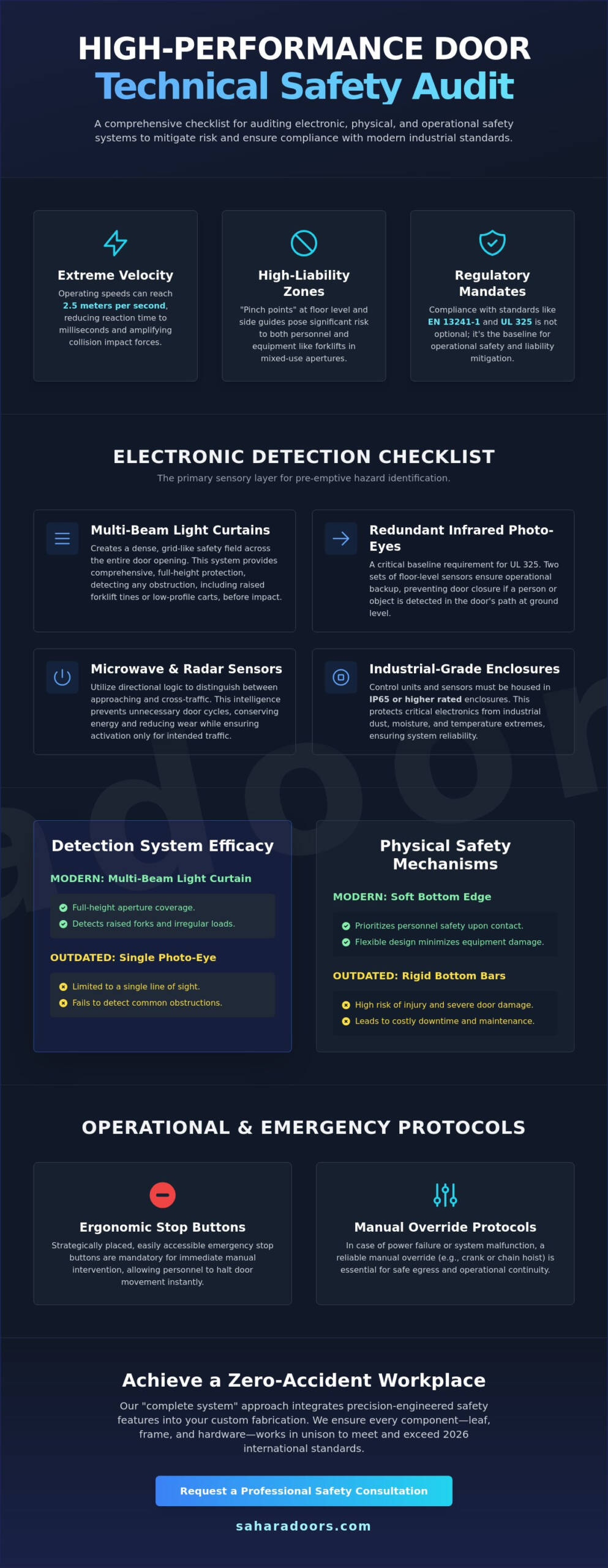
Electronic detection systems act as the primary sensory layer for any rapid-access entryway. Unlike traditional roll-up doors, high-speed variants require logic-driven high speed door safety features that can process spatial data in real-time. A robust electronic grid must be able to detect obstructions before physical contact occurs, allowing the motor’s braking system to halt the curtain’s descent within milliseconds. To ensure your facility meets modern safety benchmarks, your electronic audit should include the following components:
- Multi-beam light curtains for full-height aperture protection
- Redundant floor-level infrared photo-eyes to meet UL 325 requirements
- Microwave radar sensors with directional logic to filter cross-traffic
- IP65 or higher rated enclosures to protect control units from industrial dust and heat
Light Curtains vs. Standard Photo-Eyes
Single-point photo-eyes provide a limited line of sight, typically positioned only a few inches from the floor. While these are effective for detecting a forklift’s tires, they often miss raised forks, low-profile pedestrian equipment, or trailing loads. Multi-beam light curtains create a dense safety grid across the entire height of the opening. According to DASMA industry standards, these grids must maintain specific beam spacing to ensure even small objects or individual limbs are detected. This non-contact approach eliminates mechanical wear on the door and provides a significantly wider safety margin during high-velocity cycles.
Advanced Motion Logic
Smart detection goes beyond simply seeing an object; it interprets the intent of the traffic. Modern microwave radar sensors allow for directional detection, which means the door only triggers when a vehicle approaches the opening directly. The system ignores cross-traffic or pedestrians walking parallel to the door, preventing unnecessary cycles. This precision reduces energy loss and preserves the mechanical integrity of the motor. Integrating these sensors with advanced industrial door solutions uae ensures that your facility maintains a fluid, logical traffic pattern without compromising on security.
Environmental resilience is equally vital for high-speed electronics. In industrial settings where humidity or extreme heat are prevalent, your sensors must be housed in specialized, industrial-grade enclosures. We recommend IP67-rated components for wash-down environments or high-dust fabrication zones to prevent signal interference. If you’re looking to upgrade your facility’s safety grid, you can explore our specialized door systems to find a configuration tailored to your specific traffic profile. Precision engineering at the fabrication stage ensures these electronics are perfectly calibrated to the door’s specific motor torque and braking speed.
Physical Safety Mechanisms: Impact Resistance and Flexibility
Electronic detection serves as your first line of defense, but physical design acts as the final safeguard. Even with advanced sensors, industrial environments remain unpredictable. High speed door safety features must include passive mechanisms that absorb kinetic energy and protect both the door assembly and the impacting vehicle. Transitioning from rigid, heavy components to flexible, high-performance materials is the hallmark of modern industrial door fabrication.
A comprehensive physical safety audit should focus on these critical hardware components:
- Soft-bottom edge technology to replace rigid weighted bars
- Wireless safety edges for instantaneous stop-signal transmission
- Self-repairing break-away tracks that prevent permanent curtain damage
- High-strength composite wind bars for lateral stability in external apertures
The “Soft Edge” Revolution
Traditional rolling shutters often utilize heavy steel or aluminum bottom bars to maintain curtain tension. In high-velocity environments, these bars become dangerous projectiles during a collision. Soft-bottom technology utilizes reinforced polymers and durable PVC to create a flexible leading edge. This design is particularly mandatory for high speed freezer doors, where ice buildup can further complicate mechanical safety. When a forklift strikes the curtain, the break-away system allows the fabric to disengage from the side tracks without tearing, automatically re-inserting itself into the guides during the next opening cycle.
This self-repairing function is a significant leap forward in precision engineering. Unlike standard crash doors that require manual re-assembly and hardware replacement, these specialized door systems utilize a flexible bead-track or zip-style interface. The motor logic detects the tension change during a strike, reverses the curtain to the top position, and resets the system without operator intervention. This prevents operational downtime and eliminates the need for emergency maintenance calls after minor impacts.
Wind Ribs and Lateral Stability
Balancing high opening speeds with wind load resistance is a complex engineering challenge, especially for external-facing apertures. If a curtain isn’t properly stabilized, high-velocity wind gusts can cause a “blow-out,” where the fabric is forced out of the side guides. This creates a massive safety hazard and compromises the building’s thermal envelope. To prevent this, we utilize high-strength composite wind bars and fabric tensioning systems. These industrial-grade materials provide the necessary rigidity to withstand pressure while remaining light enough to allow for rapid vertical travel. By integrating these high speed door safety features, you ensure that your facility remains secure and functional even in demanding coastal or high-wind regions.
Operational Controls and Emergency Protocols
The command architecture of a rapid-access system dictates how it behaves when the unexpected occurs. While previous sections focused on detection and physical resilience, the control system acts as the central hub that interprets these signals. High speed door safety features must be integrated into a logic-driven interface that prioritizes fail-safe operation. This ensures that in the event of a power failure, sensor malfunction, or emergency, the door remains a predictable asset rather than a liability.
A high-performance control suite should include these essential operational features:
- Hardwired emergency stop buttons with ergonomic mushroom-head designs
- Integrated Uninterruptible Power Supply (UPS) for continued operation during outages
- Visual flashing lights and acoustic buzzers that pre-announce door movement
- Dedicated manual override systems for emergency egress and maintenance cycles
Intelligent Control Logic
Modern industrial door fabrication relies on Programmable Logic Controllers (PLCs) to manage the door’s complex movement profile. These controllers don’t simply turn a motor on and off; they manage sophisticated acceleration and deceleration curves. This “soft start and stop” logic reduces mechanical stress on the drive system and ensures the door doesn’t rebound at the top of its cycle. Advanced PLCs also feature continuous fault monitoring. If a safety sensor fails or a wireless edge battery runs low, the system identifies the specific error and can be programmed to default to a “dead-man” operation mode, requiring a constant hold on the button to move the door safely. This alignment with UL 325 standards prevents the door from closing automatically when its primary safety grid is compromised.
Manual Recovery Procedures
When power fails, the ability to clear an aperture is critical for both logistics and fire safety. The debate between “Crank Handle” and “Counter-Weight” systems usually depends on the door’s size and application. Counter-balance systems are often preferred for larger specialized door systems because they allow for a quick-release pull cord that opens the door instantly without manual cranking. However, for maintenance cycles, a secure locking mechanism is required to ensure the door cannot be triggered while technicians are working on the drive assembly. Facility managers must implement regular training programs to ensure personnel can operate these manual overrides confidently during an emergency. This human element is just as vital as the precision engineering of the hardware itself.
Visual and acoustic signals serve as the final layer of pre-emptive safety. High-intensity LED strips integrated into the side guides can change color to indicate door status: green for clear passage, flashing amber for movement, and red for a system fault. These signals are indispensable in high-noise environments where acoustic alarms might be muffled by machinery. If your facility requires a safety audit to meet the latest 2026 standards, you can contact our technical team for a High Speed Door consultation to ensure your control logic is fully optimized for your traffic flow.
The Sahara Standard: Integrating Safety into Your Custom Fabrication
Safety isn’t a bolt-on accessory; it’s a fundamental part of the fabrication process. At Sahara Doors & Metals llc, we view high speed door safety features as a synchronized ecosystem. This begins with selecting industrial-grade materials that can withstand the mechanical fatigue of thousands of high-velocity cycles. Precision engineering allows us to match specific safety hardware to the unique pressure and traffic demands of your facility. A door fabricated for a high-traffic logistics hub requires a different safety profile than one designed for a cold-storage environment.
Our commitment to technical excellence ensures that every component serves a protective purpose. We focus on these fabrication pillars:
- Integration of multi-beam sensors directly into reinforced GI frames
- Selection of high-resilience synthetic materials for soft-edge curtains
- Precision-calibrated motor logic for instant braking response
- Custom metalwork designed to house and protect electronic control units
Custom Metalwork and Fabrication Excellence
Our fabrication process integrates advanced safety sensors directly into heavy-duty GI frames. This protects delicate electronics from physical impact and environmental degradation. In high-traffic UAE facilities, specialized door systems must endure extreme ambient heat while maintaining millisecond response times. We ensure that every high speed door we manufacture undergoes rigorous quality control to verify sensor alignment and motor braking torque. This attention to detail prevents the mechanical failures that often lead to workplace accidents. Consult with Sahara Doors for a custom safety audit of your facility.
Long-Term Reliability and Support
Professional installation is the final step in eliminating mechanical risks. Even the most advanced light curtains or wireless edges will fail if the door frame isn’t perfectly plumb or if the curtain tension is uneven. Our expert teams focus on precision alignment to ensure that safety logic operates without false triggers or lag. We believe that craftsmanship extends beyond the initial sale. Reliability is built through consistent performance over time, ensuring your investment remains a stable partner in your operations.
Comprehensive maintenance serves as the final pillar of our safety checklist. Routine audits allow us to identify component fatigue before it results in a system failure. We examine curtain integrity, sensor calibration, and emergency override functionality to ensure your facility remains compliant with international standards. Sahara Doors & Metals llc stands as a dependable, high-end industrial partner committed to your operational excellence. Contact Sahara Doors for specialized fabrication and precision engineering solutions that prioritize the well-being of your personnel and the security of your assets.
Securing Your Industrial Future with Precision Engineering
Implementing modern high speed door safety features is a strategic investment in your facility’s long-term operational health. By synchronizing multi-beam electronic grids with self-repairing physical curtains, you eliminate the common “pinch points” that lead to costly downtime. Compliance with the latest 2026 international standards isn’t just about avoiding liability; it’s about fostering a zero-accident workplace where productivity can thrive. A well-integrated system protects your personnel, your equipment, and your bottom line simultaneously.
Sahara Doors & Metals llc brings over 15 years of UAE manufacturing expertise to every project. We specialize in high-durability GI and high-speed door fabrication, providing specialized door systems that leading industrial contractors and developers trust for their most demanding environments. Our precision engineering ensures that your safety protocols are built into the hardware, not added as an afterthought. We’re committed to being the sturdy, dependable partner your facility requires for high-end industrial solutions.
Take the next step in optimizing your facility’s security and efficiency. Request a Quote for Certified High-Speed Door Systems today. We look forward to helping you achieve a safer, more resilient workspace.
Frequently Asked Questions
What are the most important high speed door safety features for warehouses?
The most critical safety features include multi-beam light curtains, soft-bottom leading edges, and intelligent PLC controllers. These components work together to create a non-contact safety grid and a fail-safe mechanical response. High-density light curtains are particularly vital in high-traffic warehouses because they detect obstructions across the entire aperture height, preventing accidents involving raised forklift masts or low-profile equipment.
How do light curtains differ from standard photo-eye sensors?
Light curtains provide a dense, multi-beam grid that covers the full height of the door opening, whereas standard photo-eyes offer only a single point of detection. While a photo-eye might miss an object between the beam and the floor, light curtains eliminate these blind spots. This comprehensive coverage is essential for high speed door safety features because it ensures even small objects trigger an immediate motor stop during rapid descent cycles.
Can high-speed doors be opened manually during a power failure?
Yes, specialized door systems are equipped with manual override mechanisms such as crank handles or counter-balance release cords. These systems allow personnel to clear the aperture for emergency egress or continued logistics flow when electricity is unavailable. It’s important to train your facility staff on these recovery procedures to ensure they can safely manage the door’s weight without motorized assistance during an outage.
Is a “soft-bottom” edge really safer than a traditional rigid edge?
Soft-bottom edges are significantly safer because they replace heavy steel weighted bars with flexible, reinforced polymers or PVC. This material selection minimizes the force of impact if contact occurs, protecting both personnel and delicate cargo. Beyond safety, these edges often feature self-repairing break-away technology. This allows the curtain to disengage from its tracks upon impact and automatically reset during the next cycle, reducing maintenance costs.
What safety standards should industrial doors in the UAE comply with?
Industrial doors should align with international benchmarks such as EN 13241-1, UL 325, and DASMA performance standards. While the UAE has specific localized requirements, following these global norms ensures your facility meets rigorous criteria for wind load and operational safety. Adhering to the 2026 “complete system” approach found in standards like BS 8214 also helps in maintaining high-level fire safety and documentation for insurance compliance.
How often should high-speed door safety sensors be tested?
Manufacturers generally recommend that facility owners perform a visual inspection and functional test of all safety sensors every month. This routine check ensures that light curtains and photo-eyes are properly aligned and free of industrial dust. Additionally, a professional service technician should conduct a comprehensive audit at least annually to calibrate motor torque and verify the integrity of the high speed door safety features.
What happens if a forklift hits a high-speed door equipped with break-away technology?
If a forklift strikes the curtain, the break-away mechanism allows the fabric to disengage from the side guides without tearing the material or damaging the motor. The system’s logic detects the impact and halts movement to prevent further stress. Once the obstruction is cleared, the door is programmed to re-insert itself into the tracks during the next opening cycle, which eliminates the need for emergency repair calls.
Are acoustic warning signals mandatory for industrial high-speed doors?
Acoustic signals aren’t always strictly mandatory by prescriptive law, but they’re highly recommended under the General Duty Clause to mitigate recognized hazards. In high-noise environments where machinery might drown out the sound of a moving door, combining acoustic buzzers with visual LED flashing lights provides a redundant warning system. This pre-announces door movement to pedestrians and vehicle operators, significantly reducing the risk of accidental collisions in busy zones.
1 Comment