Article by
Sahara Doors & Metals LLC
Leaders in rolling shutters
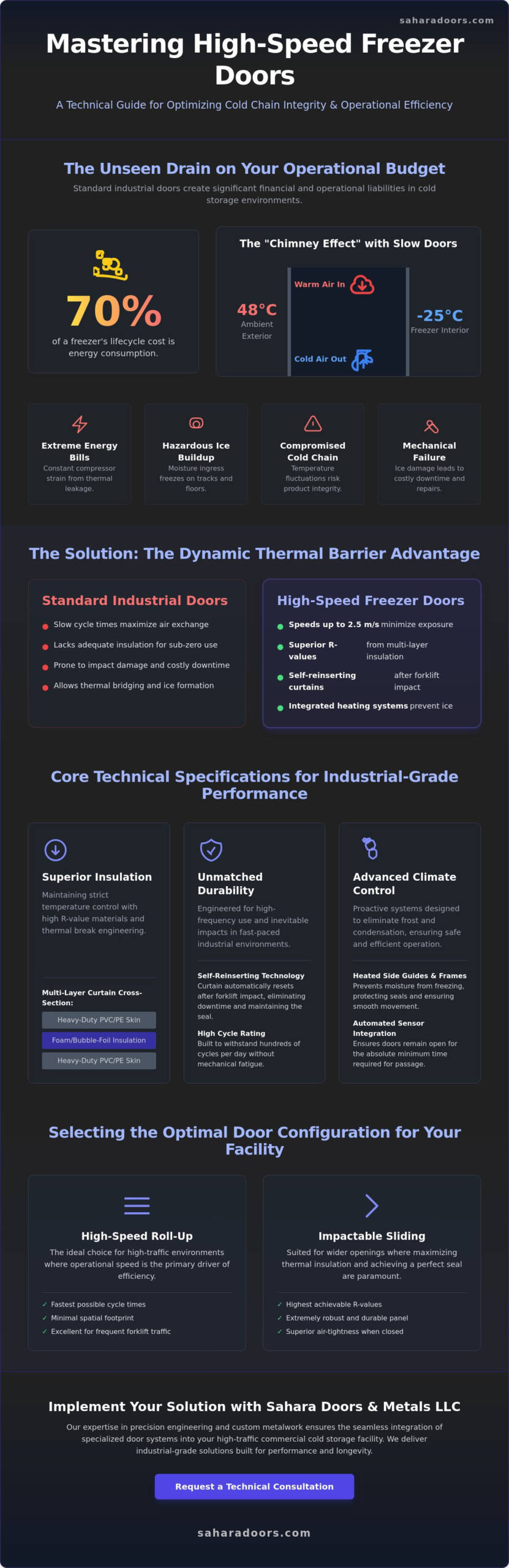
Did you know that energy consumption can account for up to 70% of a commercial freezer’s total lifecycle cost? For facility managers and developers, a door is more than just an entryway; it’s a critical thermal barrier that protects your operational budget. When your facility relies on high speed freezer doors, every second the seal remains broken represents a direct loss of expensive refrigerated air. You’ve likely dealt with the frustration of rising electricity bills from thermal leakage or the mechanical failure caused by ice formation on door tracks. These issues don’t just slow down your workflow; they compromise the integrity of your entire cold chain.
This guide helps you master the technical requirements and selection criteria needed to secure your facility according to 2026 standards. You’ll learn how to navigate the latest ASHRAE air leakage requirements and AIM Act GWP limits while choosing durable, industrial-grade materials that withstand frequent forklift traffic. We’ll explore the precision engineering behind insulated panels and high-speed activation systems to help you maintain strict temperature control, reduce moisture accumulation, and increase overall traffic efficiency.
Key Takeaways
- Understand the critical role of a dynamic thermal barrier in preserving cold chain integrity and preventing the failures typical of standard industrial doors.
- Master the technical evaluation of insulation materials and R-values to ensure your high speed freezer doors provide maximum energy savings in sub-zero environments.
- Compare the spatial and traffic benefits of high-speed roll-up systems against the heavy-duty insulation capabilities of horizontal sliding configurations.
- Explore advanced automation features, including integrated track heaters and air blowers, designed to eliminate frost accumulation and reduce maintenance overheads.
- Learn how precision engineering and custom metalwork allow for the seamless integration of specialized door systems into high-traffic commercial cold storage facilities.
The Role of High Speed Freezer Doors in Cold Chain Integrity
In a high-traffic cold storage facility, a door is far more than a simple point of entry. It functions as a dynamic thermal barrier, a specialized piece of equipment designed to withstand extreme pressure and temperature differentials. While a wall provides static insulation, high speed freezer doors must maintain that same thermal integrity while facilitating constant movement. This dual requirement makes them one of the most technically demanding components in modern industrial architecture. Unlike standard industrial doors, which often lack the necessary insulation and speed, these systems are engineered specifically for sub-zero environments where mechanical failure is not an option.
Standard doors often fail in freezer applications because they aren’t built to handle the physical stress of rapid temperature changes. When a slow-moving door stays open, it allows for massive air infiltration. This isn’t just a minor inconvenience; it’s a financial drain. Cold air is dense and heavy, meaning it naturally flows out of the bottom of an opening while warm air rushes in at the top. This “chimney effect” creates a constant cycle that hammers your refrigeration compressors. Since energy consumption can account for 60% to 70% of a commercial freezer’s total lifecycle cost, every second of air exchange represents a direct hit to your bottom line.
Combating Thermal Bridging and Condensation
In regions like the UAE, the temperature differential is extreme. You might face an ambient exterior temperature of 48°C while the freezer interior sits at -25°C. This 73-degree gap makes thermal bridging a constant threat. Precision engineering is required to create a “thermal break” within the door frame, preventing the metal from conducting heat into the cold room. Without this, moisture from the humid air condenses and freezes instantly upon contact with the cold frame. This results in hazardous ice patches and damaged seals. Strategic door placement and the use of heated side guides are essential to mitigate this moisture ingress and maintain a safe, dry environment.
Operational Efficiency and Traffic Flow
Traffic efficiency is the second pillar of cold chain protection. Modern high-speed doors can achieve opening rates of up to 2.5 meters per second, which is significantly faster than traditional sectional doors. Investing in specialized high speed freezer doors ensures that the window of exposure during forklift passage is drastically minimized. By reducing the cycle time, you maintain consistent internal temperatures and prevent the “fogging” that occurs when warm, moist air meets the freezer’s atmosphere. This isn’t just about raw speed; it’s about the precision of automated sensors that ensure the door remains open for only the absolute minimum time required, protecting both the product and the cooling equipment.
Technical Specifications: Evaluating Insulation, Speed, and Durability
High-frequency distribution centers demand more than just quick movement. They require equipment capable of handling hundreds of cycles per day without mechanical fatigue. When evaluating high speed freezer doors, you must look for a cycle rating that matches your operational intensity. Another critical feature is “self-reinserting” technology. In a busy environment, forklift impacts are inevitable. A self-repairing door curtain will break away from the tracks upon impact and automatically reset itself during the next cycle, preventing costly downtime and maintaining the seal. This resilience is a hallmark of precision engineering in specialized door systems.
Curtain Materials and Thermal Performance
The choice between multi-layer and single-layer fabrics depends on your specific temperature targets. Multi-layer insulated curtains provide a superior thermal break by sandwiching foam or bubble-foil insulation between heavy-duty PVC or reinforced polyethylene skins. R-value represents the capacity of an insulating material to resist heat flow; the higher the R-value, the greater the insulating power. Maintaining these values is vital for adhering to FDA guidelines on safe food storage, which emphasize consistent temperature control to prevent spoilage. At temperatures as low as -30 degrees Celsius, standard materials can become brittle and crack. You must specify materials engineered for extreme cold-flexibility to ensure the curtain remains supple and airtight throughout its lifespan.
Motor and Drive System Reliability
The drive system is the heart of the door. Variable Frequency Drives (VFD) are essential for managing the high-speed operation of these units. A VFD allows for “soft start” and “soft stop” transitions, which significantly reduce the mechanical wear on the motor and gears. Because freezer environments are prone to high humidity and condensation, motors should carry an IP65 rating or higher to protect against moisture ingress. Reliability also means planning for the unexpected. Every installation should include a manual override system, such as a hand crank or chain hoist, to ensure you can secure the freezer during a power failure. This level of preparedness is essential for maintaining cold chain integrity during technical emergencies.
Selecting the right technical configuration requires a deep understanding of both material science and mechanical engineering. If you’re planning a new facility or upgrading an existing one, reviewing a specialized High Speed Door portfolio can help you identify the precise specifications needed for your project.
Comparing Door Configurations: Roll-Up vs. Impactable Sliding Systems
Selecting the ideal configuration for high speed freezer doors involves a careful balance between traffic volume and your facility’s physical geometry. You primarily choose between vertical roll-up systems and horizontal sliding units. Roll-up doors utilize flexible, multi-layer insulated fabric curtains that coil at the top of the opening. These are the preferred solution for high-traffic zones where floor space is limited. Because they operate vertically, they eliminate the need for side-room clearance, which allows you to place storage racking closer to the threshold. These fabric-based curtains are often superior to standard PVC because they maintain flexibility at extreme temperatures and don’t crack under repeated stress.
Horizontal sliding doors utilize rigid, industrial-grade insulated panels. While the cycle time is slightly slower than a fabric curtain, these systems provide unmatched thermal resistance for larger apertures that require maximum R-values. For wide-load passages, bi-parting sliding systems offer a significant advantage. These doors use two panels that move in opposite directions, effectively doubling the opening speed. This rapid movement is critical for adhering to the rules for processing refrigerated foods, as it maintains the internal climate during heavy equipment transitions. Our precision engineering ensures these panels seal tightly against the gaskets, eliminating the air gaps that lead to energy loss.
Space Optimization and Clearance
Vertical roll-up freezer doors demand substantial headroom to house the motor and rolling barrel. If your facility architecture features low ceilings or overhead obstructions, a horizontal sliding configuration is often the more practical choice. However, sliding doors require clear wall space on either side of the opening to accommodate the panels when they are retracted. You should evaluate your logistics flow early in the planning stage. Obstructions like fire pipes or electrical conduits can complicate the installation of sliding tracks, making custom metalwork and careful fabrication essential for a seamless fit within your warehouse.
Durability and Impact Resistance
Modern high speed freezer doors must survive the rigors of constant distribution cycles. Roll-up models often incorporate “soft bottom” technology. These flexible edges house wireless sensors that trigger an immediate stop or reversal if they detect an obstruction. This prevents damage to forklift masts and the door itself. For rigid sliding doors, we look for impactable panel designs. These panels use specialized hardware that allows the door to dislodge from its track upon impact without sustaining structural damage. Modular fabrication ensures that if a component fails, your maintenance team can perform a quick repair without a full system replacement.
Critical Safety and Automation Features for Industrial Freezers
Advanced automation serves as the intelligence behind every successful installation of high speed freezer doors. While previous sections focused on physical barriers and insulation, the operational longevity of a freezer entryway depends on active systems that prevent ice buildup. Without these features, even the most well-insulated door will eventually succumb to the mechanical stress of a sub-zero environment. Integrated heating elements in the side guides are the most critical component for preventing track icing. These low-wattage cables keep the guide rails just above the freezing point, ensuring the door curtain moves freely without jamming or tearing the seals.
This technology is often paired with heated gaskets that maintain a multi-point airtight closure. To further enhance the thermal break, many facilities employ air curtains and blowers. These systems create an invisible, high-velocity stream of air across the opening. This barrier minimizes the mixing of warm and cold air, effectively acting as a secondary shield when the door is open. It’s a precision engineering approach that protects your refrigeration compressors from the “chimney effect” described earlier in this guide.
Anti-Frost and De-Icing Technologies
Modern PLC controllers allow for sophisticated maintenance routines, such as programmable defrost cycles. These cycles use the door’s own heating elements to clear residual frost that accumulates during high-frequency operation. This automation prevents condensation from forming on the warm side of the door leaf, which is a common cause of slippery floors and safety hazards. By using a PLC, you can also customize opening heights. If a pallet jack is passing through instead of a high-mast forklift, the door only opens halfway. This reduces the volume of air exchange and ensures your facility meets the air leakage requirements set by updated ASHRAE standards.
Personnel and Equipment Safety
Standard sensors often don’t function correctly in cold storage because of lens fogging or frost. You must specify motion and presence sensors specifically optimized for low-temperature operation. Light curtains offer a superior alternative to basic photo-eye sensors; they create a dense grid of infrared beams that detect even small obstructions. For visual awareness, integrated LED strips on the side frames can flash to warn personnel before the door begins its rapid descent. These systems can also integrate with your Warehouse Management System (WMS) to synchronize door movement with automated guided vehicles. For a comprehensive audit of the sensor logic and safety protocols your facility needs to meet 2026 compliance standards, review our essential high speed door safety features checklist before finalizing your installation plan. To ensure your facility remains compliant and efficient, you can consult with our experts on a specialized High Speed Door tailored to your specific industrial requirements.
Implementing Your Solution with Sahara Doors & Metals LLC
Successful cold storage projects depend on more than just high-quality components; they require a partner who understands the nuances of custom metalwork and industrial architecture. At Sahara Doors & Metals LLC, we recognize that every facility presents a unique set of challenges. Whether you’re managing a pharmaceutical warehouse or a large-scale food distribution hub, standard off-the-shelf products often fall short of the required precision. Our approach centers on custom fabrication, ensuring that your high speed freezer doors are tailored to your specific aperture dimensions and structural constraints. By utilizing industrial-grade materials and precision engineering, we deliver specialized door systems that meet the rigorous UAE industrial standards for safety and thermal efficiency.
Why Technical Expertise Matters in Installation
A door is only as effective as its installation. Even the most advanced insulated curtain will fail to prevent thermal leakage if the tracks aren’t perfectly aligned. Our installation teams focus on maintaining the integrity of the thermal seal, ensuring that every gasket and side guide is positioned to eliminate air gaps. We also prioritize the calibration of variable frequency drives and motor speed. Correct calibration ensures optimal motor longevity and prevents the mechanical fatigue that leads to premature failure in high-cycle environments. Integrating high speed doors uae into existing cold storage shells requires a deep understanding of structural metallurgy to ensure a secure, airtight fit without compromising the building’s envelope.
Long-term reliability is sustained through our comprehensive maintenance support. Industrial high-speed systems require periodic inspections to ensure that safety sensors, heated seals, and drive components remain in peak condition. We provide structured service plans designed to minimize the risk of unexpected downtime, protecting your perishable inventory from the temperature fluctuations mentioned earlier in this guide. This proactive approach to maintenance is essential for facilities that operate 24/7 and cannot afford a breach in their cold chain integrity.
Requesting a Technical Consultation
Choosing the right entryway system is a significant capital investment that impacts your operational overhead for years. Our process begins with a detailed evaluation of your site conditions, including humidity levels, traffic frequency, and temperature differentials. We don’t just provide a product; we develop a custom specification that addresses the specific pain points of your facility. This includes selecting the appropriate R-values, sensor arrays, and anti-frost technologies discussed throughout this guide. Our goal is to provide a sturdy, dependable solution that withstands the rigors of an industrial environment.
We invite architects, contractors, and facility managers to leverage our technical expertise for their next project. Our commitment to craftsmanship and durability ensures that your cold chain remains protected while your energy costs stay under control. As 2026 UAE compliance requirements continue to reshape procurement decisions, understanding the full landscape of industrial door solutions UAE facilities rely on can help you make a more informed capital investment. Contact our engineers today to request a comprehensive high speed freezer door quote or to explore our project portfolio of specialized industrial solutions.
Securing Your Cold Chain Infrastructure
Maintaining a high-performance cold storage facility requires a strategic approach to entryway management. The right high speed freezer doors do more than just facilitate traffic; they serve as a critical defense against energy loss and mechanical failure. By prioritizing technical specifications like R-values, self-reinserting curtains, and integrated heating elements, you protect your inventory and your bottom line. Precision engineering and professional installation are the final steps in ensuring these systems survive the rigors of high-cycle industrial use.
Sahara Doors & Metals LLC has been a specialized UAE industrial manufacturer since 2010, providing precision metal fabrication for complex commercial projects. We’ve delivered expert installation for national cold storage facilities, ensuring that every specialized door system meets the highest standards of durability. Whether you’re upgrading an existing shell or developing a new distribution center, our team provides the technical expertise needed to optimize your logistics flow. Consult with our industrial door experts for a custom freezer solution today. We’re ready to help you build a more efficient and secure industrial environment.
Frequently Asked Questions
How do high speed freezer doors prevent ice buildup?
High speed freezer doors prevent ice buildup primarily through integrated heating elements in the side guides and perimeter seals. These low-wattage cables maintain a temperature just above freezing to ensure the curtain doesn’t jam or stick. This active de-icing technology prevents the accumulation of frost that typically causes mechanical failure in standard industrial doors.
What is the ideal opening speed for a cold storage door?
The ideal opening speed for a cold storage door ranges between 1.5 and 2.5 meters per second. This rapid movement minimizes the duration of the thermal break during forklift passage. By reducing the time the door remains open, you significantly decrease the volume of warm, moist air that enters the freezer, protecting your energy overheads.
Can high speed doors be integrated with PVC strip curtains?
High speed doors can be integrated with PVC strip curtains, though the efficiency of the motorized system often makes strips unnecessary. While strip curtains provide a secondary barrier, they can sometimes interfere with the sensors of the automated door. For most modern facilities, the high-speed cycle itself is sufficient to maintain the required thermal integrity without the added maintenance of strips.
What maintenance is required for freezer doors in high-humidity areas?
Maintenance in high-humidity areas focuses on inspecting the heated gaskets and side guide cables to ensure they’re functioning correctly. You should also regularly clean the safety sensors to prevent lens fogging from condensation. Checking the tension of the insulated curtain ensures the motor operates smoothly without unnecessary mechanical stress during high-frequency cycles.
How much energy can a high speed door save in a cold warehouse?
A high speed door can save significant energy by reducing air infiltration by up to 80% compared to standard sectional doors. Since energy consumption accounts for a large portion of a freezer’s total lifecycle cost, these savings are substantial. Rapid cycle times ensure the refrigeration compressors don’t have to work overtime to compensate for heat gain.
Are these doors resistant to forklift impacts?
Yes, most modern high speed freezer doors are designed with self-reinserting technology to handle accidental forklift impacts. If a collision occurs, the flexible curtain breaks away from the tracks to prevent structural damage. The system then automatically resets itself during the next opening cycle, which eliminates the need for manual repairs and prevents downtime.
Do freezer doors require special electrical connections for heaters?
Freezer doors require dedicated electrical connections to power the integrated heating elements and the variable frequency drive. These connections must be properly insulated to withstand the temperature differentials between the warm and cold sides of the wall. Professional installation ensures that the wiring is safely routed and protected from the high moisture levels common in these environments.
What happens to a high speed freezer door during a power failure?
During a power failure, high speed freezer doors utilize a manual override system, such as a hand crank or chain hoist, to allow for emergency operation. This ensures that you can manually close and seal the freezer to protect your inventory from spoilage. Some advanced systems also offer battery backup options to provide a limited number of automated cycles during outages.