The fastest door isn’t automatically the right choice. If you’re assessing high speed doors uae for a busy facility, start by asking how well the system fits your traffic flow, site conditions and operating needs.
Speed matters when staff, vehicles or goods pass through an entrance throughout the day. But high-speed doors serve a different role from rolling shutters and PVC strip curtains. The right option depends on how the opening is used, not just how quickly the door operates.
This guide explains where high-speed doors fit in industrial and commercial facilities and what to consider when comparing entrance solutions. You’ll learn how to assess traffic and site conditions, what information to prepare for a project, and how to plan installation and ongoing support around daily operations.
Sahara Doors & Metals LLC provides high-speed doors, along with site surveys, customized planning, installation and technical support. Defining what your facility needs from an entrance is a practical first step toward a system that fits the work taking place there.
Key Takeaways
- Assess a high-speed door by how it supports daily traffic and facility operations, not speed alone.
- Map vehicle and pedestrian movement, document how the opening is used, and review site conditions before arranging a survey.
- Compare high-speed doors, rolling shutters and PVC strip curtains according to their distinct functions and operating contexts.
- Plan the full project sequence, from site survey and tailored planning to installation, handover and ongoing support.
- For high speed doors uae, prepare clear details about your facility’s opening and operating needs to guide project planning.
High-Speed Doors in the UAE: What They Do in Busy Facilities
High-speed doors are powered industrial entrance systems designed for repeated access as people, vehicles or goods move through an opening. Their role is to support frequent movement between operational spaces, rather than simply close off an entrance. In practical terms, a high-speed door is a powered entrance system for managing repeated access between operational spaces.
This can matter in facilities where an entrance connects receiving, storage, production or dispatch areas. Each opening and closing is part of the workflow, so the system should suit the traffic pattern and site conditions. Speed is one consideration, but the opening’s purpose and how it fits into daily operations matter too. For a general overview of the door category and its applications, see High-speed door.
What operational problem can a high-speed door address?
Consider a warehouse aisle where forklifts move goods between storage and dispatch, or a factory passage used by staff travelling between work areas. When the same opening is used repeatedly, access through it becomes part of the facility’s daily flow. A suitable entrance system can help manage that movement in line with how the opening is used.
Start by documenting the workflow. Note who or what passes through, how often the opening is used, and whether movements follow a predictable sequence or overlap. These details help determine whether a high-speed door suits that location. They also help avoid a common planning mistake: choosing a system based on speed alone without considering the opening’s purpose, surrounding layout or mix of traffic.
Which facilities may consider high-speed doors?
Warehouses and factories are useful examples because internal routes may connect receiving, storage, production and dispatch spaces. An opening between a busy staging area and a work zone may have different demands from one used mainly for occasional access. Assess each opening according to its use rather than assuming every warehouse or factory needs the same door type.
Commercial facilities can have different traffic patterns. A service or back-of-house entrance may handle deliveries and staff movement, while another opening may be used less often or serve a different purpose. Consider each entrance separately. A door that suits one route may not be right for another opening in the same building.
It also helps to distinguish industrial access from other door uses. A loading or production passage has different operational requirements from a dedicated vehicle entrance. Residential garage doors, for example, serve a separate access context. Choosing among high speed doors uae options starts with defining what the opening needs to do, then matching that role to the site’s conditions.
How to Assess High-Speed Door Requirements for Your Facility
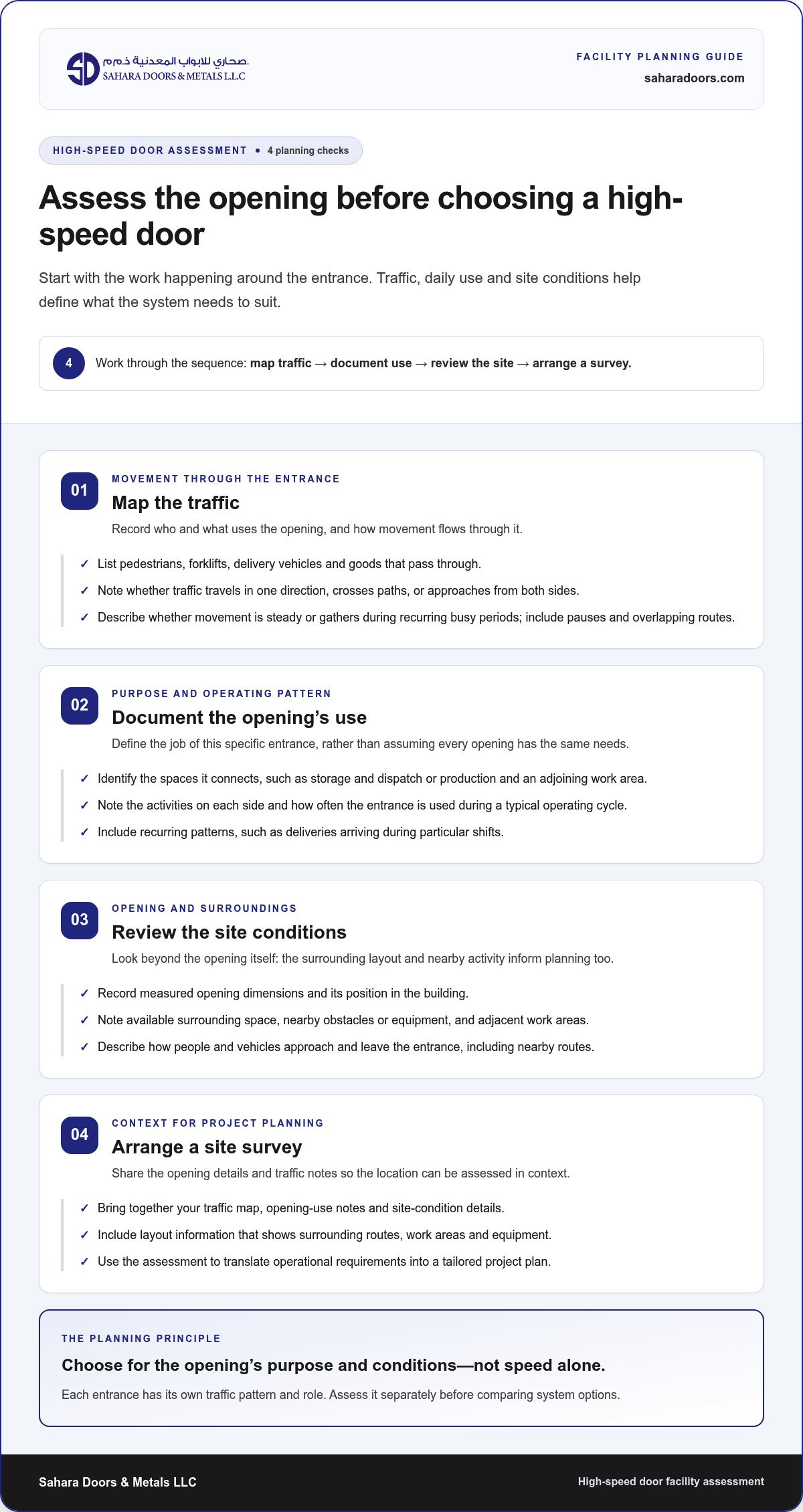
A good project starts with the opening’s job, not a product specification. Before comparing high speed doors uae, gather practical details about traffic, daily use and the space around the entrance. Assess the facility first, because the right door depends on how people, vehicles and goods move through that specific opening.
Use this sequence to prepare for planning:
- Map the traffic. Identify who and what passes through the opening, such as pedestrians, forklifts, delivery vehicles or goods. Note whether traffic moves in one direction or crosses paths, and whether it flows steadily or builds during recurring busy periods.
- Document the opening’s use. Record which spaces it connects, what activities take place on either side and how often it is used during a typical operating cycle. Include recurring patterns, such as deliveries arriving during particular shifts.
- Review the site conditions. Record the opening’s dimensions and location, available surrounding space and nearby activity that could affect access or installation planning. Include adjacent work areas, routes and equipment.
- Arrange a site survey. Share your notes so the opening and its surroundings can be assessed in context. A survey helps translate operational requirements into a tailored project plan.
Map traffic and daily opening use
Vehicle and pedestrian movement can shape entrance planning. A route used by forklifts carrying goods has different movement patterns from a passage mainly used by staff on foot. If both groups share an opening, record their routes and timing. Note busy periods, pauses in activity and whether traffic approaches from one or both sides. These details give the project team a more useful picture than a general estimate of how busy the facility feels.
Describe what the opening connects as well. A route between storage and dispatch may serve a different purpose from an entrance between a production area and an adjoining workspace. Defining the opening’s role helps establish the application before product selection begins.
Review the opening and surrounding site conditions
Look beyond the opening itself. Its position in the building, the space available around it and nearby facility activity can all inform planning. Note the measured opening dimensions, nearby obstacles or equipment, and how people and vehicles approach and leave. These details give the technical team useful context for assessing the site.
Sahara Doors & Metals LLC conducts site surveys and develops customized solutions around facility requirements. Sharing traffic notes, opening details and layout information helps the team understand the application and plan the project. To discuss your requirements, share your facility details with Sahara.
High-Speed Doors vs. Rolling Shutters and PVC Strip Curtains
These entrance solutions serve different operational priorities. A high-speed door may suit an opening where repeated access is central to the workflow. A rolling shutter is a separate closure option, often considered when the opening needs to be closed off. A PVC strip curtain creates a flexible passage between areas. They are not automatic substitutes, so compare them according to the opening’s purpose and access pattern.
| Solution | Primary function | Operating context | Questions for project planning |
|---|---|---|---|
| High-speed door | Manage repeated access through an entrance. | Openings used regularly by staff, vehicles or goods as part of a facility workflow. | Who uses the opening? How does traffic move? What happens on either side? |
| Rolling shutter | Provide a distinct closure for an opening. | Entrances where closing off the opening is a key consideration, including security-focused applications. | What is the closure expected to do, and how does it fit the surrounding layout? |
| PVC strip curtain | Create a flexible passage between spaces. | Areas where people or goods need to pass through while the curtain provides a boundary between spaces. | What environmental or access conditions should the project account for? |
Use the table as a starting point, not a performance ranking. Configuration, site conditions and project requirements affect what each solution can do. Define the intended function during planning and assess the product against the specific needs of the opening.
When a high-speed door may fit the operating priority
Consider a high-speed door when an opening is part of a repeated movement route and managing access is an operational priority. A passage between work areas, for example, may see staff and goods moving throughout a shift. Discuss how traffic approaches, what shares the route and how the entrance is used. For a meaningful speed comparison, use the operating information for the specific system rather than relying on a general claim.
How rolling shutters and PVC strip curtains differ
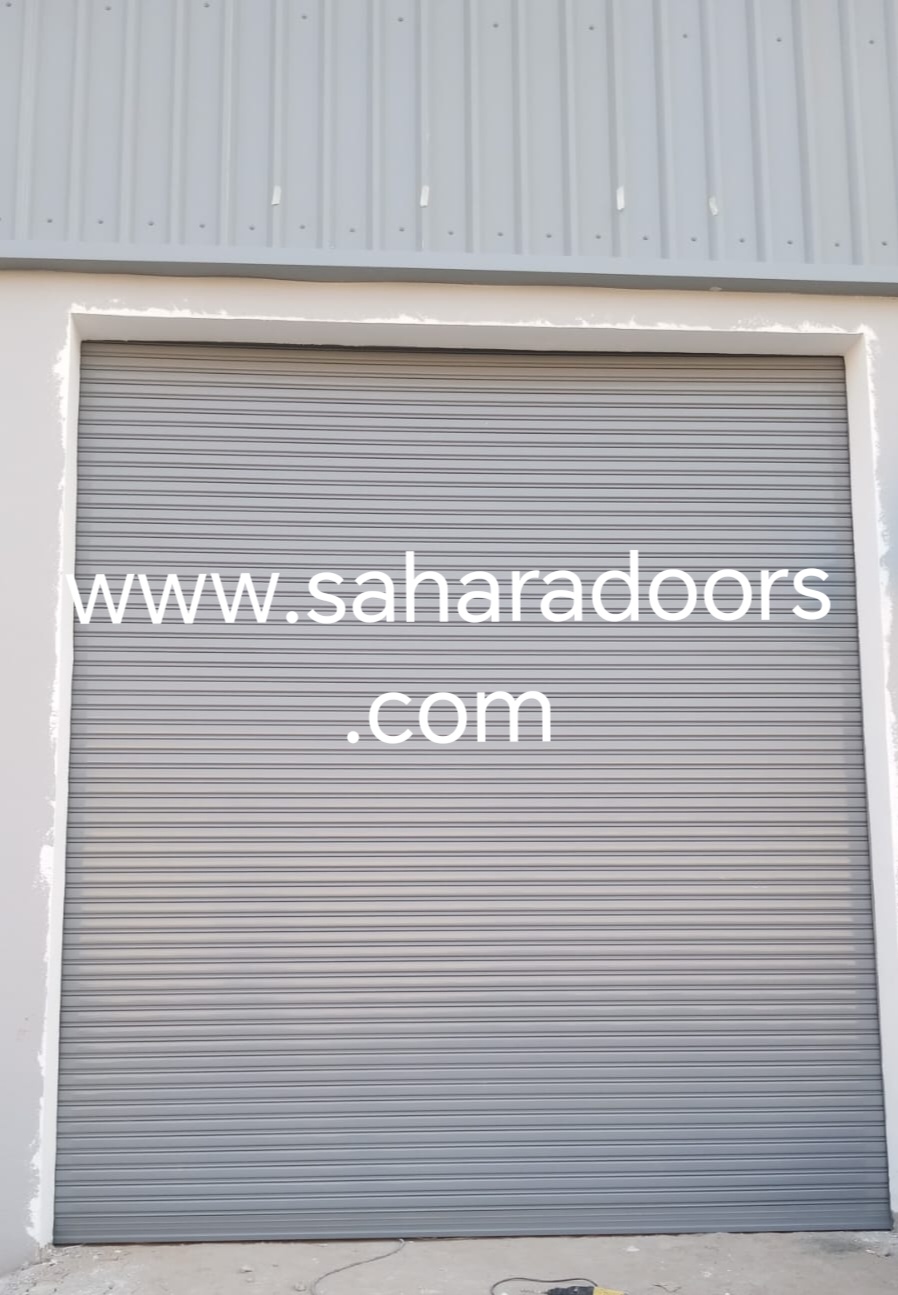
Rolling shutters are a separate closure option in Sahara’s range. If the priority is a security-focused closure, compare the opening’s requirements with the role of a GI rolling shutter. PVC strip curtains provide a flexible barrier and are used in settings where a project aims to manage factors such as temperature, insects, wind or dust while allowing passage. The appropriate option depends on the site and the intended function.
A facility may need one solution for a particular opening, or different products at separate entrances with distinct purposes. Define the job of each opening first, then compare the options against that need. This keeps the decision focused on function rather than treating high speed doors uae, rolling shutters and PVC strip curtains as interchangeable products.
Planning High-Speed Door Installation, Support, and Upkeep
A well-planned project considers more than the door. It connects the facility’s needs to a practical sequence: assess the opening, tailor the plan, install the system, complete handover and establish how ongoing support will work. For high speed doors uae, discussing these stages early helps teams prepare and coordinate the project with site activity.
A typical project sequence includes:
- Site survey: Review the opening, surrounding layout and intended use.
- Tailored planning: Use the site and operational requirements to shape the project approach.
- Installation: Carry out the work according to the agreed plan and site conditions.
- Handover: Give relevant staff clear guidance on the system’s operation.
- Ongoing support: Establish how to access technical support and where to direct operational questions.
What a site survey helps establish
A survey gives the technical team an opportunity to review the opening in context. This includes its dimensions and position, the surrounding layout, nearby activity and the entrance’s role in daily operations. These details help the team plan for the facility rather than treating the opening as an isolated fitting.
Sahara Doors & Metals LLC uses site surveys to understand project requirements and develop customized solutions. The findings inform the project plan, including how installation fits the site conditions. Sharing layout information and explaining how the entrance is used helps focus the assessment. The selected system’s requirements are then considered as part of the project planning.
What to plan for after installation
Handover is a chance to make sure the people who use or oversee the door understand its normal operation and know where to turn with questions. Troubleshooting guidance can help staff describe an issue clearly and follow appropriate next steps. Sahara provides technical support and troubleshooting training as part of its project support.
Plan upkeep around the selected system and the facility’s operating needs. Keep relevant handover information accessible, note operational questions and establish an internal point of contact for support. Follow project-specific guidance for maintenance rather than assuming one schedule applies to every system. Sahara also provides post-handover assistance, extending project support beyond installation.
How Sahara Doors & Metals Supports High-Speed Door Projects
Choosing a system is one part of an entrance project. The work also calls for understanding the facility, planning around the site, installing the door and providing support after handover. Sahara Doors & Metals LLC supplies and installs high-speed doors for industrial and commercial applications, with project planning shaped around each site’s requirements.
A project approach shaped around the facility
Sahara begins by understanding how the entrance is used and what the surrounding layout allows. A site survey helps the team assess the opening and its operational setting. The findings inform a customized solution for the project, whether the entrance serves an industrial process or a commercial facility. System details are planned according to the application and project requirements.
Useful preparation makes the discussion more productive. Share the opening’s purpose, the types of traffic it handles and relevant layout information. If several entrances are involved, describe the role of each one separately. This gives the project team a practical basis for planning a solution for each application.
Sahara’s wider capabilities include in-house fabrication and powder-coating, alongside a broad portfolio of tailored door and entrance solutions. These capabilities support the company’s project work, while the materials, finish and construction of a high-speed door are determined by the selected system and project requirements.
From installation to ongoing technical support
After installation, Sahara provides technical assistance and troubleshooting training to help relevant staff understand how to operate the system and communicate issues clearly. Post-handover support is also part of the company’s approach, so project planning can account for operational questions that arise after the door is in use.
Facility teams can identify who will oversee the entrance, keep handover information accessible and brief staff who use it. These practical steps connect the installed system to everyday operations. For upkeep, follow guidance for the specific system and its operating requirements.
Sahara’s documented project experience includes warehouse and industrial rolling-door projects. This work reflects experience in related industrial settings. For high speed doors uae, the project plan should still be grounded in the specific site and its operational needs.
Opening details and operational priorities provide a clear starting point for planning around your facility.
Make Your Next Entrance Project Work for Your Facility
Turn your operational priorities into a clear project brief. Before selecting a system, decide what the entrance needs to support and how the project can fit around your facility’s work. This gives planning a practical starting point and keeps the discussion focused on your site rather than generic product claims.
For businesses considering high speed doors uae, Sahara Doors & Metals brings site surveys and customized solutions together with installation and technical assistance. In-house fabrication and powder-coating support the company’s wider tailored-solutions portfolio, while troubleshooting training and post-handover support extend the project beyond installation. The selected door and its capabilities are planned according to the project requirements.
Bring together the opening details, traffic patterns and priorities that will shape the project. A well-defined brief helps set a clear direction for the work ahead.
With practical planning and project support, you can move forward with a solution shaped around your facility.
Frequently Asked Questions
Can a high-speed door be installed in an existing building?
Yes. A high-speed door can be installed in an existing building when the opening and surrounding site conditions suit the selected system. A retrofit assessment should account for the current structure, nearby services, installation access and how work can be coordinated with facility operations. Sahara’s site survey helps assess these conditions and shape a project-specific approach for high speed doors uae.
How fast does a high-speed door open?
Opening speed varies by system, so there isn’t one figure that applies to every high-speed door. For a useful comparison, review the selected system’s operating information and clarify whether figures refer to opening, closing or a complete operating cycle. Sahara’s technical team can discuss the system details relevant to your project.
Can high-speed doors work alongside rolling shutters?
Yes. They can be used at different points in a facility when each opening has a distinct role. For example, a site might plan one entrance around frequent internal movement and another around closing off an access point. Whether this arrangement suits your layout depends on how the entrances relate to one another and how the facility uses them.
Are high-speed doors suitable for every warehouse?
No. A warehouse with occasional access needs may have different priorities from one where an opening is central to routine operations. Consider the route’s purpose, nearby activities and whether the proposed door fits the facility’s layout. A site assessment can help determine whether a high-speed door is appropriate for a particular opening.
What information should I prepare before discussing a high-speed-door project?
Gather basic opening and use details, along with any available building plans, recent photographs of the entrance and information about nearby equipment or services. Note whether the project involves a new or existing opening, who will coordinate site access, and whether installation needs to fit around scheduled facility activity. This gives the project discussion a useful starting point.
Does a high-speed door require ongoing maintenance?
Plan upkeep according to the requirements of the installed system. Keep its operating information available, make sure staff know how to report unusual operation and avoid unapproved adjustments. A clear internal process helps direct issues to the appropriate technical support. Maintenance needs vary by system and site conditions, so follow the relevant product guidance rather than assuming one schedule applies to every door.