Article by
Sahara Doors & Metals LLC
Leaders in rolling shutters
Fire containment is not just a regulatory hurdle; it’s a precision engineering discipline that defines building longevity and the survival of your assets. For major developments requiring fire rated rolling shutters uae, Dubai, Sharjah, Qatar, Saudi arabia, the stakes involve much more than just passing a final inspection. You’ve likely found that balancing strict Civil Defense codes with industrial durability and aesthetic design is one of the most challenging aspects of modern project management.
Sahara Doors & Metals LLC understands that your reputation depends on hardware that performs when it matters most. This technical reference simplifies the complexities of fire safety, providing the precise insights you need to specify and maintain high-performance containment systems. We’ll explore the critical differences between 60, 120, and 240-minute resistance ratings, the necessity of seamless fire alarm integration, and how precision-engineered hardware protects your facility. By the end, you’ll have a clear roadmap for achieving full regulatory compliance while ensuring your door systems remain low-maintenance and dependable in the harshest GCC climates.
Key Takeaways
- Understand the engineering principles of gravity fail-safe mechanisms and dual-activation systems that ensure reliable shutter closure during emergency power loss.
- Identify the specific certification standards required for fire rated rolling shutters uae, Dubai, Sharjah, Qatar, Saudi arabia to ensure your project meets 60 to 240-minute resistance benchmarks.
- Evaluate critical selection criteria for industrial facilities, focusing on the structural demands of wide-span openings and the impact of high ambient temperatures on hardware.
- Learn how to achieve full Civil Defense compliance through the seamless integration of specialized door systems with existing building fire alarm and detection frameworks.
Understanding Fire Rated Rolling Shutters in Modern Infrastructure
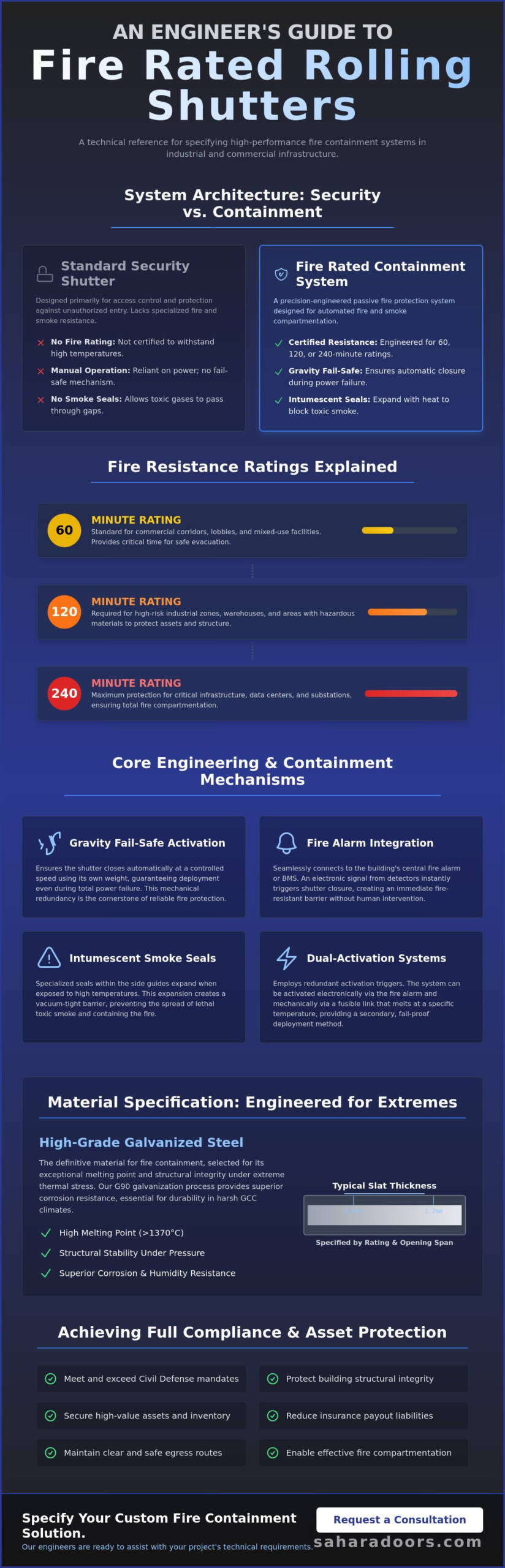
Fire rated rolling shutters are specialized steel barriers engineered to prevent the rapid spread of flames and toxic smoke throughout a building. While they may look similar to standard security gates, their internal architecture is fundamentally different. These systems serve as a core component of passive fire protection, working silently to protect lives and property without requiring human intervention. When specifying fire rated rolling shutters uae, Dubai, Sharjah, Qatar, Saudi arabia, architects must ensure the hardware aligns with strict national safety frameworks designed to mitigate large-scale industrial disasters.
The distinction between a high-quality gi rolling shutter and a dedicated fire-rated model is significant. A standard shutter provides excellent security against unauthorized entry, but it lacks the thermal expansion joints and heat-resistant seals necessary to survive a blaze. Fire-rated variants are equipped with specialized motors and sensors that trigger an automatic closure the moment a fire is detected. These systems are most commonly deployed in high-occupancy or high-value environments, including industrial warehouses, expansive shopping malls, and critical commercial corridors where fire containment is a legal mandate.
The Concept of Fire Compartmentation
Fire compartmentation is a strategic engineering barrier designed to isolate a fire within a specific zone of a building. By creating these temporary fire-resistant zones, shutters prevent the lateral and vertical spread of heat, which protects the structural skeleton of the facility. This method is crucial for maintaining clear egress routes for emergency evacuation. Beyond life safety, robust compartmentation directly impacts risk assessment; insurers often view these installations as a primary factor in reducing potential payout liabilities. For those unfamiliar with the broader category of these systems, Understanding Fire Doors offers a helpful foundation on how passive barriers function within modern building codes.
Material Science: Why Steel Dominates Fire Protection
High-grade galvanised steel remains the preferred material for fire containment due to its incredible melting point and structural stability. The slats must be thick enough to maintain their shape under the intense pressure of rising temperatures. We typically specify slat thicknesses between 0.8mm and 1.2mm, depending on the required fire resistance rating and the width of the opening. In the unique climate of the Middle East, these materials must also feature superior corrosion resistance. Salt-laden air and high humidity can degrade inferior metals, but precision-engineered galvanised steel ensures the shutter remains reliable and ready to deploy even after years of exposure to harsh environmental conditions.
The Engineering Behind Fire Containment Mechanisms
High-performance fire containment requires a fail-safe synergy between mechanical physics and electronic detection. For projects requiring fire rated rolling shutters uae, Dubai, Sharjah, Qatar, Saudi arabia, these systems aren’t just barriers; they’re active safety devices. They rely on dual-activation protocols to ensure the curtain descends even if the central power grid fails or the building’s infrastructure is compromised. This redundancy is what separates industrial-grade protection from standard entryways.
Modern industrial facilities increasingly rely on Building Management Systems (BMS) for real-time oversight, a feature often overlooked in basic safety discussions. Advanced fire-rated systems provide constant feedback to the BMS, reporting on motor health, obstruction detection, and current status. This high-level integration allows facility managers to monitor the entire safety perimeter from a single interface. If a sensor fails or a shutter is partially blocked, the system alerts the team immediately, preventing a critical failure during a real emergency.
A cornerstone of fire engineering is the ‘Gravity Fail-Safe’ mechanism. This ensures that the shutter closes at a controlled speed using its own weight, even if the electrical supply is severed. To prevent the ‘chimney effect’, where fire and smoke are sucked through gaps, precision-engineered side guides and intumescent smoke seals are used. These components expand when exposed to heat, creating a vacuum-tight barrier that halts the movement of toxic gases. Maintaining these standards is a core part of Regulatory Compliance and Certification, ensuring the hardware meets international safety benchmarks like NFPA 80.
Fusible Link Technology vs. Electronic Triggers
Mechanical fusible links act as the final line of defense. These links are designed to melt at a specific temperature, usually 74°C, which triggers the mechanical release of the curtain. While reliable, they’re slower than electronic solenoids. Electronic triggers respond instantly to smoke detector signals, closing the shutter long before heat reaches the link. Combining both methods provides a redundant safety net that accounts for both slow-smoldering fires and rapid thermal spikes.
Motorised vs. Manual Control Systems
Heavy-duty motors drive the daily operation of these systems, but the emergency cycle is where engineering excellence is tested. Sahara Doors incorporates fail-safe braking systems to prevent an uncontrolled free-fall descent, which could damage the hardware or cause injury. Manual override features remain essential, allowing emergency services to gain access if the electronic systems are locked down. If you’re designing a facility with complex entry requirements, you can explore our project portfolios to see how these mechanisms are integrated into large-scale industrial builds.
Regulatory Compliance and Certification Standards in 2026
Compliance isn’t just a box to tick; it’s a legal safeguard that protects your investment and the people within your facility. In 2026, the regulatory environment across the GCC has reached a peak of stringency, reflecting a commitment to global safety benchmarks. Civil Defense departments in the UAE, Qatar, and Saudi Arabia mandate that every fire-rated installation carries a valid Certificate of Conformity. This documentation must be backed by rigorous third-party testing from accredited laboratories. If your project specifies fire rated rolling shutters uae, Dubai, Sharjah, Qatar, Saudi arabia, you’re likely choosing between three primary resistance windows: 60, 120, or 240 minutes. These durations represent the exact time the barrier can withstand a controlled inferno before structural failure.
Architects must align their technical specifications with recognized international benchmarks to ensure seamless project approval. The most prominent include BS EN 1634-1 for European compliance and UL 10B for North American standards. Adherence to NFPA 80 Standards is particularly vital, as it governs the installation, inspection, and maintenance of fire doors and other opening protectives. Without these certifications, a building won’t receive its final operational permit, leading to costly delays and potential legal liabilities for the contractor.
Integrity (E) vs. Insulation (EI) Ratings
Distinguishing between Integrity (E) and Insulation (EI) is critical for high-occupancy safety. An ‘E’ rating confirms the shutter’s ability to stop flames and hot gases from passing through the curtain. However, it doesn’t necessarily prevent heat radiation from transferring to the other side. In contrast, an ‘EI’ rating includes thermal insulation, restricting the temperature rise on the non-fire side to safe levels. We recommend specifying EI-rated shutters for sensitive areas like server rooms, hospital corridors, or data centers where radiant heat alone could ignite equipment or endanger people during an evacuation.
Testing Procedures and Quality Assurance
Quality assurance starts in the furnace. Full-scale furnace tests subject the complete shutter assembly to temperatures exceeding 1,000°C to simulate real-world fire conditions. It’s not enough to test a single slat or a sample of the metal; the motor, guides, and barrel must function as a unified system under extreme thermal stress. For 2026, GCC testing requirements have moved toward validating the ‘worst-case’ scenario, which includes testing the largest possible opening sizes. This ensures that even extra-wide shutters maintain their integrity without bowing or warping when the heat is on.
Strategic Selection Criteria for Industrial Facilities
Selecting the right containment system requires more than just checking a resistance rating. Architects and developers must account for the specific physical and operational realities of the site. When you specify fire rated rolling shutters uae, Dubai, Sharjah, Qatar, Saudi arabia, the engineering challenges often start with the opening dimensions. Extra-wide spans, commonly found in aircraft hangars or large distribution centers, require precision-engineered barrels to prevent curtain deflection. If a barrel bows even slightly under its own weight, the slats may jam in the side guides during the thermal expansion of a fire, rendering the safety system useless.
Environmental conditions in the GCC are equally critical. High ambient temperatures and extreme humidity in coastal regions like Dubai and Sharjah can accelerate the corrosion of internal components. Meanwhile, fine particulate dust and sand in Saudi Arabia can infiltrate the motor housing and tracks. We recommend specifying high-grade galvanized steel with weather-resistant finishes and sealed motor units to ensure the hardware remains functional for decades. This attention to material science prevents the mechanical failures that often plague lower-quality installations in high-heat environments.
Specifying for Heavy-Duty Industrial Use
In busy logistics hubs, shutters aren’t just safety barriers; they’re high-traffic gateways. Standard fire shutters aren’t designed for dozens of cycles per day. You’ll need to specify reinforced high-cycle spring assemblies and heavy-duty motors to prevent premature mechanical fatigue. For facilities where acoustic management is as vital as fire safety, you can specify hybrid systems that include soundproof rolling shutters. This dual-purpose approach protects the workforce from both industrial noise and fire hazards within a single, precision-engineered installation.
Maintenance and Longevity in the GCC
Longevity in harsh climates depends on a proactive service schedule. We advise quarterly inspection protocols that focus on cleaning the tracks to prevent sand accumulation, which can cause the motor to overwork. The most critical part of an annual safety audit is the ‘Drop Test’. This procedure involves a controlled release of the shutter to simulate an actual fire event, verifying that the gravity fail-safe and braking systems are fully operational. Regular maintenance ensures the system reacts perfectly during a crisis. If you need technical assistance with your current project specifications, request a consultation with our engineering team to ensure your facility meets all national safety standards.
Sahara Doors: Precision Manufacturing and Installation Expertise
Sahara Doors & Metals LLC serves as a specialized partner for the region’s most ambitious industrial projects. We believe that physical security is a product of precision engineering rather than just heavy materials. For clients requiring fire rated rolling shutters uae, Dubai, Sharjah, Qatar, Saudi arabia, we provide a vertically integrated service that covers everything from initial design to final certification. Our manufacturing facility utilizes high-grade industrial metalwork to produce specialized door systems that meet the rigorous demands of the GCC’s construction sector.
Custom fabrication is a core strength of our team. We recognize that every facility has unique architectural constraints, whether it’s an extra-wide warehouse bay or a retail corridor with specific aesthetic requirements. Our legacy of reliability is built on providing high-performance solutions, including the insulated double skin rolling shutter uae market. These systems are essential for projects where thermal control and fire resistance must coexist within a single, durable assembly.
Our Technical Consulting Process
Our engineering team works alongside architects to draft technical specifications that leave no room for error. We provide comprehensive technical drawings and load calculations that are essential for large-scale structural integration. On-site assessments allow us to identify potential installation hurdles early in the design phase. This ensures that when our certified technicians arrive for the final installation, the hardware fits perfectly and functions exactly as intended. We don’t just deliver a product; we provide a complete technical roadmap for your project’s safety requirements.
Why Industrial Leaders Trust Sahara
Industrial leaders trust us because we prioritize long-term durability over short-term savings. We use premium industrial-grade materials that withstand the mechanical stresses of high-cycle operations. Beyond the initial build, we offer comprehensive after-sales support and structured maintenance contracts. This commitment ensures your fire-rated systems remain compliant with national safety standards year after year. We’ve built our reputation on being a stable, no-nonsense partner for contractors who value craftsmanship and technical excellence. If you’re ready to secure your facility with a partner that understands the complexities of the regional market, contact us today to request a quote or explore our project portfolios.
Securing the Future of Your Industrial Infrastructure
Fire containment is a critical investment in the structural integrity and safety of your facility. You’ve seen how precision engineering and material science work together to create fail-safe barriers against heat and smoke. From choosing the correct resistance ratings to integrating hardware with advanced Building Management Systems, every specification decision impacts your long-term risk profile. Selecting the right fire rated rolling shutters uae, Dubai, Sharjah, Qatar, Saudi arabia ensures that your project remains fully compliant with national safety mandates while protecting your most valuable assets.
Sahara Doors & Metals LLC brings over 15 years of industrial engineering expertise to every project. Our systems are National Civil Defense Compliant and BS EN 1634-1 Certified, providing the peace of mind that comes with proven; third-party validated performance. Don’t leave your facility’s safety to chance. Consult with our engineers for your fire-rated shutter specifications to ensure your next build is secured by the highest standards of craftsmanship. We look forward to helping you build a safer, more resilient industrial environment.
Frequently Asked Questions
What is the maximum fire rating available for rolling shutters in the UAE?
The maximum fire resistance rating available for rolling shutters in the UAE is 240 minutes. These specialized systems are engineered to maintain their structural integrity for up to four hours during an intense blaze. While 60 and 120-minute ratings are common for standard commercial builds; high-risk industrial facilities often require the 240-minute benchmark to meet stringent Civil Defense safety codes and international standards.
Can fire rated rolling shutters be used for daily security as well?
Yes, fire rated rolling shutters provide excellent daily security alongside their life-safety functions. Because they are fabricated from high-grade industrial steel slats, they offer robust protection against unauthorized entry and physical impact. This dual-purpose nature makes them a cost-effective choice for facility managers who need to balance mandatory fire containment with the physical security of their high-value inventory and equipment.
What happens to the fire shutter if the building loses power during a fire?
If a building loses power during an emergency, the shutter utilizes a gravity fail-safe mechanism to close automatically. This system doesn’t rely on electricity; instead, it uses a mechanical release that allows the curtain to descend at a controlled speed. This ensures that the fire compartment is sealed even if the main electrical grid or backup generators fail during the incident.
How often should fire rated shutters be inspected and drop-tested?
You should conduct a formal drop test at least once per year to verify the mechanical reliability of the system. In addition to this annual requirement, we recommend quarterly inspections to check for dust accumulation in the tracks and to test the motor brakes. Regular maintenance is essential for ensuring that fire rated rolling shutters uae, Dubai, Sharjah, Qatar, Saudi arabia perform correctly when triggered.
Are fire rated shutters mandatory for all industrial warehouses?
Fire-rated shutters are mandatory for industrial warehouses where compartmentation is required by the local Civil Defense code. These regulations typically apply to openings in fire-rated walls that separate different hazard zones or protect escape routes. You should check your specific building classification and fire safety plan to determine the exact resistance ratings required for your facility’s final operational permit.
What is the difference between a fire door and a fire rated rolling shutter?
The primary difference lies in the form factor and the size of the opening they protect. A fire door is typically a hinged or sliding leaf used for pedestrian access in standard-sized doorways. A fire rated rolling shutter is a motorized vertical barrier designed for much larger spans, such as loading bays or wide commercial corridors, providing the same level of protection for industrial-scale openings.
Can fire shutters be integrated with existing smoke detection systems?
Yes, these shutters are designed for seamless integration with existing smoke detection and fire alarm systems. When the central alarm is triggered, an electronic signal is sent to the shutter’s control panel, initiating an immediate closure. This ensures that the barrier is deployed at the earliest sign of smoke, long before the heat reaches the thermal fusible links, providing an earlier response time.
What materials are used to ensure the shutters withstand 4 hours of heat?
To withstand 240 minutes of extreme heat, shutters are manufactured using high-grade galvanized steel slats with a typical thickness of 1.0mm to 1.2mm. The assembly also includes heavy-duty steel guides and a reinforced barrel designed to resist warping. These industrial-grade materials ensure the system maintains its integrity and prevents the passage of flames even when temperatures exceed 1,000 degrees Celsius during a fire.