Article by
Sahara Doors & Metals LLC
Leaders in rolling shutters
Why should a high-security barrier have to look like a grim industrial fortress and breathe like a vacuum seal? Many architects and developers in the UAE struggle to balance the rigid demands of physical protection with the modern need for airflow and visual transparency. Specifying powder coated perforated shutters allows you to maintain a secure perimeter without sacrificing the ventilation required for server rooms or the visibility needed for after-hours window shopping.
This 2026 guide helps you master the technical specifications of these systems, transforming a security necessity into a precision-engineered architectural asset. With the global powder coatings market reaching an estimated $16.22 billion this year, the technology behind thermosetting resins has never been more resilient. We’ll examine the metallurgy of industrial-grade substrates and explain how to meet regional ventilation standards and Al Sa’fat green building regulations. You’ll also learn to navigate the selection process to ensure your installation provides the durability and brand-matched finish your specific project requires.
Key Takeaways
- Understand the material composition of powder coated perforated shutters, including the use of high-strength Galvanised Iron (GI) and thermally bonded polymer resins.
- Learn how the Electrostatic Spray Deposition (ESD) process ensures 100% coverage on perforated edges to prevent corrosion in high-humidity environments.
- Discover the dual-purpose benefit of perforated laths for storefronts, providing high-security protection while allowing for after-hours window shopping and natural ventilation.
- Gain technical insights into selecting the appropriate lath profiles and motorisation systems based on barrel size and total curtain weight.
- Explore how precision engineering and custom fabrication allow for the integration of specialized door systems that meet rigorous 2026 industrial standards.
Understanding Powder Coated Perforated Shutters
Security doesn’t have to mean total occlusion. Powder coated perforated shutters are specialized door systems designed for environments where visibility and ventilation are as critical as physical protection. These systems consist of interlocking laths featuring thousands of precision-punched holes. Unlike solid barriers, these shutters allow light to permeate the space while maintaining a formidable physical deterrent against unauthorized entry. For retail storefronts, this means your merchandise remains visible to window shoppers long after the lights go out. In industrial zones or car parks, these shutters facilitate the constant airflow required to prevent the buildup of exhaust fumes or heat.
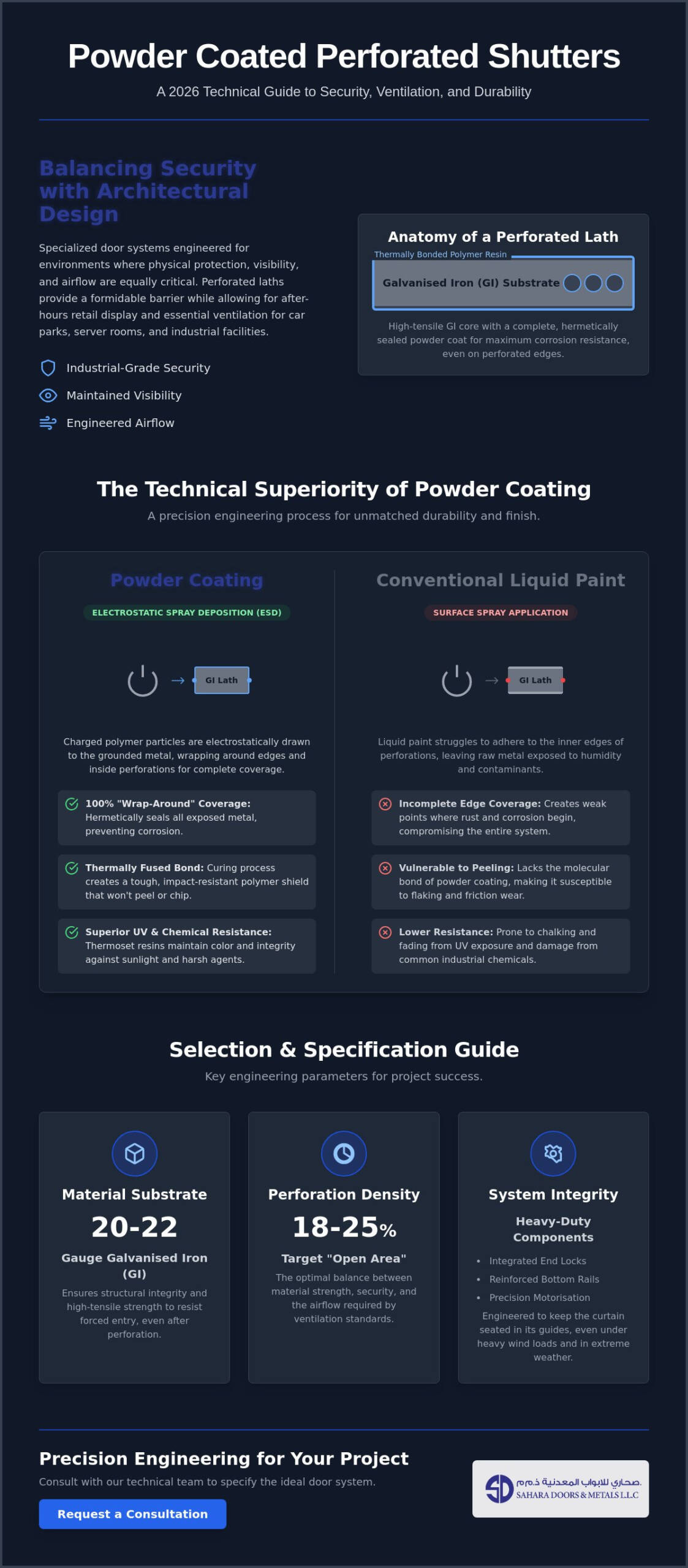
We utilize Galvanised Iron (GI) as the primary substrate for our perforated rolling shutter systems. GI provides the high-tensile strength needed to resist forced entry, but the perforation process exposes the raw edges of the metal. This is where the finishing process becomes vital. Standard liquid paint often fails to penetrate the interior edges of each punched hole, leaving the metal vulnerable to oxidation and premature failure. Powder coating solves this through an electrostatic process that pulls the polymer resin into every crevice. The result is a thermally bonded shield that offers superior coverage and impact resistance compared to traditional industrial paints.
The Anatomy of a Perforated Lath
Material thickness is a non-negotiable factor in industrial-grade fabrication. We typically utilize 20-gauge or 22-gauge steel to ensure the lath retains its structural integrity even after the perforation process. While round hole patterns are the industry standard for general security, square patterns are sometimes specified for modern architectural designs. To ensure the curtain stays seated under heavy wind loads, we integrate heavy-duty end locks and reinforced bottom rails. This precision engineering prevents the curtain from blowing out of its guides during extreme weather events.
Vision and Airflow Percentages
Specifying the correct perforation density is a balancing act between transparency and strength. Most professional specifications target an “open area” between 18% and 25% to satisfy both security and ventilation requirements. Open area is the ratio of punched space to solid metal. If the perforation density is too high, the lath may lose its rigidity; if it’s too low, the shutter won’t meet the ventilation standards required for server rooms or enclosed parking structures. It’s a technical decision that impacts both the safety and the functional performance of the building’s envelope.
The Technical Superiority of Powder Coating
The application of powder coated perforated shutters relies on Electrostatic Spray Deposition (ESD). This isn’t just a surface treatment; it’s a precision engineering step. During ESD, the shutter laths are grounded while the powder particles are given a positive charge. This creates a magnetic-like attraction that pulls the powder into the “shadow areas” of each perforation. Competitive liquid spray finishes often miss the interior edges of these holes. The ESD process ensures 100% coverage. This wrap-around effect is the only way to hermetically seal the exposed metal edges created during the punching process, preventing the microscopic rust spots that often plague inferior products.
Once coated, the components enter a curing oven for thermal treatment. The powder melts and undergoes a chemical cross-linking reaction. This process transforms the loose powder into a continuous, tough polymer film. It creates a molecular bond with the metal substrate that functions as a high-performance shield. This layer resists mechanical impacts and prevents the coating from peeling even under the constant friction of the shutter moving through its guides. It’s a level of durability that traditional paint simply cannot match.
In high-heat climates, UV resistance is a critical specification. Standard finishes can chalk or fade within months of exposure to intense sunlight. High-quality powder finishes utilize thermoset resins that maintain their colour integrity and structural bond despite intense solar radiation. These shutters also provide excellent chemical resistance. They withstand industrial cleaning agents and salt spray, making them ideal for coastal retail developments or chemical storage facilities. If you are designing a project with specific aesthetic or environmental requirements, you can consult our technical team to find the perfect finish.
Aesthetic Versatility with RAL Colours
Architects value the RAL colour chart for its precision. We offer a vast spectrum of finishes to ensure brand consistency across your commercial properties. Matte finishes are often preferred for high-traffic industrial zones because they excel at hiding dust and fingerprints. Gloss finishes provide a sleek, reflective surface that enhances modern architectural designs. This versatility allows us to match your shutters to existing architectural aluminium or UPVC frames for a unified look, similar to how patioscoast2coast.com.au applies precision design to create durable and aesthetically pleasing outdoor living solutions.
Durability in Industrial Environments
Corrosion prevention is the primary reason why powder coating is essential for GI rolling shutters. The zinc layer on galvanised iron is strong, but the powder topcoat adds a secondary barrier against moisture. This flexible polymer layer absorbs minor scuffs without chipping, maintaining the professional appearance of your facility. These finishes are also largely self-cleaning. A simple rinse with water is often enough to remove industrial grime and keep the system functioning smoothly.
Performance Benefits for Commercial and Industrial Facilities
Integrating powder coated perforated shutters into a commercial facility provides a strategic advantage that solid shutters cannot match. While a solid curtain offers total privacy, it also creates a “dead zone” for retail marketing. Perforated systems allow your storefront to work for you 24/7. Potential customers can browse displays after hours; this effectively turns your security barrier into a marketing tool. This visibility doesn’t compromise the security envelope. It simply allows light and vision to pass through the precision-engineered pattern while keeping intruders out.
In industrial settings, safety is often tied to visibility and light. Perforated laths reduce dark spots and shadows in loading bays. This allows operators to see movement on the other side of the door before it opens. The perforation pattern also serves a secondary acoustic function. Unlike solid steel laths that reflect sound waves directly back into a space, the thousands of small holes in a perforated shutter help break up and dampen acoustic energy. This reduces the echo and noise levels in high-traffic warehouses, creating a better environment for your staff.
Security Without the “Fortress” Look
You don’t have to make your property look like a bunker to keep it safe. Perforated shutters offer a sophisticated, inviting aesthetic that maintains your professional image. Unlike open-link grilles, which can sometimes be scaled by intruders, the flat surface of a perforated lath offers no significant toe-holds. It acts as a natural anti-climb feature. These systems integrate seamlessly with modern alarm sensors and security monitoring. They provide a dependable first line of defense that complements your overall facility management strategy.
Climate Control and Airflow
Managing internal temperatures in the UAE’s extreme heat requires a nuanced approach to ventilation. In non-insulated zones like car parks or loading docks, constant airflow is essential to prevent the build-up of hazardous fumes and trapped heat. Perforated shutters facilitate passive ventilation. They allow hot air to escape while keeping the premises secured. While pvc strip curtains are excellent for maintaining temperature in climate-controlled areas, perforated metal shutters are the superior choice for high-security zones that require maximum air circulation and dust management. This balance ensures your facility remains compliant with ventilation standards without sacrificing the structural integrity of your entryways.
Selection and Specification Guide for Professionals
Selecting powder coated perforated shutters requires a deep understanding of structural requirements and operational frequency. The choice between curved and flat lath profiles is often dictated by the barrel diameter and available headroom. Curved laths provide greater inherent strength and allow for tighter rolling in compact installations. Flat laths offer a cleaner, modern aesthetic but may require larger barrels to prevent coning or distortion of the curtain over time. Your choice should reflect both the visual intent of the building and the physical constraints of the installation site.
Motorisation must be matched to the specific weight of the perforated curtain. Because perforated laths are lighter than solid steel, the motor torque must be calibrated precisely to prevent over-tensioning the spring assembly. For standard retail applications, internal tubular motors provide a discrete and quiet solution. For high-cycle industrial environments, side-mounted motors are the preferred choice due to their superior heat dissipation and ease of maintenance. Every motorized system must include a manual override, such as a hand crank or chain hoist, to ensure the facility remains accessible during a power failure.
In high-rise developments or exposed industrial sites, wind load is a primary specification factor. While the perforation pattern naturally allows some wind to pass through, the gauge of the metal remains the foundation of the system’s integrity. Specifying 20-gauge steel ensures the curtain maintains its shape against positive and negative design pressures. To ensure your project meets these technical requirements, you can request a professional consultation with our engineering team today.
Hybrid Shutter Configurations
For projects requiring a specific environmental balance, we can fabricate hybrid curtains that combine solid and perforated laths. You might specify solid laths for the bottom two meters to prevent ground-level dust ingress while utilizing perforated sections at the top for heat exhaustion. When thermal control is the priority over ventilation, you should consider our insulated rolling shutters instead. We can also integrate wicket doors within a perforated curtain to provide pedestrian access without opening the entire shutter.
Installation Standards and Tolerances
Precision engineering continues into the installation phase. Guide rails must be perfectly plumb to ensure the perforated curtain travels without snagging or excessive noise. Barrel and spring tensioning must be calibrated for the specific open-area percentage of the laths to ensure smooth operation. A standard commercial storefront installation typically takes between four and six hours to complete under normal site conditions. This efficient timeframe ensures minimal disruption to your project schedule while maintaining the high standards of industrial-grade fabrication.
The Sahara Advantage: Precision Engineering and Installation
Choosing a security partner requires confidence in both manufacturing quality and technical expertise. At Sahara Doors & Metals LLC, we’re committed to producing powder coated perforated shutters that meet the most rigorous industrial standards. We don’t just supply generic products; we manufacture specialized door systems in-house. This allows us to maintain total control over the fabrication process, from the initial steel punching to the final thermal bonding of the polymer finish. Our precision engineering ensures that every lath is perfectly formed, preventing the mechanical friction that can lead to premature motor failure.
Custom fabrication is the cornerstone of our service. We tailor perforation patterns and RAL colours to your unique project requirements. Whether your facility needs a specific open-area percentage for high-volume ventilation or a bespoke finish to match existing architectural metalwork, we provide the technical flexibility you need. Our comprehensive portfolio also includes high-performance solutions like high speed doors and specialized industrial entryways, making us a versatile partner for large-scale commercial developments.
Expert installation is just as critical as the manufacturing process itself. A motorized system’s longevity depends on perfect alignment and correct spring tensioning. Our professional installers ensure that every component is calibrated for the specific weight of the perforated curtain. This meticulous approach reduces stress on the motor and barrel assembly, protecting your investment for years of heavy-duty use.
Quality Control in Manufacturing
We implement strict quality control protocols at every stage of production. Our technicians monitor powder coating thickness across every lath to ensure consistent coverage and corrosion resistance. We conduct rigorous testing for motor reliability and curtain alignment before any system leaves our facility. By sourcing only industrial-grade materials, we guarantee a maximum lifespan for your security barriers, even in the most demanding environments.
Consultation and Project Support
We provide comprehensive support for contractors and architects throughout the project lifecycle. Our team assists with detailed CAD drawings and material specifications to ensure your installation meets all local building codes and ventilation requirements. We offer national service coverage to support large-scale industrial developments, ensuring consistent quality across multiple sites. If you’re ready to specify a high-performance security solution for your next project, you can Contact Sahara Doors for a technical consultation and quote today.
Elevating Your Project Specifications with Precision Security
Specifying the right entry system is a decision that impacts the long-term safety and the operational efficiency of your facility. By choosing powder coated perforated shutters, you integrate a solution that balances the rigid requirements of physical protection with the modern need for airflow and visual transparency. You’ve seen how precision engineering in the fabrication process, combined with advanced coating technologies, ensures a finish that resists corrosion and mechanical impact in the UAE’s demanding climate. This technical foundation is essential for meeting performance standards while maintaining an inviting storefront aesthetic.
Sahara Doors & Metals LLC was founded in 2010. We bring over 15 years of manufacturing expertise to every project, specializing in GI, motorised, and architectural shutters. Our national UAE installation and support team is ready to assist you in navigating technical tolerances and complex wind-load requirements. We don’t just sell products; we provide dependable partnerships for contractors and developers who value craftsmanship and technical excellence. It’s time to secure your property with a system built for longevity and performance.
Request a Professional Quotation for Powder Coated Shutters
We look forward to helping you transform your architectural vision into a secure and functional reality.
Frequently Asked Questions
Are perforated shutters as secure as solid steel shutters?
Perforated shutters provide a high level of security comparable to solid steel shutters when manufactured from industrial-grade galvanised iron. The small diameter of the holes prevents intruders from gaining toe-holds for climbing or inserting tools to pry the laths apart. While they offer visibility, the structural integrity of 20-gauge or 22-gauge steel remains a formidable physical barrier against forced entry in commercial environments.
Can perforated shutters be powder coated in any colour?
Yes, powder coated perforated shutters can be finished in any colour from the standard RAL chart to match your brand identity. The electrostatic spray deposition process ensures the polymer resin wraps around every punched edge, providing a uniform and durable finish. This versatility allows architects to integrate the shutters seamlessly into the building facade without sacrificing protection or aesthetic appeal.
How much airflow do perforated rolling shutters provide?
Standard perforated designs typically provide an open area between 18% and 25%. This ratio is engineered to facilitate natural ventilation in enclosed spaces like car parks and loading bays while maintaining the curtain’s rigidity. It is an ideal balance that prevents the buildup of heat and exhaust fumes without compromising the security envelope of the facility.
What is the maximum width for a perforated industrial shutter?
We can manufacture perforated shutters for openings up to 7 meters in width, depending on the specific wind load and gauge requirements. Large-scale industrial applications often require reinforced guide rails and larger barrel diameters to support the weight of the curtain. Every wide-span installation undergoes a technical review to ensure the system operates smoothly under daily cycles.
Do perforated shutters require more maintenance than solid ones?
No, perforated shutters don’t require significantly more maintenance than solid versions. The high-quality powder finish is naturally resistant to dust and grime; a simple rinse with low-pressure water is usually sufficient to keep the surface clean. You should perform standard checks on the motor and side guides every six months to ensure the mechanical components remain in peak condition.
Can I motorise an existing manual perforated shutter?
It is often possible to motorise an existing manual system if the barrel and side room clearances meet the necessary technical specifications. We evaluate the condition of the current springs and laths before recommending a tubular or side-mounted motor. Retrofitting a motor can improve the ease of use and extend the lifespan of the shutter by providing a consistent and controlled operating speed.
Are perforated shutters suitable for high-wind areas?
Yes, perforated shutters are suitable for high-wind areas when specified with heavy-duty wind locks and deep guide rails. The perforation pattern actually reduces the wind pressure on the curtain by allowing a portion of the air to pass through. This makes them a dependable choice for exposed industrial sites and high-rise commercial developments where wind load is a primary concern.
What is the difference between punched laths and perforated laths?
The primary difference lies in the size and density of the openings. Perforated laths feature a high density of small, circular holes that provide a transparent effect while maintaining a flat, anti-climb surface. Punched laths usually have larger rectangular or brick-bond cutouts, often used for maximum visibility in shopping malls. Perforated designs are generally preferred for industrial applications requiring a balance of ventilation and high security.