Article by
Sahara Doors & Metals LLC
Leaders in rolling shutters
What if the biggest drain on your facility’s operational budget isn’t an equipment failure, but the air escaping through your open doorways? Maintaining a stable environment in high-traffic industrial zones is a constant battle. You likely understand the frustration of watching energy costs climb while dust and pests slip through standard barriers, or worse, dealing with tangled strips that compromise safety and slow down your forklift operators.
Investing in Sliding PVC curtains/WAREHOUSE PVC CURTAINS/COLD STORE CURTAINS is about more than just hanging a barrier; it’s about engineering a controlled environment. This guide will provide the technical expertise you need to select, install, and maintain these systems for maximum durability. We’ll examine how these specialized sliding solutions reduce energy loss and ensure compliance with food and pharma hygiene standards, all while keeping your logistics flow seamless and efficient.
Key Takeaways
- Learn how modular sliding systems provide superior temperature retention and dust mitigation compared to fixed barriers in high-traffic industrial zones.
- Master the selection of strip thicknesses and textures, ensuring your Sliding PVC curtains/WAREHOUSE PVC CURTAINS/COLD STORE CURTAINS withstand heavy forklift traffic without premature wear.
- Utilize a technical decision framework to determine the optimal balance between initial capital expenditure and long-term operational efficiency for your facility.
- Understand critical installation requirements, including structural lintel assessments and precision track alignment, to ensure the mechanical longevity of your industrial barriers.
- Discover the benefits of integrating custom-engineered metal fabrication with flexible PVC technology for specialized environmental control in heavy-duty warehouse applications.
Understanding Sliding PVC Curtains and Warehouse Barriers
A sliding PVC curtain is more than a simple plastic sheet; it’s a precision-engineered modular barrier mounted on a lateral steel track. This design allows for horizontal movement, providing a flexible alternative to traditional fixed-mount systems. While fixed strips are common, they often fail in high-traffic zones where forklifts or large pallets need unobstructed access. The sliding mechanism ensures that the barrier can be moved entirely out of the way when necessary, preserving the material’s integrity and ensuring a seamless logistics flow.
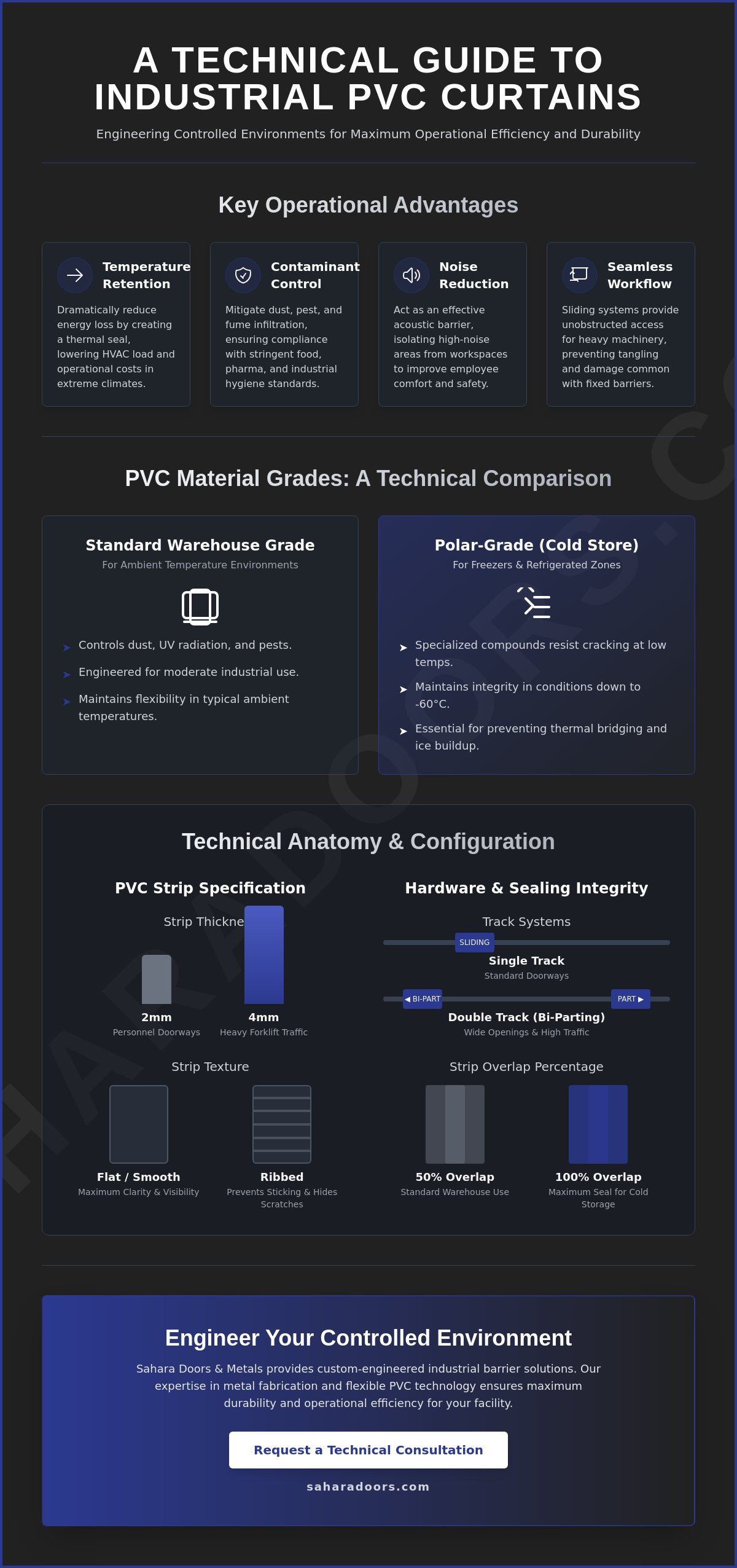
The primary functions of these systems are straightforward but critical: temperature retention, dust mitigation, and noise reduction. By creating a physical seal, these barriers prevent conditioned air from escaping, which is vital in the UAE’s extreme climate. Similar to how industrial curtain systems provide side-access flexibility for transport vehicles, sliding PVC barriers offer industrial facilities the same level of adaptable protection against environmental contamination.
Modern warehouses are moving away from fixed strips. Fixed systems can get tangled or damaged when heavy machinery passes through repeatedly. Sliding variants solve this by allowing the operator to push the entire barrier aside during peak traffic hours or for wide loads. These systems also play a major role in achieving LEED and other energy-efficiency certifications. By reducing the thermal load on HVAC systems, they contribute to a lower carbon footprint and help facilities meet modern sustainability standards.
Warehouse PVC Curtains vs. Cold Store Curtains
Standard warehouse grades focus on controlling dust, UV radiation, and pest infiltration. They’re built for ambient temperatures and moderate use. In contrast, Sliding PVC curtains/WAREHOUSE PVC CURTAINS/COLD STORE CURTAINS used in freezer environments require polar-grade compounds. These specialized materials are designed to resist cracking at temperatures as low as -25°C or even -60°C. Without these additives, standard PVC would become brittle and shatter under stress. Specialized facilities may also require anti-static or welding grades to protect sensitive electronics or personnel from sparks and static discharge.
The Environmental Impact of Industrial Barriers
Energy loss through open industrial doorways is a significant overhead cost. When a large door remains open, the exchange of warm and cold air forces refrigeration units and AC systems to work double-time. Installing a PVC barrier reduces the load on HVAC systems significantly. It’s a passive solution that yields active results. Beyond the financial numbers, these barriers improve employee comfort. They block drafts and keep high-heat areas separated from air-conditioned workspaces, directly impacting productivity and safety on the warehouse floor.
Technical Anatomy: Material Grades and Sliding Mechanisms
Precision in material selection defines the operational lifespan of your environmental barriers. When configuring Sliding PVC curtains/WAREHOUSE PVC CURTAINS/COLD STORE CURTAINS, the thickness of the material is the first critical variable. While a 2mm strip is generally sufficient for personnel doorways, heavy forklift traffic requires a 4mm industrial-grade strip to withstand constant mechanical impact. Texture is equally vital. Flat strips offer maximum clarity, yet ribbed strips provide air pockets that prevent strips from sticking together and hide the scratches caused by pallet movement, maintaining visibility over time.
The mechanical heart of a sliding system is the track. Galvanized steel tracks are the industry standard for high load-bearing capacity, while aluminium rails offer a lighter, corrosion-resistant alternative for smaller openings. Achieving an effective air-tight seal depends on the overlap percentage of the strips. A 50% overlap is standard for most warehouse applications, but a 100% overlap is often necessary for cold storage to prevent thermal bridging and ice buildup. Adhering to these technical specifications ensures your facility remains aligned with OSHA warehouse safety standards regarding opening protection and pedestrian visibility.
Sliding Hardware and Track Systems
Single-track systems work well for standard doorways, but double-track configurations allow for bi-parting movement in wider openings. This setup is essential for large-scale logistics where wide loads are common. Steel rollers are the preferred choice for heavy-duty applications due to their longevity and weight capacity. Conversely, nylon rollers are an excellent choice for noise reduction in pharmaceutical or retail environments. If you’re designing a high-traffic zone, you might consider consulting our engineering team about automated track integration to further streamline your logistics flow.
UV Stabilisation and Chemical Resilience
The UAE’s high-intensity sunlight causes standard PVC to turn yellow and brittle within months. Industrial-grade curtains must incorporate specific UV stabilizers to maintain transparency and flexibility under extreme heat. For food and beverage or pharmaceutical zones, FDA-compliant, food-grade PVC is mandatory. These specialized materials resist chemical degradation from heavy cleaning agents, ensuring your facility remains hygienic and compliant with international safety protocols while resisting the brittleness that leads to material failure.
Sliding PVC Curtains vs. High Speed Doors: A Decision Framework
Selecting the right entryway solution requires balancing initial investment against long-term utility. While Sliding PVC curtains/WAREHOUSE PVC CURTAINS/COLD STORE CURTAINS provide a cost-effective environmental seal, they serve a different operational purpose than automated systems. The “breaking point” for manual curtains usually occurs when traffic exceeds 15 to 20 cycles per hour. At this volume, the cumulative time spent moving a manual sliding track starts to impact logistics speed. This is typically the threshold where a facility manager should evaluate the transition to an automated system.
It’s vital to remember that PVC offers zero protection against unauthorized entry. In most UAE facilities, these curtains act as a secondary thermal barrier installed behind a primary GI rolling shutter. This combination secures the perimeter during non-operational hours while maintaining internal temperatures throughout the day. Hybrid solutions are also becoming common; by mounting PVC strips behind high speed doors, you create a dual thermal lock that prevents heavy air exchange even during the door’s opening cycle.
Performance Comparison Table
| Feature | Sliding PVC Curtains | High Speed Doors |
|---|---|---|
| Initial Cost | Low / Budget-Friendly | High / Long-term Investment |
| Access Speed | Manual / Moderate | Automated / Instant |
| Insulation Value | Excellent (with 100% overlap) | High (with air-tight seals) |
| Durability | High (simple strip replacement) | High (requires motor servicing) |
One distinct advantage of PVC is its fail-safe nature. During power outages, manual sliding tracks remain fully operational, ensuring that your cold chain isn’t compromised by electrical failure. Maintenance complexity is also drastically lower. Replacing a single damaged strip is a task your on-site team can handle in minutes, whereas servicing a motor or sensor array on a high-speed door requires specialized technical support and potential downtime.
When to Choose Sliding PVC Curtains
For budget-conscious projects requiring immediate environmental control, Sliding PVC curtains/WAREHOUSE PVC CURTAINS/COLD STORE CURTAINS are the most practical choice. They’re particularly effective in low-clearance areas where the head-room required for high-speed door drums isn’t available. Additionally, they’re the ideal solution for internal zoning. If you need to separate a packing area from a main conditioned warehouse without installing heavy permanent doors, a sliding track system provides the necessary flexibility without obstructing the visual field or personnel movement.
Installation and Maintenance for UAE Industrial Standards
Structural integrity is the foundation of a successful installation. Unlike lightweight domestic alternatives, industrial Sliding PVC curtains/WAREHOUSE PVC CURTAINS/COLD STORE CURTAINS exert significant stress on door lintels and mounting brackets. Before we begin any fabrication, a thorough structural assessment is mandatory to ensure the overhead support can handle the combined weight of the galvanized steel track and high-density PVC strips. Precision alignment during the mounting phase is non-negotiable; even a minor deviation from a perfectly horizontal plane will lead to roller seizing and uneven wear on the sliding mechanism.
The “UAE Heat Factor” presents a unique challenge that generic installation guides often overlook. PVC is a thermoplastic material, meaning it expands and contracts significantly with temperature fluctuations. In the local climate, we calculate a specific thermal expansion allowance. If strips are installed with zero floor clearance during a cool morning, they’ll expand and drag against the ground as the warehouse temperature rises. This leads to material fatigue and hygiene breaches. Our technicians ensure a precise gap is maintained to balance environmental sealing with mechanical longevity.
Safety protocols are paramount when installing in active forklift zones. We utilize temporary physical barriers and high-visibility signage to isolate the work area. The installation process follows a strict sequence: securing the track, verifying the lateral glide, and finally clipping the strips with the pre-calculated overlap. This systematic approach prevents the common errors that lead to operational downtime.
Preventative Maintenance Checklist
- Cleaning Protocols: Use only mild, non-abrasive detergents. Harsh chemicals or solvent-based cleaners will cloud the PVC, permanently reducing visibility and creating a safety hazard in high-traffic zones.
- Track Lubrication: Apply a dry-film lubricant to the sliding rails every six months. This ensures smooth lateral movement and prevents nylon or steel rollers from flat-spotting or seizing.
- Strip Inspection: Regularly check for tears, curling, or brittleness. A single warped strip can break the thermal seal, causing your energy costs to spike instantly.
Common Installation Pitfalls
Incorrectly calculated overlaps are a primary cause of energy loss. This often leads to “fish-mouthing,” where air gaps appear between strips, rendering the barrier ineffective. Another common error is using under-rated hardware for external openings. In areas prone to high winds, standard hangers will fail; heavy-duty, reinforced mounting systems are required. Finally, ignoring floor clearance leads to trip hazards and rapid strip degradation. For a professional installation that meets rigorous industrial safety standards, contact Sahara Doors & Metals LLC for a technical consultation today.
Custom Industrial PVC Solutions by Sahara Doors & Metals
Sahara Doors & Metals LLC stands at the intersection of precision metal fabrication and advanced environmental control. We don’t just supply materials; we engineer integrated entry systems. Our team leverages decades of expertise in custom metalwork to design Sliding PVC curtains/WAREHOUSE PVC CURTAINS/COLD STORE CURTAINS that withstand the rigors of heavy industrial use. By manufacturing our own sliding tracks and mounting hardware, we ensure every component meets the high load-bearing requirements of UAE warehouses.
Our consultation process is designed to eliminate the guesswork from your project. We begin with a detailed site assessment, measuring not just the opening dimensions but also the structural capacity of the mounting points. We then guide you through material selection, ensuring the PVC grade matches your specific thermal and traffic requirements. Whether you’re integrating a sliding system with our insulated rolling shutters for maximum climate control or seeking standalone pvc strip curtains for internal zoning, we provide a unified solution.
Why Industry Leaders Trust Sahara Doors
Precision engineering is our baseline. Every custom-engineered sliding track we produce is designed for the high-intensity cycle counts typical of regional logistics hubs. We understand that downtime costs money, so we prioritize a rapid turnaround for custom-sized warehouse and cold store curtains. Our unique strength lies in multi-product integration. Many of our clients require a layered approach, such as installing a sliding PVC barrier behind a GI rolling shutter to maintain air-conditioned environments while the main door is open for loading. This dual-barrier strategy is a hallmark of high-efficiency facility management.
Requesting a Technical Consultation
To begin your project, we recommend providing accurate clear-opening measurements: the width and height from lintel to floor. Our engineers will then determine the necessary overlap and strip thickness based on your industry. A logistics center requires different technical specifications than a pharmaceutical cleanroom or a retail cold storage unit. We invite you to contact us directly to explore our project portfolios or request a detailed quote tailored to your facility’s requirements. Our goal is to serve as your dependable partner, delivering tangible results in functional safety and environmental efficiency.
Optimizing Your Industrial Environment for Long-Term Success
Implementing the right environmental barrier is a strategic investment in your facility’s operational longevity. You’ve seen how precise material selection and robust track engineering prevent the common pitfalls of energy loss and mechanical failure. By prioritizing technical specifications like strip overlap and UV stabilization, you ensure your entryways remain functional under the most demanding conditions. The integration of these systems offers a fail-safe solution that protects your cold chain and improves worker comfort without compromising traffic flow.
Sahara Doors & Metals llc delivers specialized expertise in Sliding PVC curtains/WAREHOUSE PVC CURTAINS/COLD STORE CURTAINS, utilizing our UAE-based manufacturing to provide rapid delivery. Our products are engineered for extreme heat and UV resistance, making them a dependable choice for the regional climate. We’re proud to be trusted by major logistics and cold storage firms who value precision and durability. If you’re ready to enhance your facility’s efficiency, Request a Quote for Custom Sliding PVC Curtains today. We’re here to help you build a more secure and cost-effective industrial space.
Frequently Asked Questions
What is the difference between standard and polar grade PVC curtains?
Polar grade PVC contains specialized plasticizers that prevent cracking in temperatures as low as -25°C to -60°C. Standard PVC is designed for ambient temperatures and will become brittle if used in freezers. Selecting the correct grade is essential for the longevity of your COLD STORE CURTAINS, ensuring they remain flexible and maintain an effective thermal seal in sub-zero environments.
Can sliding PVC curtains be used for external warehouse doors?
You can use these curtains for external warehouse doors, but they’re most effective as a secondary barrier behind a primary rolling shutter. For external use, the material must include high-intensity UV stabilizers to resist the UAE’s solar radiation. This prevents the strips from yellowing or becoming brittle too quickly while providing an extra layer of dust and pest control during operational hours.
How much overlap is required for effective warehouse PVC curtains?
Effective WAREHOUSE PVC CURTAINS typically require a 50% overlap for standard environmental control. In high-wind areas or cold storage zones, a 100% overlap is necessary to create a complete air-tight seal. This precision in overlapping ensures that the strips fall back into place correctly after passage, preventing conditioned air from escaping and reducing the load on your facility’s HVAC systems.
Are PVC strip curtains fire-rated for industrial use?
Yes, specific industrial-grade PVC curtains are fire-retardant and certified to international standards such as NFPA 701 and BS 7837. These materials are designed to self-extinguish once the heat source is removed. It’s vital to verify fire-safety certifications with your provider to ensure full compliance with the UAE Fire and Life Safety Code, especially in manufacturing or high-risk storage zones.
How do I clean industrial PVC curtains without damaging the transparency?
Clean industrial PVC strips using only a mixture of mild soap and warm water applied with a soft cloth. You should never use abrasive chemicals or solvent-based cleaners, as these will cloud the material and permanently damage transparency. Regular cleaning prevents the buildup of grime that can obscure visibility and create a safety hazard for forklift operators and personnel in high-traffic areas.
Can I automate a sliding PVC curtain system?
Sliding PVC curtains can be automated by integrating motorized openers with the track system. This is a common upgrade for large-scale facilities that require hands-free operation for wide forklift loads. Automation improves logistics flow and ensures the curtains are always closed when not in use, maximizing energy efficiency and maintaining strict environmental control without manual intervention from your staff.
What thickness of PVC do I need for heavy forklift traffic?
Heavy forklift traffic requires a PVC thickness of at least 4mm to withstand constant mechanical impact and stretching. Thinner 2mm or 3mm strips are suitable for personnel doorways but will degrade rapidly under the stress of heavy machinery. For high-frequency industrial use, we also recommend ribbed strips, as the raised ribs take the brunt of the impact and protect the visibility of the material.
How long do PVC curtains typically last in the UAE climate?
In the harsh UAE climate, industrial-grade PVC curtains typically last between two to four years before requiring replacement. This lifespan depends heavily on the level of UV stabilization in the material and the frequency of mechanical impact. Regular maintenance, such as track lubrication and gentle cleaning, can extend the durability of the system, but strips exposed to direct sunlight will eventually require replacement to maintain transparency.