Article by
Sahara Doors & Metals LLC
Leaders in rolling shutters
Did you know that as of 2026, any permanent pergola structure in Dubai exceeding 20 square meters now requires a formal municipality permit and rigorous wind load analysis? For property developers and industrial managers, an outdoor shade is no longer just a decorative element. It’s a critical architectural extension that must withstand extreme thermal expansion and high-velocity seasonal winds. You’ve likely seen standard retail installations succumb to the UAE’s harsh environment, leading to costly maintenance or total structural failure.
Investing in professional pergola shades Dubai/AbuDhabi/UAE requires a deep understanding of industrial-grade materials and the latest safety benchmarks, including the ASCE 7-22 structural standards. In this guide, we’ll detail the technical specifications of motorized and retractable systems that ensure long-term durability and compliance with Law No. 3 of 2026. You’ll discover how precision-engineered aluminum fabrication and UV-stabilized coatings create a seamless, low-maintenance integration with your existing building management systems.
Key Takeaways
- Understand how architectural pergola shades function as essential climate-control structures to mitigate the impact of intense UV radiation and extreme ambient temperatures.
- Compare the technical specifications of fixed tensile structures against motorized Pergola shades Dubai/AbuDhabi/UAE, focusing on motor torque and sensor integration.
- Evaluate the performance of Galvanized Iron (GI) and high-grade aluminium in coastal environments, including the benefits of specialized powder coating and anodizing.
- Identify the critical stages of structural planning for large-scale projects, from geotechnical foundation anchoring to precision 3D architectural modeling.
- Discover how 15 years of industrial metalwork expertise ensures that your shading solutions integrate seamlessly with modern building management systems.
Understanding Pergola Shades: Function and the UAE Climate
In the Gulf region, the concept of outdoor living is dictated by environmental extremes. While a standard What is a Pergola? provides a basic architectural framework, the implementation of Pergola shades Dubai/AbuDhabi/UAE represents a sophisticated approach to climate control. These aren’t merely decorative garden additions; they’re high-performance structures engineered to mitigate the intense UV radiation and ambient temperatures that characterize the local climate.
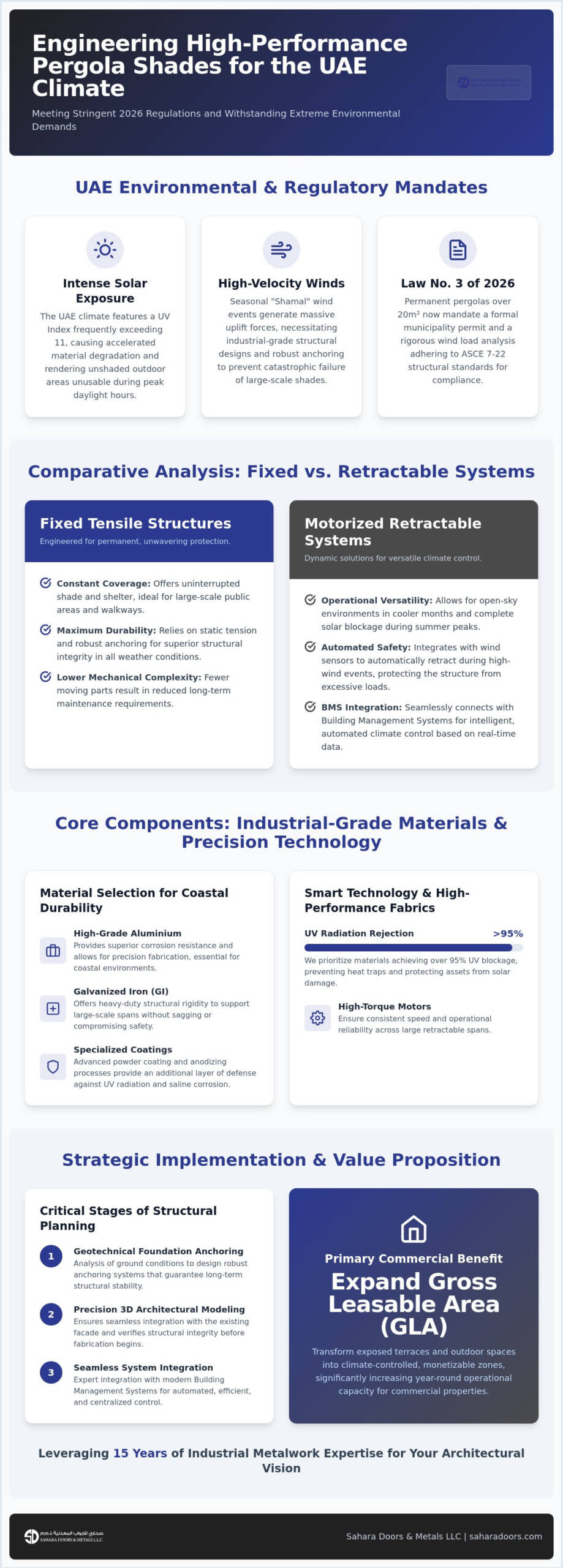
Intense solar exposure in the UAE can reach UV Index levels above 11 for several months of the year. This radiation degrades standard materials and makes unshaded outdoor spaces unusable during daylight hours. By deploying industrial-grade shading solutions, commercial property owners can extend the operational life of their outdoor assets. This protection prevents material fatigue in furniture and flooring while maintaining a habitable environment for occupants.
The difference between a residential decorative shade and an industrial-grade structure lies in the load-bearing capacity and the choice of materials. We focus on heavy-duty GI and precision-fabricated aluminium. These materials provide the structural rigidity needed to support large-scale spans without sagging or compromising safety during seasonal wind events.
Thermal Efficiency and UV Protection Standards
National climate standards for high-performance shading require specific fabric densities to ensure maximum UV blockage. We prioritize materials that achieve over 95% UV rejection while facilitating consistent airflow to prevent the formation of heat traps. Without proper ventilation, stagnant air beneath a large-scale structure can reach temperatures significantly higher than the surrounding environment. Thermal gain refers to the increase in temperature within a space caused by the absorption and re-radiation of solar energy through the metal framework and shading material.
Architectural Integration and Value Addition
For commercial developers, the primary benefit of installing Pergola shades Dubai/AbuDhabi/UAE is the immediate expansion of Gross Leasable Area (GLA). By transforming exposed terraces into climate-controlled zones, restaurants, hotels, and retail hubs can monetize their square footage year-round. Modern UAE architecture demands a balance between aesthetic design and structural integrity. We focus on custom metalwork that aligns with the building’s facade while meeting the 2026 wind load requirements. This shift toward multi-functional outdoor spaces reflects a broader trend in national development projects, where the environment is managed through smart engineering rather than avoided.
Technical Specifications: Retractable vs. Fixed Pergola Systems
Choosing between a fixed tensile structure and a retractable system depends on the specific operational requirements of the site. Fixed shades offer permanent coverage and are often preferred for large-scale public areas where constant protection is the priority. In contrast, retractable systems provide versatility, allowing for open skies in cooler months and complete solar blockage during the summer peak. Retractable Pergola shades Dubai/AbuDhabi/UAE are designed to retract automatically during high-wind events, which significantly reduces the surface area exposed to wind pressure.
Retractable systems require more complex engineering than fixed structures. While a fixed tensile shade relies on static tension and robust anchoring, a retractable system depends on dynamic mechanical components. Precision-engineered tracks and guide rails are essential for high-usage environments to prevent jamming or misalignment caused by thermal expansion. This preventative action protects the structural frame from the massive uplift forces that can occur during a “Shamal” wind. If you’re planning a complex installation, you can consult our engineering team for custom integration plans.
Motorization and Smart Control Integration
Modern industrial shading must integrate seamlessly with Building Management Systems (BMS). This allows for automated climate control where the shade positions itself based on real-time solar data. High-torque motors are used to ensure consistent speed and reliability across large spans. We implement wind and sun sensors that act as a first line of defense, triggering retraction before wind speeds reach critical thresholds. For industrial applications, these systems include manual safety overrides and dedicated power circuits to ensure operational safety even during power fluctuations.
Tensile Strength and Load-Bearing Calculations
Engineering a structure for the UAE’s varied terrain requires precise calculations. Coastal areas in Dubai face higher humidity and different wind patterns compared to the inland desert regions of Abu Dhabi. Research into the parametric optimization of shading structures highlights how specific geometries can reduce the mechanical stress on the frame. Material fatigue is a critical consideration for retractable mechanisms that operate daily; we use industrial-grade components to ensure longevity. For a standard 5x5m pergola, the required load-bearing capacity must account for a minimum wind pressure of 1.5 kN/m² to comply with local safety codes and ASCE 7-22 benchmarks.
Material Selection and Precision Engineering for Durability
Durability in the UAE isn’t just about structural strength; it’s a matter of chemical resistance and precision engineering. The coastal humidity of Dubai and the extreme thermal cycles of the Abu Dhabi desert demand materials that can withstand rapid expansion and aggressive oxidation. High-performance Pergola shades Dubai/AbuDhabi/UAE rely on a combination of industrial-grade metals and technically advanced fabrics to ensure a service life that exceeds a decade. While aluminium is often selected for its lightweight properties and aesthetic flexibility, Galvanized Iron (GI) remains the backbone for heavy-duty, large-span installations.
Corrosion resistance is achieved through two primary methods: powder coating and anodizing. For most architectural projects, we recommend a heavy-duty powder coating of at least 80 microns. This creates a resilient barrier against sand abrasion and salt spray. Anodizing is an alternative for aluminium frames, providing a metallic finish that is integrated into the surface of the metal itself. Precision metalwork is critical here; seamless structural joints prevent moisture from entering the core of the frame, which is where most structural failures begin. Adhering to the Dubai building codes for pergolas ensures that every joint and anchor point meets the necessary safety factors for regional wind loads.
Metal Fabrication Standards for Shading Frames
Custom metalwork allows for unique architectural spans that standard kits cannot achieve. We leverage our extensive experience in GI rolling shutter fabrication to create pergola frames that offer superior rigidity. GI is the industry standard for industrial-scale shades because it provides the highest strength-to-cost ratio for massive structures. This expertise in heavy-duty metallurgy ensures that our shading frames remain stable even under the mechanical stress of motorized retraction systems.
High-Performance Fabric Specifications
The choice of fabric determines the thermal comfort and longevity of the shade. We compare three primary technologies:
- PVC (Polyvinyl Chloride): Offers excellent water resistance and durability for retractable systems.
- PTFE (Polytetrafluoroethylene): A premium, self-cleaning material with a lifespan of 25+ years.
- HDPE (High-Density Polyethylene) Mesh: Best for airflow and reducing “heat traps” in standard fixed structures.
All fabrics must meet NFPA 701 fire-retardant ratings and demonstrate high color fastness to prevent fading under 12 hours of daily solar exposure. These benchmarks ensure the structure remains an asset rather than a maintenance liability.
Implementation and Structural Planning for Large-Scale Projects
A successful installation of Pergola shades Dubai/AbuDhabi/UAE relies on a structured project management framework that prioritizes engineering precision over simple assembly. For contractors and architects, the roadmap begins with a comprehensive site assessment. We evaluate geotechnical factors to determine the required foundation anchoring, which is essential to resist the significant uplift forces common in open desert or coastal environments. This technical groundwork ensures the structure remains stable during extreme weather events.
Custom design and 3D modeling follow the site assessment. This phase ensures architectural alignment with the existing building facade and verifies that the shading geometry optimizes thermal comfort. Once the design is finalized, fabrication occurs within our controlled industrial environment. Manufacturing components in a factory setting allows for rigorous quality control and precision metalwork that isn’t possible with on-site assembly. It ensures that every joint and guide rail meets our high durability standards.
Professional installation is executed with a focus on facility continuity. We coordinate with site managers to minimize disruption to daily operations, utilizing specialized lifting equipment and precision-engineered mounting systems. The final step involves a post-installation inspection and the implementation of a preventative maintenance schedule. This proactive approach protects the long-term integrity of the investment and ensures the motorized systems function reliably under constant operation.
Compliance with National Building Codes
Safety regulations for permanent shades in the UAE are stringent and require meticulous documentation. Navigating these requirements involves ensuring compliance with fire safety and egress standards, particularly in covered commercial spaces like hotel terraces or retail walkways. High-wind-load structures require professional certification to meet the 2026 structural benchmarks and municipality mandates. If you’re ready to begin the planning phase of your project, you can request a technical consultation with our engineering team to ensure full regulatory alignment.
Maintenance Protocols for Industrial Shading
Dust accumulation is a primary operational concern in the region. Routine cleaning prevents fabric abrasion and maintains the self-cleaning properties of premium materials. Motorized components and tensioning systems require periodic mechanical servicing to ensure smooth operation and prevent motor fatigue. You can also discover our car parking shades suppliers UAE resource for detailed insights into maintaining large-scale tensile structures and motorized shading assets in the local climate.
Custom Shading Solutions by Sahara Doors & Metals
Sahara Doors & Metals LLC leverages over 15 years of specialized metalwork expertise to deliver high-performance Pergola shades Dubai/AbuDhabi/UAE. We’ve built our reputation on precision engineering and industrial-grade fabrication. We don’t just provide off-the-shelf products; we engineer architectural extensions that meet the specific thermal and structural demands of the region. Our background in heavy-duty metallurgy allows us to address complex structural challenges that standard retail vendors simply can’t handle.
There’s a significant technical synergy between our industrial shutter systems and our architectural shades. Both require high-torque motorization, precision-engineered guide rails, and materials that resist aggressive oxidation. This shared mechanical foundation ensures that our retractable pergolas operate with the same reliability as our high-speed industrial doors. We’re committed to technical excellence and structural security in every project, ensuring your investment remains a durable asset for years to come.
Why Industrial Clients Choose Sahara
Contractors and commercial developers choose us because we’re a dependable, single-source partner for shutters, doors, and architectural shading. This consolidated approach simplifies procurement and ensures consistent material quality across large-scale projects. Our expertise in specialized metalwork goes far beyond standard retail offerings. We provide the structural calculations and material certifications required for modern UAE building codes. We offer reliable support and technical consultation to ensure every installation aligns with your facility’s operational goals and safety requirements.
Requesting a Professional Consultation
We’ve established direct channels for technical inquiries to provide you with immediate, project-specific quotations. You can explore our portfolio of industrial and high-end residential installations to see how we balance aesthetic design with industrial-grade durability. For comprehensive facility control, see our insulated rolling shutter UAE guide to learn about our thermal efficiency solutions for industrial entryways. Our team is available to discuss your specific architectural requirements and provide the engineering expertise needed for your next project. We focus on tangible results and functional safety, positioning ourselves as your stable partner in the UAE construction sector.
Engineering the Future of UAE Outdoor Spaces
Implementing high-performance Pergola shades Dubai/AbuDhabi/UAE demands a shift from decorative thinking to rigorous structural engineering. You’ve seen how precision-fabricated GI and aluminium frames, paired with advanced motorized systems, solve the persistent challenges of thermal gain and seasonal windstorms. By prioritizing 2026 wind load standards and expert material selection, you’re not just adding a shade; you’re securing a long-term architectural asset that enhances property value and operational square footage.
As a specialized UAE manufacturer since 2010, Sahara Doors & Metals LLC brings a proven track record in industrial-grade metalwork and motorized systems to every project. Our focus on technical excellence and custom fabrication ensures that your shading solution integrates seamlessly with modern building management systems while resisting the region’s aggressive coastal humidity. We invite you to Request a Technical Consultation for Your Shading Project to explore bespoke engineering options for your next commercial or residential development. We look forward to helping you transform your outdoor space into a functional, climate-controlled environment that stands the test of time.
Frequently Asked Questions
What is the average lifespan of a pergola shade in the UAE climate?
High-performance Pergola shades Dubai/AbuDhabi/UAE typically have a structural lifespan of 10 to 15 years when constructed from industrial-grade aluminum or galvanized iron. The fabric components vary; premium PTFE can last over 25 years, while standard HDPE mesh usually requires replacement every 5 to 8 years due to intense solar degradation. Regular maintenance and the use of UV-stabilized coatings are essential to reaching these longevity benchmarks in the local climate.
Can retractable pergola shades be integrated with existing smart home or BMS systems?
Retractable pergola systems can be fully integrated into existing Building Management Systems (BMS) or smart home platforms. We use motorized systems that support standard communication protocols, allowing for automated shade deployment based on pre-set schedules or real-time solar data. This integration enables centralized control over multiple units, optimizing energy efficiency and thermal comfort across large-scale commercial or industrial facilities without the need for manual intervention.
What wind speeds are Sahara Doors’ pergola structures designed to withstand?
Our pergola structures are engineered to comply with the latest ASCE 7-22 standards for wind load resistance. While retractable systems are equipped with sensors to close automatically at wind speeds between 50 and 60 km/h to protect the fabric, the underlying metal frames are fabricated to withstand much higher static pressures. This dual-layered approach ensures structural integrity during seasonal winds and protects the mechanical components from overstrain during extreme weather events.
Which fabric is best for UV protection and heat reduction in the Emirates?
PTFE (Polytetrafluoroethylene) and high-density PVC are the most effective materials for maximizing UV protection and heat reduction. PTFE offers superior self-cleaning properties and long-term solar resistance, while PVC provides excellent thermal insulation and water resistance for retractable applications. These fabrics are rated to block over 95% of harmful UV radiation, significantly lowering the ambient temperature beneath the structure and protecting the Gross Leasable Area of commercial properties.
Do I need a building permit for a permanent pergola shade structure?
A building permit is generally required for any permanent pergola structure in the UAE, particularly those exceeding 20 square meters in Dubai. Regulations vary by jurisdiction, such as Dubai Municipality, Trakhees, or the Abu Dhabi City Municipality. You must also obtain a No Objection Certificate from the master developer before applying for government approvals. We recommend consulting with a professional engineering partner to ensure your design meets all current safety and structural codes.
How often should motorized pergola systems undergo professional maintenance?
Motorized pergola systems should undergo professional maintenance at least twice per year to ensure mechanical reliability. These inspections focus on checking motor torque, lubricating guide rails, and inspecting the tensioning systems for signs of material fatigue. In environments with high dust accumulation, more frequent cleaning of the fabric is necessary to prevent abrasion. Routine servicing extends the operational life of the motorized components and prevents costly emergency repairs during the peak summer months.
What are the benefits of using GI (Galvanized Iron) for pergola frames?
Galvanized Iron (GI) provides superior structural rigidity and is the industry standard for large-scale industrial pergola frames. It offers a higher strength-to-cost ratio compared to aluminum, making it the preferred choice for expansive spans that require maximum load-bearing capacity. When treated with high-micron powder coatings, GI frames provide excellent resistance to corrosion and physical impact, ensuring the structure remains stable under the mechanical stress of heavy-duty shading applications.
Can pergola shades be customized to fit non-standard architectural layouts?
Bespoke Pergola shades Dubai/AbuDhabi/UAE can be fully customized to accommodate non-standard architectural layouts, including irregular angles and multi-level terraces. Our custom metalwork and 3D modeling capabilities allow us to fabricate frames that align precisely with existing building facades and structural constraints. This tailored approach ensures that even complex commercial or industrial sites receive optimal shading coverage while maintaining architectural integrity and meeting all local safety benchmarks.