Article by
Sahara Doors & Metals LLC
Leaders in rolling shutters
A high-performance Tensile Shade UAE installation can reduce surface temperatures by up to 25°C while providing 98% UV protection. For architects and property developers, these structures are no longer just aesthetic additions. They’re essential industrial assets engineered to survive 162 km/h wind loads in coastal zones. We know you’re looking for more than a simple fabric cover. You need a structural solution that won’t degrade under extreme heat or fail during the rare but heavy wind events that challenge the region’s infrastructure.
It’s frustrating to see inferior materials succumb to salt air corrosion or fabric fatigue within just a few seasons. This 2026 architectural guide promises to bridge the gap between technical engineering and design excellence. You’ll discover the specific advantages of materials like PTFE and PVC membranes, the importance of 316-grade stainless steel fasteners, and the latest regulatory requirements for Dubai Municipality compliance. We’ll examine how precision metal fabrication and advanced tensioning techniques create durable, code-compliant outdoor spaces that offer long-term reliability and peace of mind.
Key Takeaways
- Compare the performance of PVDF-coated PVC and PTFE fiberglass membranes to ensure your structure survives the UAE’s 50°C+ heat and coastal salt air.
- Identify the most stable architectural geometries, such as Hypar and Conical designs, when planning a high-performance Tensile Shade UAE installation.
- Understand the 2026 national engineering standards for foundation safety and the critical role of professional re-tensioning in maintaining structural integrity.
- Discover how integrating custom GI metal fabrication with advanced polymer science provides a durable, code-compliant shading solution for commercial developers.
What is a Tensile Shade Structure in the UAE Context?
A Tensile structure is a sophisticated architectural system that achieves stability through the tensioning of high-strength membranes rather than the weight of heavy, traditional materials. Unlike conventional buildings that rely on mass to resist gravity, these structures use pre-stressed fabric to create rigid, self-supporting forms. By 2026, the UAE architectural landscape has shifted significantly toward these lightweight solutions. Traditional heavy roofing often traps heat and requires massive support columns that obstruct space. Modern tensioned membranes provide large-span coverage with minimal structural interference, creating open environments that feel both expansive and modern.
The primary advantage for UAE developers is the strategic balance of UV protection and natural light transmission. You don’t have to choose between a dark, solid roof and a scorching open space. These membranes filter out up to 98% of harmful UV rays while allowing soft, diffused light to illuminate the area below. Because the local climate involves extreme thermal cycling, every Tensile Shade UAE must be engineered to account for significant thermal expansion. This precision ensures the fabric maintains its tension and aesthetic form even as temperatures fluctuate between the intense midday sun and cooler desert nights.
The Science of Tensioned Membranes
The structural integrity of a tensioned membrane comes from its double-curvature geometry. These shapes ensure that wind loads are distributed evenly across the surface, which is critical for meeting the 162 km/h wind speed standards required in coastal regions. While a temporary tent might flap or fail during a storm, a permanent architectural shade is a different class of engineering. It requires specialized metal fabrication and GI metalwork to create the rigid frames necessary to hold thousands of kilograms of tension. Our precision engineering ensures that every anchor bolt and weld is capable of withstanding the immense forces at play over a 20-year lifespan.
Applications Across the Emirates
You’ll find these high-performance structures across every major sector in the Emirates. They’re a staple for commercial plazas, where they create comfortable pedestrian walkways by mitigating the urban heat island effect. Industrial facilities rely on them for loading bays where column-free space is essential for heavy vehicle maneuvering. Other common applications include:
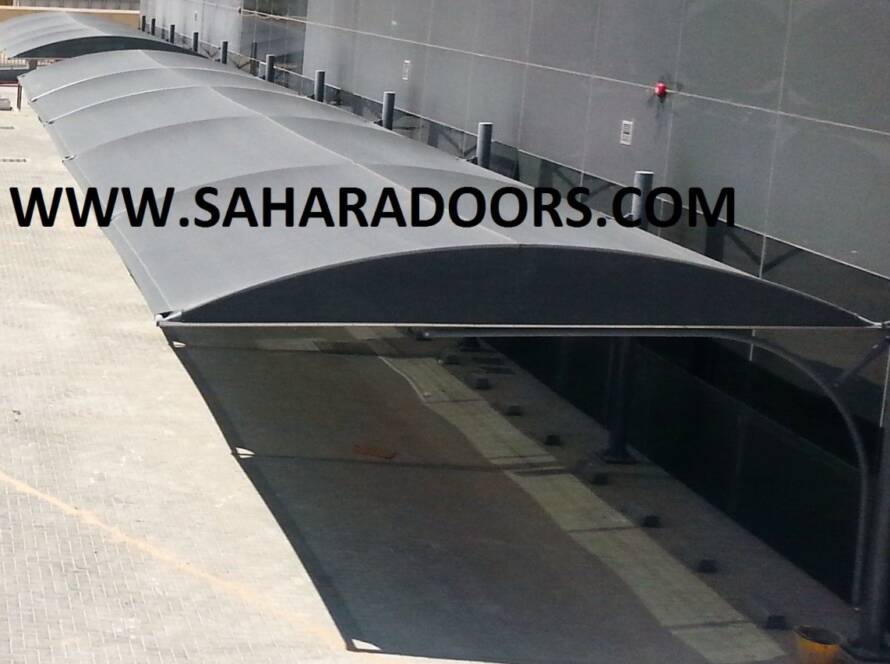
- Car Parking: Utilizing high-durability car parking shades to protect vehicle assets from 50°C+ temperatures.
- Educational Facilities: Providing safe, shaded outdoor play zones that comply with national health and safety codes.
- Recreational Hubs: Covering large stadium seating or park pavilions with aesthetically pleasing, large-span designs.
- Industrial Storage: Creating weather-protected zones for temperature-sensitive materials.
Material Engineering: Selecting Fabrics for 50°C+ Environments
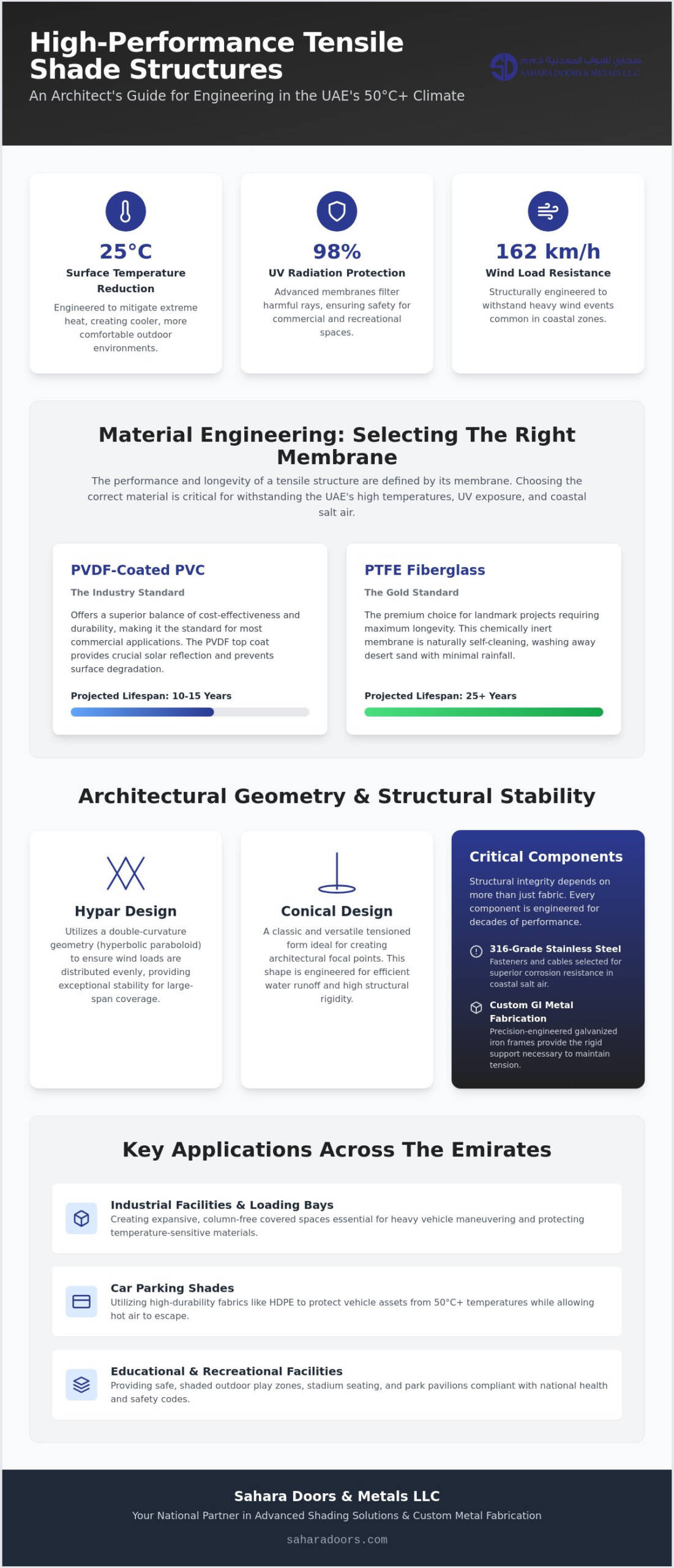
Selecting the right membrane is the most critical decision in the lifecycle of a Tensile Shade UAE project. In an environment where ambient temperatures regularly exceed 50°C, material degradation isn’t just an aesthetic concern; it’s a structural risk. High-performance fabrics must resist intense UV radiation, prevent heat absorption, and maintain tensile strength under constant stress. For most commercial applications, PVDF-coated PVC serves as the industry standard. It offers an excellent balance of cost-effectiveness and durability, with a typical lifespan of 10 to 15 years. The Polyvinylidene Fluoride (PVDF) top coating acts as a protective shield, reflecting solar energy and preventing dust from bonding to the surface.
For landmark projects requiring maximum longevity, PTFE Fiberglass remains the undisputed gold standard. These membranes are chemically inert and offer a lifespan exceeding 25 years. Because PTFE is naturally self-cleaning, the rare rainfall in the Emirates is often enough to wash away accumulated desert sand. In car parking applications where airflow is a priority, HDPE monofilament is frequently utilized. This breathable mesh provides high-density shade while allowing hot air to escape, significantly reducing the temperature of the vehicles parked beneath. To ensure these systems don’t fail at the seams, we utilize UV-stabilized PTFE threads and 316-grade marine-grade stainless steel hardware for all tensioning points.
PVDF vs. PTFE: Which is Right for Your Project?
The choice between these materials depends on your project’s 10-year maintenance cycle and fire safety requirements. PTFE fiberglass is non-combustible and offers superior chemical resistance, making it ideal for high-salinity coastal zones. However, PVDF-coated PVC is more flexible, allowing for complex geometries that might be difficult to achieve with stiffer fiberglass cores. As explored in Tension Fabric: Waves of the Future, the evolution of these polymer coatings has revolutionized how we manage solar gain in arid climates. If you’re managing a large-scale development, a cost-benefit analysis often reveals that the higher upfront investment in PTFE pays for itself through reduced cleaning costs and extended replacement intervals. You can consult with our engineering team to determine which material grade matches your specific site conditions.
The Role of Steel Fabrication in Durability
The fabric is only as strong as the skeleton supporting it. For any Tensile Shade UAE installation, hot-dip galvanized (GI) steel is the essential baseline for the support framework. This process involves submerging the steel in molten zinc, creating a metallurgical bond that prevents internal and external rust. For a premium architectural finish, we apply an epoxy primer followed by a high-micron powder coating. This dual-layer protection ensures the structure remains aesthetically pleasing while resisting the abrasive force of wind-blown sand. Structural wind load calculation is a mandatory engineering analysis that determines the specific force a structure must resist during 162 km/h wind events to ensure total site safety and regulatory adherence. By combining precision metal fabrication with advanced fabric science, we deliver structures that remain sturdy and dependable for decades.
Popular Tensile Shade Designs and Structural Forms
Selecting a structural form for a Tensile Shade UAE project involves balancing architectural vision with the physics of tension. Unlike rigid roofing, these membranes require specific geometries to remain stable under environmental loads. The design you choose dictates how the structure manages wind, heat, and rare but intensive rainfall. We specialize in several core architectural forms that have proven their durability across the Emirates:
- Conical and Umbrella Designs: These utilize a central mast to create high points. They’re ideal for prominent aesthetics and ensure efficient rainwater runoff to prevent fabric damage.
- Hypar (Hyperbolic Paraboloid): Recognized as one of the most stable forms, its double-curvature design provides exceptional resistance to wind-induced stress.
- Pyramid and Arch Structures: These are the standard for industrial walkways and car parks, offering clear spans and reliable coverage.
- Barrel Vaults: Perfect for loading zones or long corridors, these provide continuous, uninterrupted shading for logistical efficiency.
Engineering Shapes for Performance
The engineering principles of tensile structures dictate that every curve serves a functional purpose. Conical shapes are specifically designed to prevent “ponding,” a dangerous condition where water collects in fabric depressions during heavy rain. This prevents the membrane from stretching or the support steel from buckling under unexpected weight. For large-scale flair, the hypar shape’s opposing tension points eliminate the “fluttering” effect that can occur during high-wind events in coastal areas. In warehouse and logistics settings, we often customize these spans to integrate with high speed doors. This ensures that the shade structure provides ample clearance for rapid vehicle movement without compromising the building’s thermal envelope.
Aesthetic Customization in 2026
By 2026, the integration of utility and design has become a standard requirement for commercial developments. We now frequently integrate LED lighting systems directly into the tensile framework. This transforms a functional daytime shade into a secure, well-lit nighttime asset for public plazas or industrial yards. Color selection is another critical engineering factor you must consider. While darker colors might hide dust, lighter membranes offer significantly better thermal performance by reflecting solar radiation. You’ll need to decide between modular designs, which offer rapid installation timelines, and custom-built structures that provide the architectural uniqueness your specific site demands. Our fabrication team works closely with your architects to ensure the final form is both sturdy and visually striking.
Installation Standards and Maintenance in the UAE
The structural integrity of a Tensile Shade UAE installation begins long before the fabric is tensioned. As of 2026, UAE national building codes have introduced more stringent standards for foundation engineering and anchor bolt safety to address the increasing frequency of extreme weather events. For any structure exceeding 25 square meters, a certified structural engineer must verify the footing design to ensure it can resist the massive uplift forces generated by 162 km/h wind gusts. This isn’t just a regulatory hurdle; it’s a fundamental safety requirement that protects your property and the public. In Dubai, obtaining a No Objection Certificate (NOC) from the Dubai Municipality is a mandatory step for permanent structures, requiring detailed structural drawings and calculations from approved consultants.
You must also account for the natural “creep” of architectural membranes. Within the first 12 months of installation, fabrics undergo a settling period where they may lose a small percentage of their initial tension. Professional re-tensioning at the one-year mark is mandatory to prevent the fabric from fluttering, which causes premature fatigue and reduces the structure’s lifespan. Regular cleaning is equally vital. Sand and salt buildup in coastal regions can act as an abrasive, slowly stripping away the protective PVDF coating. We recommend a low-pressure wash using pH-neutral detergents every six months to maintain the membrane’s self-cleaning properties and solar reflectivity.
The Installation Roadmap
A dependable installation follows a rigorous, methodical progression. It starts with comprehensive site surveys and soil testing to determine the bearing capacity for heavy-duty foundations. Following this, our precision metal fabrication team produces the support framework using industrial-grade GI steel. On-site assembly is conducted by specialized teams who ensure every component meets UAE Civil Defense standards for fire safety and structural stability. This integrated approach ensures that the final structure is a sturdy and dependable asset that complements your existing architectural features while meeting all local safety protocols.
Preventative Maintenance for Longevity
Neglecting maintenance is the fastest way to turn a high-performance asset into a liability. Annual fabric health checks allow us to identify micro-tears or seam stress before they escalate into structural failures. We also focus on the metallurgy of the system, providing hardware lubrication and rust-proofing for all tensioning screws and fasteners. In many industrial facilities, these shade systems are installed in proximity to other security assets like gi rolling shutters. Coordinating the maintenance of these systems ensures that your entire facility remains secure and operational under the UAE’s demanding environmental conditions. If you’re ready to secure your site with an engineered shading solution, you can request a technical consultation and quote from our experts today.
Why Sahara Doors & Metals is Your National Shading Partner
Sahara Doors & Metals llc stands as a sturdy and dependable partner for developers across the Emirates. We don’t just provide fabric covers; we deliver engineered architectural assets. Our expertise in GI metalwork and precision engineering allows us to create support structures that meet the rigorous 2026 standards for wind and heat resistance. While many suppliers focus solely on the membrane, our foundation in industrial metal fabrication ensures that every Tensile Shade UAE we install is built on a skeleton of uncompromising strength. This commitment to structural integrity is what separates a temporary fix from a permanent architectural solution.
We operate as an integrated architectural solution provider, which means our clients benefit from a single point of contact for their entire site envelope. From high-security rolling shutters to specialized car parking shades, our portfolio is designed for the industrial professional who values durability and craftsmanship. We prioritize industrial-grade materials like PVDF-coated membranes and marine-grade hardware. This focus ensures that your investment remains a high-performance feature of your facility for decades, resisting the abrasive desert environment with ease.
Integrated Architectural Solutions
Achieving total climate control in a desert environment requires a holistic approach to building design. By combining our advanced tensile shades with insulated rolling shutters, you can significantly reduce the thermal load on your main facility. The shade structure acts as a primary heat shield, while the shutters maintain internal temperature efficiency. This synergy is particularly valuable for industrial loading bays and commercial warehouses where energy costs are a critical operational factor. Our team provides custom fabrication services to ensure these systems integrate naturally with your existing site requirements, regardless of the architectural complexity or scale of the project.
Get Started on Your Shading Project
We understand that large-scale architectural projects require transparency and technical precision. That’s why we offer direct consultations and on-site visits for national contractors and property developers. You can explore our extensive project portfolio to see how we’ve solved complex shading challenges across the UAE, from expansive public plazas to high-traffic industrial zones. Our engineers are ready to assist you with structural calculations, material selection, and site-specific design challenges. Contact us today to request a detailed quotation and take the first step toward a code-compliant, aesthetically superior shading solution. We’re committed to your ultimate satisfaction and the long-term safety of your outdoor spaces.
Securing Your Architectural Vision with Engineered Shading
The evolution of architectural fabrics and structural engineering has transformed outdoor spaces across the Emirates. By prioritizing advanced polymer membranes and precision GI metalwork, you ensure that your Tensile Shade UAE installation remains a durable asset rather than a maintenance burden. Success in these high-stakes environments requires a synergy of material science and rigorous adherence to national building safety codes. Whether you’re designing a sprawling commercial plaza or a high-traffic industrial loading bay, the stability of your structure depends on the quality of its fabrication and the expertise of its installers.
Sahara Doors & Metals llc provides the technical excellence and national installation coverage required for complex shading projects. We’re proud to be an authoritative UAE industrial partner committed to the highest standards of craftsmanship and safety. Our team is ready to help you navigate the technical specifications of your next development. We’ll ensure your structure is engineered for maximum longevity and aesthetic impact.
Request a Professional Consultation for Your Tensile Project today to see how our expertise in custom metal fabrication can bring your architectural designs to life. We look forward to building a safer, cooler future for your property.
Frequently Asked Questions
What is the typical lifespan of a tensile shade in the UAE?
The lifespan of a tensile structure depends largely on the membrane material you select for your project. High-Density Polyethylene (HDPE) typically lasts between 5 and 10 years; while Polyvinyl Chloride (PVC) membranes generally offer a 10 to 15-year warranty. For long-term industrial applications, PTFE fiberglass is the gold standard, often exceeding a 25-year lifespan when supported by hot-dip galvanized steel frames and professional maintenance.
How do tensile structures handle high wind speeds during storms?
Every Tensile Shade UAE must be engineered to withstand specific regional wind loads according to the latest 2026 building codes. In coastal areas, structures are designed to resist basic wind speeds of 162 km/h. Stability is achieved through double-curvature geometry and precision-engineered anchor systems. These designs distribute force evenly across the fabric and support steel, preventing structural failure during rare but intensive wind events.
Can tensile shades be installed over existing steel or concrete structures?
Yes, tensile membranes can be integrated into existing steel or concrete frameworks provided the original structure can handle the additional tension loads. Our engineers conduct a thorough analysis of the existing connection points and load-bearing capacity before proceeding. Custom metal fabrication is often required to create specialized brackets or transition plates that securely anchor the new fabric to the old structure without compromising safety or integrity.
Which fabric is best for 100% UV protection and heat reduction?
Are tensile shades in the UAE fire-rated and compliant with safety codes?
All permanent tensile structures must comply with national safety codes and UAE Civil Defense fire regulations. Materials like PTFE are non-combustible; while high-quality PVC membranes are treated to be flame retardant. We ensure that every installation meets the mandatory 2026 standards for fire spread and smoke development. This provides architects and developers with the necessary safety certifications for project approval and long-term site security.
How often should I clean the fabric of my tensile structure?
We recommend a professional cleaning of the fabric every six months to remove sand, dust, and salt buildup. In coastal regions, salt accumulation can be particularly abrasive to the protective PVDF coatings. Using low-pressure water and pH-neutral detergents preserves the membrane’s self-cleaning properties and maintains its solar reflectivity. Regular maintenance prevents the buildup of organic matter that can lead to permanent staining or material degradation over time.
What is the difference between a car parking shade and an architectural tensile shade?
A car parking shade is a functional structure designed for specific vehicle clearance and maximum coverage efficiency. An architectural Tensile Shade UAE focuses on aesthetic form and complex geometries like hypars or cones. While both utilize similar tensioning principles, architectural shades often involve more intricate metal fabrication and specialized membranes. They serve as a focal point for plazas, stadiums, or commercial building entrances while providing essential protection.
How much does a custom tensile shade cost per square meter in 2026?
The cost of a tensile structure varies based on the membrane type, the complexity of the steel fabrication, and the project scale. While budget-friendly HDPE options are available for small residential plots, premium PTFE or PVC systems for commercial developments involve higher material and engineering costs. You should consult with a specialized provider to receive a customized quote that accounts for your site’s specific wind load requirements and foundation needs.