Article by
Sahara Doors & Metals LLC
Leaders in rolling shutters
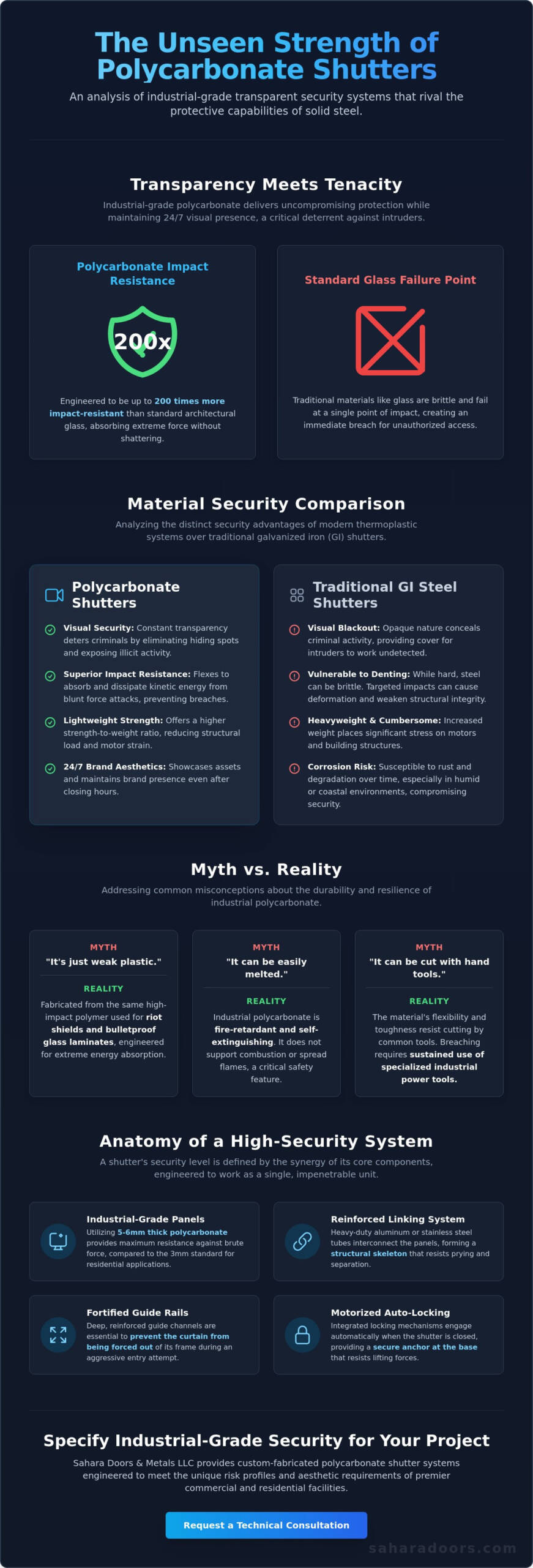
Can a material as clear as glass actually stop a determined intruder? It’s a common concern for developers and retailers who are tired of the visual blackout caused by traditional steel doors. While solid metal has long been the industry standard, the security level of polycarbonate shutters has reached a point where it rivals the strength of high-grade alloys. These systems are engineered through precision fabrication to withstand extreme forces, offering up to 200 times the impact resistance of standard glass without sacrificing the ability to showcase your assets around the clock.
We know that protecting your investment shouldn’t mean hiding it behind a heavy, manual barrier. You need a solution that provides uncompromising protection while maintaining your brand’s visual presence 24/7. This guide will show you how industrial-grade polycarbonate provides steel-equivalent protection for commercial and high-end residential assets. We’ll analyze current impact resistance ratings, the technical implications of the 2026 building code updates regarding threshold buildings, and the long-term durability of these specialized door systems to help you secure your facility with confidence.
Key Takeaways
- Learn why the molecular structure of industrial-grade polycarbonate allows for superior energy absorption and impact resistance compared to traditional architectural materials.
- Understand how the security level of polycarbonate shutters is enhanced by 24/7 transparency, which acts as a deterrent by eliminating hiding spots for intruders.
- Compare the weight-to-strength ratio of thermoplastic panels against GI rolling shutters to see why lighter, precision-engineered systems often provide more effective protection.
- Discover the technical importance of reinforced guide rails and motorized auto-lock features in maintaining the structural integrity of your specialized door systems.
- Explore how custom fabrication allows you to tailor your shutter specifications to the unique risk profile and aesthetic requirements of your commercial or residential facility.
Defining the Security Level of Polycarbonate Shutters
A Polycarbonate Rolling Shutter is a sophisticated entry management system composed of high-impact thermoplastic panels. These panels are interconnected using heavy-duty aluminium or stainless steel tubes. This precision engineering creates a curtain that is both lightweight and incredibly resilient. The security level of polycarbonate shutters is often misunderstood because the material is transparent. However, this transparency enables the concept of ‘Visual Security.’ When a facility remains visible after hours, criminals lose the cover of darkness. They cannot hide their activities from passersby or security patrols. This psychological deterrent is a primary reason why high-end retail and commercial assets choose this solution over opaque alternatives.
To verify security performance, professional specifiers look for international standards such as LPS 1175. This classification tests the resistance of building components against unauthorized access by various tool sets. A shutter’s rating depends on the specific tools used and the time it takes to create a man-sized breach. While residential systems focus on basic weather protection, industrial-grade systems are designed to withstand aggressive forced entry attempts. Specifying the correct thickness and reinforcement is essential to meeting these rigorous safety protocols.
Material Composition and Security Ratings
Polycarbonate is the same material utilized in the production of riot shields and bulletproof glass. Its unique Polycarbonate properties allow it to absorb massive amounts of kinetic energy without shattering. For residential applications, a 3mm thickness is often sufficient for basic protection. In contrast, industrial-grade shutters utilize 5mm to 6mm panels to maximize the security level of polycarbonate shutters against professional intruders. The ‘link’ system is equally vital; these metal tubes act as a structural skeleton. They ensure that even under extreme pressure, the panels remain locked together as a single, impenetrable unit that resists prying and impact.
Common Misconceptions About ‘Plastic’ Shutters
One frequent concern is that these shutters can be easily melted or cut because they aren’t metal. In reality, industrial polycarbonate is fire-retardant and self-extinguishing. It doesn’t support combustion and requires specialized industrial tools to breach. While steel is harder, it can be brittle under specific types of impact. Polycarbonate relies on impact resistance rather than raw material hardness to defeat intruders. It flexes to dissipate the force of a hammer or crowbar attack. If your project requires a completely opaque barrier for heavy industrial warehouses, you might consider The Ultimate Guide to GI Rolling Shutters to compare material behaviors. However, for most modern commercial applications, the combination of strength and visibility makes polycarbonate the superior choice.
The Science of Impact Resistance and Material Strength
The mechanical performance of a Polycarbonate Rolling Shutter begins at the molecular level. Unlike most polymers, polycarbonate consists of long, intertwined molecular chains that behave like a dense web. When an intruder strikes the surface with a blunt object, these chains slide and stretch to dissipate the energy across the entire panel. This molecular flexibility is why the security level of polycarbonate shutters remains high even under repeated attacks. While traditional architectural materials like glass fail at a single point of impact, polycarbonate distributes the load, preventing a localized breach. This material also displays high resistance to chemical attacks, ensuring that common solvents or oils cannot be used to weaken the panel’s integrity before an attempted entry.
Tensile strength metrics for high-grade polycarbonate are impressive. It typically exhibits a tensile strength of approximately 60 to 70 MPa (megapascals). This allows it to withstand significant pulling and prying forces that would deform standard aluminium slats. In high-heat regions like the UAE, maintaining this strength requires advanced UV stabilization. Without these specialized chemical additives, intense solar radiation would cause the polymer to become brittle and yellow over time. A brittle shutter is a security liability; it can be cracked or shattered with minimal effort. Sahara Doors ensures all panels are treated to withstand these extreme conditions, preserving the structural craftsmanship of the installation for decades.
Energy Absorption vs. Brittle Fracture
Security experts differentiate between energy absorption and brittle fracture when evaluating a barrier. Brittle materials reach their limit and fail instantly. Polycarbonate, however, undergoes plastic deformation. This means it bends and absorbs the kinetic energy of a blow rather than snapping. Scientific studies on testing polycarbonate impact resistance demonstrate that it can absorb thousands of Joules of energy before failing. In a real-world “smash and grab” attempt, this energy dissipation prevents the intruder from creating a quick opening. It forces them to spend more time and make more noise, which significantly increases the likelihood of detection and intervention.
Weatherproofing as a Security Factor
In the Middle East, the environment is as much of a threat as any intruder. High humidity and extreme temperatures can cause inferior thermoplastic panels to warp or discolour. This structural warping can misalign the shutter tracks, making the system vulnerable to being forced open. We ensure our systems use industrial-grade materials that resist chemical degradation and environmental stress. Protecting the motorization components from fine sand and dust is also critical; a jammed shutter that won’t close fully is an open invitation to theft. If you are planning a facility upgrade, you can request a technical consultation to ensure your specifications meet these environmental demands. By integrating dust-sealed guide rails and UV-treated panels, you preserve the long-term security level of polycarbonate shutters against both criminals and the elements.
Polycarbonate vs. GI Rolling Shutters: A Security Comparison
When evaluating the security level of polycarbonate shutters against traditional GI rolling shutters, the comparison often boils down to how each material behaves under stress. Galvanized Iron (GI) is prized for its brute mass and perceived hardness. However, mass alone doesn’t equate to superior protection. Polycarbonate offers a unique weight-to-strength ratio that provides steel-equivalent defense at a fraction of the weight. This reduced mass puts less strain on the motorization systems, ensuring the door operates reliably every time without the mechanical fatigue that can lead to security failures in heavier metal systems. It’s a more efficient way to secure a perimeter without the bulk of traditional metallurgy.
Noise is another critical differentiator in the security landscape. While a metal shutter provides an audible ‘clank’ during operation, a breach attempt on steel is often masked by ambient industrial noise. Polycarbonate, while quieter during normal use, creates a sharp, high-frequency cracking sound when subjected to extreme impact. This serves as an immediate, unintentional alarm for security staff. To maintain maximum security integrity, both systems require routine maintenance, but polycarbonate lacks the corrosion risks associated with metal. This makes it more dependable in coastal or high-humidity environments where rust could compromise the locking points of a steel shutter.
Structural Integrity Comparison
In high-wind load scenarios, the flexibility of polycarbonate is a technical advantage. While a GI slat might permanently deform or buckle under extreme pressure, polycarbonate panels flex and return to their original shape. This resilience is backed by rigorous ASTM security glazing standards, which measure a material’s ability to resist forced entry and containment. Leverage attacks using crowbars often find more purchase on the joints of metal shutters; however, the smooth, interlocking design of a Polycarbonate Rolling Shutter leaves fewer gaps for prying tools to exploit. This precision engineering ensures the curtain remains seated in its tracks even during a sustained attack.
Visual Surveillance and Deterrence
The psychological component of security can’t be overstated. A solid steel shutter creates a ‘blackout’ zone where an intruder can work undisturbed once they’ve bypassed the initial barrier. Polycarbonate eliminates this advantage. Because the panels are transparent, intruders are constantly exposed to street patrols and public view. This transparency also allows for seamless integration with internal CCTV systems. Security cameras can monitor the perimeter through the shutter 24/7, providing real-time data without requiring the shutter to be raised. If you need a high-traffic solution that maintains this visibility, exploring The Comprehensive Guide to High Speed Doors may provide additional insights into rapid-access security. Ultimately, the combination of physical strength and constant visibility significantly elevates the overall security level of polycarbonate shutters for high-value retail locations.
Critical Features that Enhance Shutter Security Levels
While the impact resistance of the panels is foundational, the overall security level of polycarbonate shutters depends heavily on the surrounding structural hardware. High-performance material is only effective if the curtain remains firmly anchored during an attempted breach. Reinforced guide rails serve as the primary containment system; these deep-channel extrusions prevent a “blow-out” scenario where an intruder tries to push or kick the curtain out of its tracks. By using heavy-duty aluminium or steel guide rails with wind-lock clips, we ensure the curtain stays seated even under extreme lateral pressure.
The bottom rail acts as the final line of defense against prying tools. A specialized, heavy-duty bottom extrusion adds significant weight and rigidity to the base of the shutter, making it nearly impossible to gain leverage with a crowbar. For modern commercial facilities, integrating smart sensors and alarm systems directly into the shutter framework provides an added layer of active defense. These sensors can trigger an alert the moment a vibration or forced lifting attempt is detected, bridging the gap between physical protection and digital surveillance.
Advanced Locking Mechanisms
Motorized systems generally offer a higher security level of polycarbonate shutters than manual ones. Industrial-grade motorization includes motor-brake technology that automatically locks the curtain in the closed position. This prevents unauthorized manual lifting from the outside. While manual side locks and central locks are available for added peace of mind, the internal braking system of a Motorized Rolling Shutter is often the most reliable deterrent against forced entry. It eliminates the risk of human error, such as forgetting to engage a manual bolt before leaving the premises.
The Role of Professional Installation
Even the most advanced shutter system’ll fail if the installation lacks precision. Precision engineering in the framing is vital to ensure zero-gap tolerances. If there’s a gap between the shutter and the masonry, it provides an entry point for prying tools. In the UAE’s specific construction landscape, we use industrial-grade fasteners that resist both mechanical stress and environmental corrosion. Professional fabrication ensures that every component, from the barrel to the guide rails, is perfectly aligned to prevent jamming and maintain structural integrity. To see how our expert team can secure your facility, you can explore our project portfolio for custom security solutions.
Specifying Sahara Polycarbonate Shutters for Your Project
Selecting the right physical protection requires more than picking a material from a catalog. At Sahara Doors & Metals LLC, we treat every installation as a unique engineering challenge. We focus on custom fabrication to ensure the security level of polycarbonate shutters matches the specific risk profile of your facility. A jewelry showroom in a high-traffic mall requires different technical specifications than a private residential garage or an industrial warehouse. Our team analyzes the structural requirements of your site to determine the ideal panel thickness, reinforcement frequency, and motorization torque needed for long-term reliability.
In many modern developments, facilities require multi-purpose zoning. You might need the transparency of a Polycarbonate Rolling Shutter for the storefront while requiring the thermal properties of insulated rolling shutters for loading bays or climate-controlled storage areas. We specialize in integrating these different systems into a cohesive architectural design. Our commitment to precision engineering means that whether you’re installing a single window shutter or a massive industrial entryway, the craftsmanship remains consistent. We use only industrial-grade materials that have been proven to withstand the rigors of the UAE’s environmental and security demands.
Industrial and Commercial Applications
High-end retail showrooms are often the primary adopters of these systems. They need to balance luxury aesthetics with maximum protection. Polycarbonate allows for 24/7 window shopping while providing a formidable barrier against smash-and-grab attempts. Banks and financial institutions also utilize these transparent systems to maintain visibility for security patrols while securing ATM vestibules or teller areas. In mall environments, our shutters help tenants meet strict safety and visibility regulations without compromising on the security level of polycarbonate shutters. We ensure that every custom metalwork component, from the hood to the bottom rail, aligns with the high standards expected by mall developers and commercial property managers.
Requesting a Security Consultation
The process begins with a detailed evaluation of your site-specific needs. We don’t believe in one-size-fits-all security. Our experts work directly with architects and contractors to review floor plans and structural tolerances. Once the specifications are finalized, the project moves to our specialized fabrication facility. We manage the entire lifecycle, from precision engineering to national installation across the UAE. To ensure your investment continues to perform at its peak, we offer preventative maintenance contracts. These regular inspections catch mechanical wear before it becomes a security vulnerability. If you’re ready to upgrade your facility’s protection, you can contact our technical team to request a professional consultation or a project quote today.
Securing Your Assets with Precision Engineering
High-performance protection is a synergy of material science and mechanical precision. By choosing polycarbonate, you leverage incredible impact resistance while maintaining 24/7 visual transparency for your storefront. It’s clear that the security level of polycarbonate shutters rivals traditional steel when supported by reinforced guide rails and industrial-grade motorization. These systems don’t just protect; they enhance your brand’s presence by keeping your assets visible and safe under any conditions. You gain the peace of mind that comes from steel-equivalent protection without the visual blackout of older systems.
Sahara Doors & Metals LLC has been a dependable partner for national contractors and architects since 2010. Every system is expertly fabricated in our specialized UAE facility using industrial-grade materials designed for high-impact protection. We understand the technical requirements of the modern construction landscape and deliver results that stand the test of time. We don’t believe in compromise when it concerns your property’s safety. Our focus on craftsmanship and technical excellence ensures your investment remains secure for years to come.
Request a Quote for Custom Polycarbonate Security Shutters and secure your commercial or residential assets with absolute confidence. Our team is ready to help you design a solution that fits your specific risk profile and architectural vision.
Frequently Asked Questions
Can polycarbonate shutters be easily cut by intruders?
Intruders cannot easily cut through industrial-grade polycarbonate using standard hand tools. This material is engineered for extreme impact resistance; it’s the same technology used in riot shields and bulletproof glazing. While a determined criminal with heavy industrial cutting equipment might eventually make progress, the time and noise required serve as a significant deterrent. Most “smash and grab” attempts fail because the material flexes and absorbs energy instead of fracturing.
How do polycarbonate shutters handle the extreme heat of the UAE?
High-quality panels are specifically formulated with UV-stabilized resins to withstand the intense solar radiation and heat of the UAE. This treatment prevents the polymer from becoming brittle or yellowing over time, which is essential for maintaining the security level of polycarbonate shutters. Inferior plastics might warp in temperatures exceeding 50°C, but our precision-engineered panels maintain their structural integrity and transparency even in the harshest desert climates.
Are transparent rolling shutters as secure as solid steel shutters?
Transparent rolling shutters provide protection comparable to steel by using high-tensile thermoplastic panels linked with metal tubes. While steel offers brute mass, polycarbonate provides superior energy absorption and the added benefit of visual security. Intruders are less likely to attempt a breach when they remain visible to street patrols or CCTV cameras. This combination of physical strength and constant visibility often results in a more effective overall security solution for retail environments.
What is the typical lifespan of a high-security polycarbonate shutter?
A high-security polycarbonate shutter typically has an operational lifespan of 10 to 15 years depending on environmental exposure and usage frequency. The use of corrosion-resistant aluminium or stainless steel links ensures the internal structure remains sound. To maximize this lifespan, it’s vital to use high-grade motors and UV-treated panels. Regular professional inspections help identify mechanical wear in the barrel and guide rails before they impact the system’s performance.
Do polycarbonate shutters require special maintenance to keep their security level?
Maintaining these shutters is straightforward and doesn’t require specialized chemicals or complex procedures. We recommend regular cleaning with water and a non-abrasive cloth to prevent dust buildup from scratching the surface. From a security standpoint, the most important task is ensuring the guide rails remain clear of debris and the motorized braking system is tested bi-annually. This ensures the security level of polycarbonate shutters remains uncompromised by mechanical friction or blockages.
Can these shutters be integrated with existing building security systems?
Our motorized systems are designed for seamless integration with modern building management systems and security alarms. You can connect the shutter’s control board to central monitoring hubs using standard dry contact relays. This allows for automated closing schedules or immediate alarm triggers if the system detects unauthorized manual lifting. Such integration ensures that your physical barriers work in perfect harmony with your digital surveillance and response protocols.
Are polycarbonate shutters fire-resistant according to UAE safety standards?
Industrial polycarbonate is inherently fire-retardant and classified as a self-extinguishing material. It doesn’t contribute to the spread of flames and will stop burning once the heat source is removed. This characteristic is critical for meeting stringent UAE safety standards for commercial and residential buildings. While they aren’t a substitute for dedicated fire doors, they provide a safe, non-combustible barrier that won’t produce toxic flaming droplets during a fire event.
What is the maximum width possible for a high-security polycarbonate installation?
High-security installations can typically reach widths of up to 6 or 7 meters in a single span. The exact maximum width depends on the specific wind load requirements and the thickness of the metal links used in the fabrication process. For wider openings, we often recommend a multi-shutter configuration with removable or fixed mullions to ensure the curtain remains stable. Our engineering team calculates these tolerances during the consultation phase to ensure structural safety.