

Article by
Sahara Doors & Metals LLC
Leaders in rolling shutters
Did you know that rolling doors account for 38% of all industrial installations worldwide, yet a significant portion of these systems fail prematurely due to an inadequate rolling shutter automation kit? You’ve likely experienced the operational headache of a warehouse door that jams during peak hours or a motor that burns out because it wasn’t rated for the high-traffic demands of a harsh UAE summer. It’s a common frustration for facility managers who prioritize security but struggle with the mechanical limitations of undersized hardware.
We understand that automation is a precision-engineered system where torque calculation and environmental protection determine your long-term return on investment. This guide provides a professional framework for selecting high-performance kits that balance power with the resilience needed for our region’s unique climate. We’ll explore how to choose the right motor for GI or insulated shutters, the importance of IP54 ratings for sand and dust protection, and the specific technical factors that guarantee seamless, remote-controlled access for your industrial facility.
Key Takeaways
- Understand how transitioning from manual GI shutters to motorized systems significantly reduces physical strain on staff while optimizing warehouse traffic flow.
- Learn to identify the essential components of a high-performance rolling shutter automation kit, from the drive motor’s torque capacity to the logic board’s control capabilities.
- Discover how to match specific motor types, such as tubular or central box motors, to your door’s material weight and operational frequency for maximum longevity.
- Identify the critical environmental specifications, including IP54 ratings and thermal protection sensors, required to withstand the UAE’s extreme heat and dust.
- Recognize the importance of professional site assessments and custom metal fabrication to ensure your automation system integrates seamlessly with your facility’s structural requirements.
The Strategic Case for Rolling Shutter Automation in Industrial Facilities
Transitioning from manual GI shutters to motorized systems is a strategic upgrade for any UAE industrial facility. Manual operation often leads to inconsistent closing speeds and physical strain on personnel. By installing a high-quality rolling shutter automation kit, you replace unpredictable human effort with precision engineering. This shift ensures that heavy steel curtains move at a constant, safe velocity every time, protecting both the hardware and the people operating it. In an environment where rolling doors account for 38% of all industrial installations, the move toward automation is a clear industry standard for modern logistics and manufacturing hubs.
Workplace safety is a primary driver for this transition. Lifting industrial-grade shutters manually poses a constant risk of repetitive strain and acute back injuries. Beyond personnel safety, automation plays a vital role in climate control. In the extreme UAE heat, every second a warehouse door remains open contributes to significant energy loss. Motorized systems allow for rapid opening and closing cycles, which helps maintain internal temperatures and reduces the load on your HVAC systems. For those looking to understand Roller Shutter Basics, it’s clear that the mechanical advantage of a motor is indispensable for large-scale industrial applications where weight and frequency of use are high.
Enhancing Facility Security and Asset Protection
Security protocols change entirely when you automate your entryways. Traditional manual padlocks are susceptible to tampering and human error, such as a staff member forgetting to secure the bolt at the end of a shift. A modern rolling shutter automation kit features integrated locking mechanisms that engage the moment the shutter reaches its limit. For managers overseeing multi-site operations, these systems can be integrated into a wider Building Management System (BMS). This allows for remote monitoring and controlled access protocols, ensuring that only authorized personnel can operate the entryways while providing a digital audit trail of every door movement. A comprehensive security strategy also requires attention to your facility’s fixed entry points, and understanding the specifications for commercial steel doors UAE projects demand is essential for meeting Civil Defense fire-rating requirements alongside your automated shutter systems.
Operational Efficiency and Long-Term ROI
Time is a critical asset in high-frequency loading bays. Waiting for staff to manually unlock and lift heavy shutters creates bottlenecks in your logistics chain. Automation streamlines this process; drivers or floor managers can trigger the door via remote or sensor before they even reach the opening. Additionally, the smooth, controlled movement provided by a motor reduces the mechanical stress on the shutter slats and tracks. Unlike the jerking motion common with manual operation, a motorized system extends the life of your hardware and prevents the common “shutter slam” that damages the bottom rail. This investment in mechanical longevity is particularly effective when paired with high-quality materials, as detailed in The Ultimate Guide to GI Rolling Shutters for UAE Business Security.
Anatomy of a Professional Rolling Shutter Automation Kit
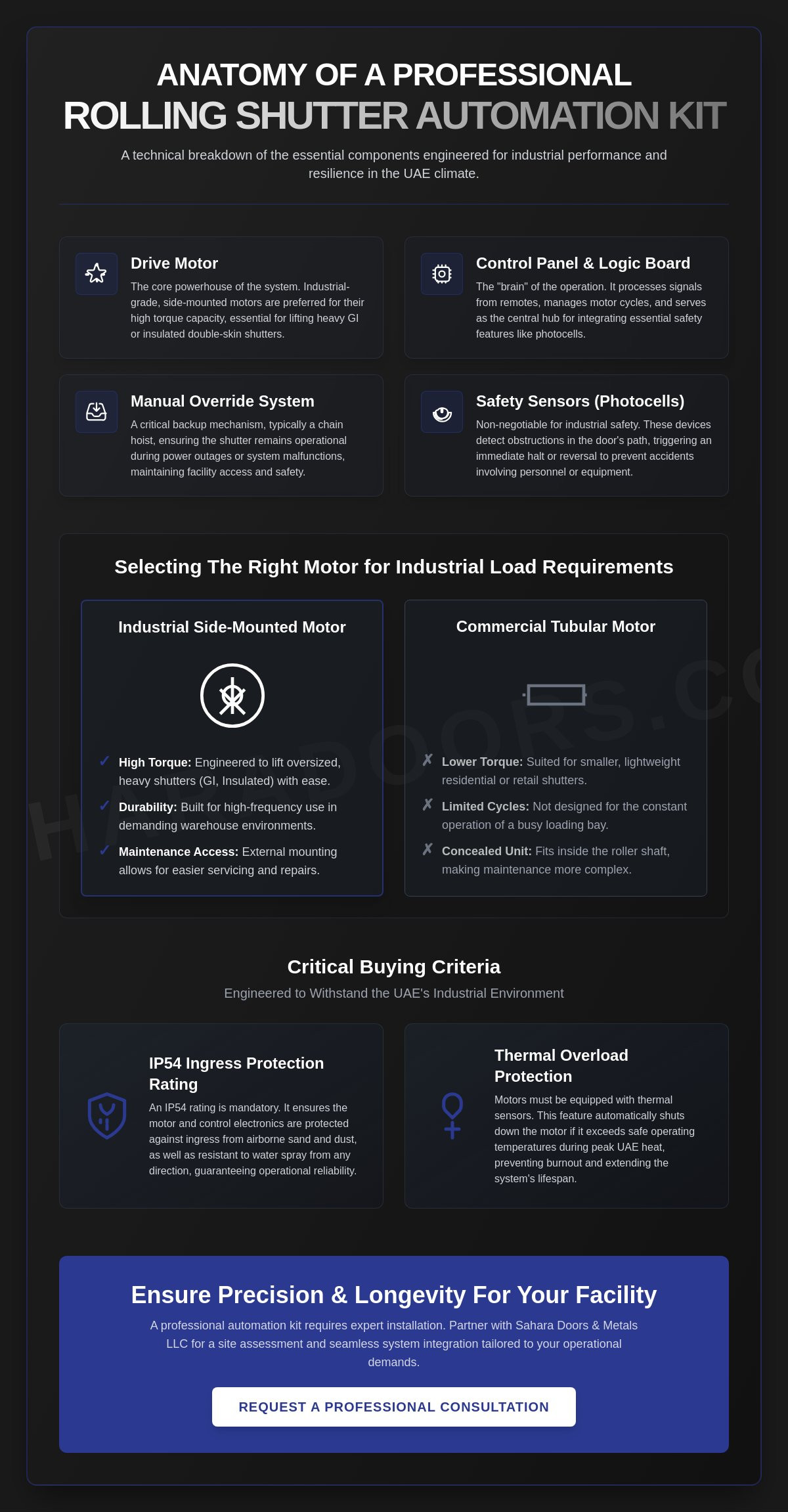
A professional rolling shutter automation kit is far more than just a motor; it is a synchronized assembly of mechanical and electronic components designed to withstand the rigors of high-cycle industrial use. At the heart of this system is the drive motor, which acts as the core powerhouse. For heavy-duty industrial applications, side-mounted motors are preferred due to their high torque capacity and ease of maintenance. These differ from the tubular motors found in smaller residential units, providing the raw strength needed to lift oversized GI or insulated double-skin shutters. Every component must work in harmony to ensure the system doesn’t fail under the mechanical stress of daily warehouse operations.
The “brain” of the entire operation is the control panel and logic board. This unit processes signals from remote receivers and manages the precise timing of the motor’s cycles. It also acts as the interface for safety sensors and photocells. These sensors are non-negotiable for industrial safety; they detect obstructions in the door’s path and trigger an immediate halt to prevent accidental closure on personnel or equipment. Adhering to rigorous safety standards is vital, and facility managers often consult UK Health and Safety Executive guidance to understand the essential requirements for powered industrial doors. Without these integrated safety features, an automated system becomes a significant liability in a busy workspace.
Fail-safe mechanisms are equally critical. Every professional kit includes a manual override system, typically a high-grade chain or crank, which allows for operation during power outages or electrical faults. This ensures your facility remains accessible and secure even when the grid fails. Managing who has access is handled through secure remote receivers and transmitters, which utilize rolling code technology to prevent unauthorized frequency duplication.
Mechanical Components and Hardware
The physical integration of the motor requires precision-engineered hardware. This includes adaptors and crowns tailored to specific axle diameters, commonly 60mm, 76mm, or 101mm, ensuring a snug fit that prevents slippage. Heavy-duty mounting brackets are essential to support industrial weight loads, while internal limit switches allow for the exact calibration of open and close positions. These mechanical details prevent the curtain from over-traveling, which would otherwise lead to slat damage or motor burnout.
Electronic Access and Control Systems
Modern industrial units utilize a variety of access points. Interior operation is usually handled by heavy-duty push-button stations, while exterior security is maintained through key-switch options. Many contemporary systems now support integration with smartphone apps and cloud-based management platforms, allowing for real-time status updates. If you’re looking to upgrade your facility’s entryways, exploring specialized motorized rolling shutter solutions can provide the technical edge your business needs for long-term reliability.
Selecting the Right Motor Type for Industrial Load Requirements
Choosing the correct rolling shutter automation kit requires a precise understanding of the mechanical load and the intended duty cycle of your entryway. You can’t simply pick a motor based on brand alone; it’s an engineering decision where torque, measured in Newton-meters (Nm), must be matched to the total weight of the shutter curtain. Under-specifying a motor leads to premature capacitor failure and burnt-out windings, while over-specifying can cause unnecessary stress on the mounting brackets and drive chain. For heavy-duty GI shutters, the calculation must account for the curtain’s weight, the friction within the side guides, and the diameter of the barrel.
There are three primary motor configurations used in the UAE market. Tubular motors are compact and fit directly inside the axle, making them the preferred choice for residential garage doors or lightweight aluminium shutters. Central or box motors are often used for retrofitting existing manual spring-loaded shutters, as they sit in the middle of the shaft. However, for industrial environments, side-mounted motors are the gold standard. These powerful units are mounted externally to the shutter barrel, utilizing a heavy-duty drive chain to move high-traffic GI doors that often exceed 500kg in weight.
Tubular vs. Side Motors: A Comparative Analysis
When your shutter curtain weighs more than 500kg, a side-mounted motor is mandatory for operational safety. Unlike tubular motors, which are prone to overheating if cycled too frequently, side motors are designed for high duty cycles. They can handle multiple operations per hour without triggering thermal cut-outs, which is essential for busy loading bays. Maintenance is also more efficient with side motors; because they are mounted externally, you can inspect or service the motor without dismantling the entire shutter barrel. Adhering to industrial door safety standards ensures that regardless of the motor type, the installation remains compliant with global risk assessment protocols.
Power Requirements and Phase Selection
Your facility’s electrical infrastructure determines which rolling shutter automation kit is viable. Single-phase (230V) motors are suitable for standard commercial units with moderate usage. For heavy industrial applications or high-speed doors that require rapid acceleration, three-phase (415V) power is necessary. Three-phase motors provide the consistent torque required to lift heavy double-skin insulated shutters without the vibration associated with smaller units. This level of power is a cornerstone of The Comprehensive Guide to High Speed Doors in the UAE (2026), where operational speed and motor reliability are critical for maintaining warehouse logistics.
Critical Buying Criteria for the UAE Industrial Environment
Operating industrial machinery in the Middle East presents challenges that standard European or North American specifications often fail to address. When selecting a rolling shutter automation kit, you must prioritize components engineered for high ambient temperatures and pervasive fine dust. A motor that works perfectly in a temperate climate will often fail within months in a Dubai warehouse if it lacks the proper thermal and ingress protection. Reliability in these conditions isn’t just about power; it’s about the resilience of the internal electronics and mechanical seals. Facilities that also rely on fixed steel entry points should review the latest compliance requirements covered in the 2026 guide to industrial security and compliance for commercial steel doors UAE to ensure every access point in their facility meets current regulatory standards.
- Thermal Protection Sensors: These are vital for preventing motor burnout. In peak summer, internal motor temperatures can skyrocket; sensors ensure the unit cuts power before the copper windings sustain permanent damage.
- IP Ratings (Ingress Protection): We recommend an IP54 rating or higher for UAE industrial sites. This ensures the motor housing and control electronics are sealed against the fine sand and moisture common in coastal zones.
- Duty Cycle Ratings: Industrial kits should carry an S1 rating for continuous use or a high-percentage S3 rating. This defines how long the motor can operate before it requires a rest period, which is critical for high-traffic loading bays.
- Material Quality: Insist on precision-engineered steel gears and 100% copper windings. Cheaper alternatives often use plastic components or aluminum wiring, which expand and fail under heavy thermal load.
Environmental Endurance and Longevity
The longevity of your automation system depends on its resistance to the local environment. High-temperature lubricants are essential; standard greases can thin or evaporate in the heat, leading to metal-on-metal friction within the gearbox. For facilities located near the coast, control boxes must feature corrosion-resistant coatings to prevent salt-air degradation of the circuitry. Additionally, sealed bearings are a critical requirement to prevent grit from entering the mechanical assembly, which is a leading cause of mechanical failure in the region’s sandy zones. The same environmental threats that affect your automation hardware also impact your building’s other entry systems, making aluminium door maintenance in Dubai an equally important consideration for comprehensive facility upkeep.
Safety Standards and Regulatory Compliance
Safety is a non-negotiable aspect of industrial door automation. Every heavy-duty GI shutter should be equipped with an anti-fall safety brake, commonly known as a “parachute.” This mechanical fail-safe prevents the curtain from crashing down in the event of a motor or chain failure. Your rolling shutter automation kit must also include emergency stop functionality and adjustable obstacle detection sensitivity to protect personnel and assets. Compliance with international safety certifications ensures that your installation meets the rigorous standards expected in modern commercial developments. If you require hardware that meets these strict industrial specifications, you can request a technical consultation for motorized rolling shutter systems from our engineering team.
Precision Installation: Partnering with Sahara Doors & Metals LLC
A high-performance rolling shutter automation kit is only as reliable as the structure it powers. At Sahara Doors & Metals LLC, we recognize that industrial automation isn’t a bolt-on accessory; it’s an integrated mechanical system that requires precision engineering from the start. Our approach begins with custom fabrication. Whether you’re installing heavy-duty GI rolling shutters or specialized polycarbonate systems, we ensure the drive motor, axle, and mounting brackets are manufactured to work in perfect synchronization. This bespoke alignment prevents the mechanical friction that typically causes premature motor failure in generic off-the-shelf setups.
Professional site assessment is the cornerstone of our installation process. Before any automation is deployed, our technical team evaluates the structural integrity of your facility’s openings. We verify that the lintels and support columns can handle the dynamic loads of a motorized system. This thorough evaluation ensures that your rolling shutter automation kit operates within its intended safety margins, providing a sturdy and dependable entry solution that protects your assets and your personnel. We don’t just sell hardware; we provide a complete industrial entryway strategy designed for long-term mechanical excellence.
The Sahara Advantage in Metalwork and Automation
Our reputation is built on decades of experience across the UAE’s construction and manufacturing sectors. We specialize in a wide range of solutions, including insulated double-skin shutters and high-speed doors, allowing us to manage complex industrial requirements that standard providers can’t handle. The in-house engineering team at Sahara Doors & Metals LLC understands the nuances of metallurgy and mechanical stress. This expertise allows us to provide direct, business-oriented support to contractors and developers, ensuring every project meets the highest standards of durability and craftsmanship. We prioritize transparency and technical precision in every partnership, positioning us as a seasoned professional in the regional market.
Next Steps for Your Automation Project
Upgrading your facility’s efficiency requires a partner who values quality as much as you do. We provide comprehensive technical support that extends from the initial specification phase through to long-term maintenance planning. This ensures your investment continues to deliver a high ROI through reduced downtime and enhanced security. You can explore our extensive portfolio of industrial and residential shutter projects to see our craftsmanship in action across various sectors. If you’re ready to enhance your facility’s operational speed and security, we invite you to reach out for a detailed technical quote tailored to your specific load requirements.
Contact Sahara Doors for a Professional Automation Consultation to discuss your custom fabrication needs and secure your facility with our specialized door systems.
Securing Your Industrial Future with Precision Automation
Selecting a rolling shutter automation kit isn’t just about adding convenience; it’s a strategic commitment to facility safety and operational continuity. We’ve explored how precise torque calculation prevents motor burnout and why environmental ratings like IP54 are non-negotiable for the UAE’s unique climate. You now have the technical framework to distinguish between generic hardware and a precision-engineered system that offers a strong return on investment. A sturdy, dependable entryway is the first line of defense for your warehouse logistics and asset protection.
As a specialized UAE manufacturer since 2010, Sahara Doors & Metals LLC brings deep manufacturing expertise to every project. We prioritize high-grade materials engineered for extreme durability and provide expert installation for GI and industrial shutters. Our team ensures that your automation system is custom-fabricated to meet the rigorous demands of your specific site. Don’t settle for undersized components that compromise your security. Take the next step toward a more efficient facility today.
Request a Quote for Rolling Shutter Automation Kits and partner with a seasoned expert who understands the technical requirements of the UAE industrial sector. We’re ready to help you build a more secure and efficient workspace.
Frequently Asked Questions
Can any manual rolling shutter be converted with an automation kit?
Most manual GI or aluminium shutters can be retrofitted with a rolling shutter automation kit, provided the existing barrel and tracks are in good mechanical condition. A professional site assessment is necessary to ensure the spring tension is balanced and the structure can support the motor’s weight. If the hardware is severely corroded or misaligned, we recommend replacing the entire system to ensure operational safety and motor longevity.
How do I calculate the motor power (Nm) needed for my heavy-duty GI shutter?
Calculating the required Newton-metres (Nm) involves multiplying the total curtain weight by the radius of the shutter barrel while accounting for a safety friction factor. For a standard industrial GI shutter, you’ll typically need a motor that offers at least 20% more lifting capacity than the static weight of the curtain. This overhead prevents the motor from straining during the initial lift phase when mechanical resistance is at its highest point.
What happens to the automated shutter during a power failure?
Automated shutters are equipped with a manual override system, such as a hand-chain or crank, to ensure access during power outages. These mechanical fail-safes allow you to lift or lower the curtain manually without damaging the gearbox. For high-security facilities, we also offer uninterruptible power supply (UPS) backups that can provide several emergency cycles, ensuring your warehouse remains secure even when the local grid fails.
How often does an industrial rolling shutter automation kit require maintenance?
We recommend a professional service every six months for industrial systems, with quarterly inspections suggested for facilities located in high-sand zones. Regular maintenance includes lubricating the drive chain, checking the limit switch accuracy, and testing the safety sensors. Consistent care prevents fine dust from accumulating in the bearings, which is a primary cause of mechanical failure in the harsh UAE environment. Applying the same diligence to your facility’s other entry points is equally important, and our professional aluminium door maintenance guide for Dubai properties outlines the exact steps to keep sliding tracks and hardware performing optimally year-round.
Are wireless remote controls secure for commercial warehouses?
Modern wireless systems are highly secure because they utilize rolling code technology to prevent unauthorized frequency duplication. Each time you use the transmitter, the system generates a new encrypted code that can’t be intercepted or replayed by intruders. For multi-site industrial operations, these controllers can be integrated with access management software to track which personnel are operating specific entryways at any given time.
What is the difference between a tubular motor and a side-drive motor?
The primary difference lies in the mounting position and weight capacity. Tubular motors are installed inside the shutter axle and are best suited for lighter applications like residential garage doors or aluminium shutters. Side-drive motors are mounted externally to the barrel and use a heavy-duty drive chain, making them the standard choice for heavy industrial GI shutters that require high torque and frequent operational cycles.
Do automation kits come with safety sensors as standard?
While some basic kits are sold as standalone units, professional industrial kits should always include safety photocells and obstacle detection sensors. These components are essential for preventing the shutter from closing on vehicles or personnel. At Sahara Doors & Metals LLC, we treat safety sensors as a mandatory part of any rolling shutter automation kit installation to ensure full compliance with international industrial safety standards.
How long does the installation of a rolling shutter automation kit take?
A standard retrofit for an industrial automation system typically takes between four to eight hours to complete. This timeframe includes the mechanical mounting of the motor, the electrical wiring of the control panel, and the precise calibration of the limit switches. More complex installations involving integration with building management systems or structural modifications to the lintels may require additional time for thorough testing and commissioning.
1 Comment