Article by
Sahara Doors & Metals LLC
Leaders in rolling shutters
The UAE sun is more than just a weather condition; it’s a relentless structural stress test that can degrade inferior materials in a single summer. You’ve likely seen the results of poor planning: sagging fabrics, rusted supports, and structures that fail during the first high-wind event of the season. It’s frustrating to invest in protection only to watch it crumble under the region’s intense UV radiation and coastal humidity.
We believe that a shade structure should be a long-term asset, not a recurring maintenance liability. This guide provides the technical blueprint for selecting high-durability carpark shades DUBAI/UAE/AbuDhabi property owners can rely on for decades of performance. We’ll examine the superior resilience of High-Density Polyethylene (HDPE) fabrics, the engineering advantages of precision-engineered Galvanized Iron (GI) frames, and the mandatory 2026 RTA permit regulations to ensure your project meets every safety and aesthetic standard across the Emirates.
Key Takeaways
- Identify why high-performance solar mitigation is essential for protecting vehicle electronics and paintwork from the UAE’s extreme UV radiation.
- Compare technical fabric specifications, including HDPE and PTFE, to select the most resilient materials for carpark shades DUBAI/UAE/AbuDhabi installations.
- Evaluate architectural design configurations, such as cantilever and conical structures, to maximize space and ensure compliance with regional wind load standards.
- Master preventative maintenance protocols and cleaning schedules to extend the lifespan of your fabric and structural metal supports.
- Understand the engineering advantages of specialized GI (Galvanized Iron) fabrication for long-term corrosion resistance in coastal environments.
The Necessity of Professional Carpark Shades in the UAE
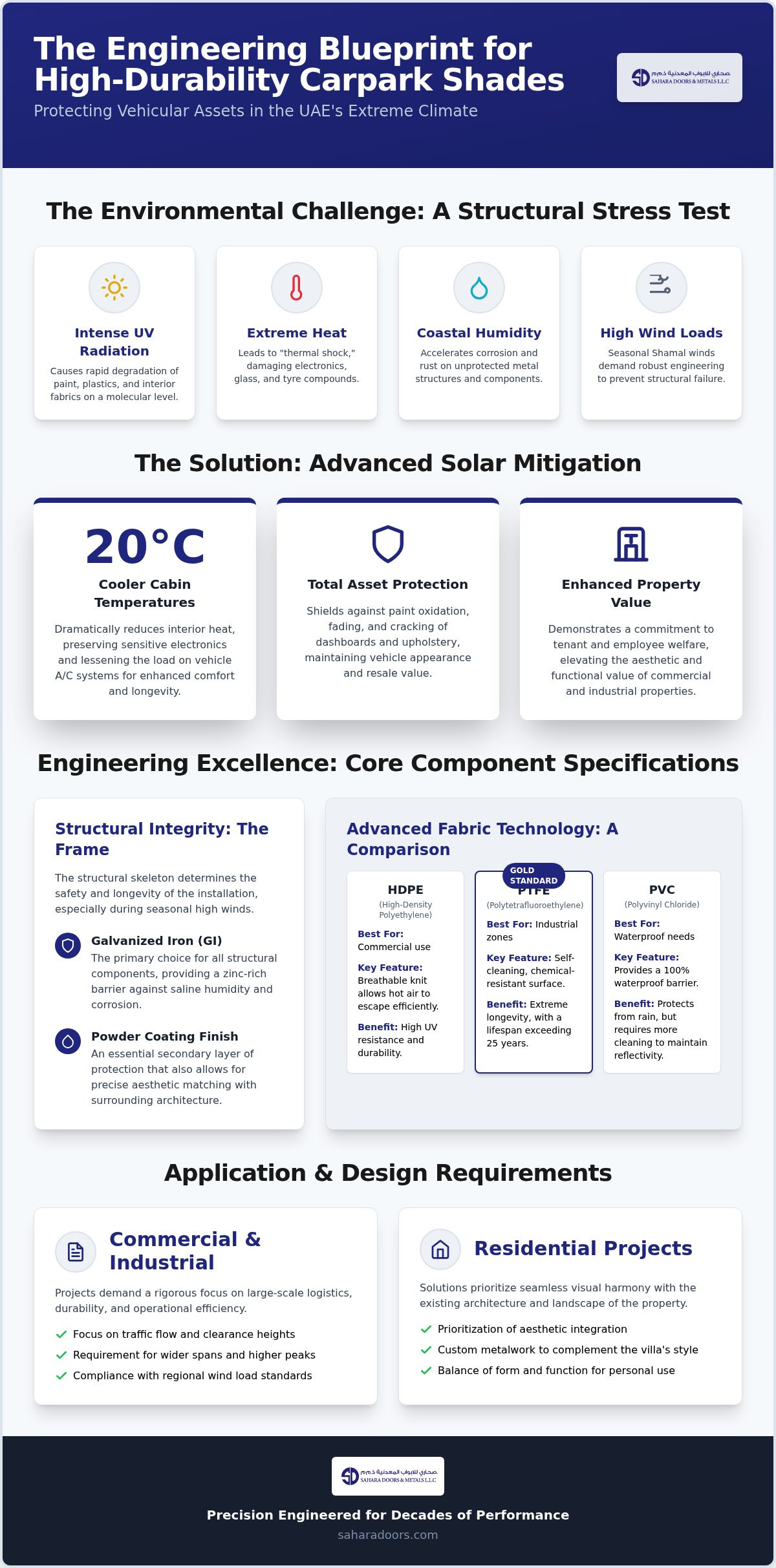
In the Gulf region, solar radiation is a constant threat to asset longevity. Professional carpark shades DUBAI/UAE/AbuDhabi providers view these structures as essential architectural tools for solar mitigation rather than simple fabric covers. These systems are engineered to intercept high-intensity radiation before it reaches the vehicle’s surface. By doing so, they protect against extreme UV indices that frequently peak during the summer months, which otherwise lead to rapid material failure. Properly installed shades can lower internal cabin temperatures by up to 20°C compared to vehicles left in direct exposure. This reduction isn’t just about driver comfort; it’s about preserving sensitive electronic components and reducing the load on climate control systems.
Beyond the immediate cooling effect, these structures offer significant economic advantages. They act as a shield for the vehicle’s exterior, preventing the oxidation of paintwork and the degradation of plastic trim. For commercial property developers and industrial clients, investing in high-quality shading increases property value and demonstrates a commitment to tenant and employee welfare. The technology behind these installations has evolved significantly. The modern Shade sail concept now utilizes advanced tensioning systems and high-tensile fabrics to provide stable, long-term protection against the elements.
Combating UV Degradation and Heat
Commercial vs. Residential Shading Requirements
Scaling shading solutions requires a deep understanding of site-specific logistics. Residential projects often prioritize aesthetic integration with the villa’s architecture, whereas commercial applications demand rigorous focus on traffic flow and clearance heights. Industrial parking lots must accommodate large-scale logistics vehicles, requiring higher structural peaks and wider spans between support pillars. We utilize precision engineering and custom metalwork to meet these diverse needs. Whether we are fabricating GI rolling shutters for secure entries or erecting massive cantilever shades, our goal is to provide a dependable, high-end industrial solution that stands up to the harsh UAE environment.
Engineering Excellence: Material and Fabric Specifications
Achieving a decade of service in the UAE requires more than just a visual match; it demands a synergy between high-performance textiles and industrial-grade metal supports. While many suppliers focus exclusively on the fabric, the structural skeleton determines the safety of the installation during seasonal Shamal winds. We prioritize Galvanised Iron (GI) for all structural components because it provides the necessary zinc-rich barrier against the saline humidity found in coastal regions. The finishing of these structures is equally critical. Powder coating over a GI base adds a secondary layer of protection while allowing the carpark shades DUBAI/UAE/AbuDhabi to match the surrounding architectural aesthetic.
When selecting textiles for carpark shades DUBAI/UAE/AbuDhabi projects, the choice usually falls between HDPE and PVC. High-Density Polyethylene (HDPE) is the preferred choice for most commercial applications due to its knitted, breathable structure that allows hot air to escape. This material is highly resilient, though understanding the effects of UV radiation and temperature on HDPE is vital for predicting its long-term tensile strength. For industrial zones where chemical exposure is a concern, PTFE (Polytetrafluoroethylene) remains the gold standard, offering a self-cleaning surface and a lifespan exceeding 25 years. PVC fabrics are often selected for projects requiring a 100% waterproof barrier, though they require more frequent cleaning to maintain their reflective properties.
Advanced Fabric Technology
Technical excellence in fabric selection is measured by three primary metrics: UV block ratings, fire retardancy, and GSM. We recommend fabrics with a UV block of 95% to 98% to ensure maximum protection for vehicle surfaces. All materials must comply with UAE Civil Defence fire retardant standards to ensure safety in high-density urban areas. Additionally, the density of the fabric, measured in Grams per Square Metre (GSM), should typically range between 320 and 340 for an optimal balance between weight and durability. Our expertise in GI metal fabrication ensures that every structural element meets these rigorous industrial standards.
GI Metalwork and Precision Engineering
The fabrication of support structures involves precision engineering to ensure every beam can withstand local wind load requirements. Industrial-grade GI support beams undergo a rigorous fabrication process where precision welding creates seamless joints, preventing internal corrosion. We tailor the gauge of the steel to the specific height and span of the project. This custom metalwork ensures that even large-span cantilever designs remain stable without the need for excessive pillars, maintaining clear traffic flow for commercial clients.
Structural Design Options for National UAE Projects
The selection of a structural configuration for carpark shades DUBAI/UAE/AbuDhabi projects is a strategic decision that balances spatial efficiency with architectural intent. For commercial developers and architects, the layout must facilitate high-volume traffic while maintaining structural stability. We utilize precision engineering to ensure that every design, whether a simple pyramid or a complex tensile array, adheres to local municipality standards. While aesthetic appeal is important, the engineering focus remains on wind load resistance and the optimization of the available footprint.
The Advantages of Cantilever Systems
Cantilever designs represent the pinnacle of parking efficiency in modern urban developments. By utilizing a single-post support system located at the rear of the parking bay, we eliminate the front pillars that often lead to minor vehicle collisions. This unobstructed movement is essential for commercial shopping centres and office parks where high turnover requires a safe and accessible environment. Depending on the soil stability and the specific wind load of the site, we offer both single-post and double-post configurations. Our custom metalwork ensures that these cantilever arms possess the necessary tensile strength to support large spans of HDPE fabric without sagging over time.
Large-Span Tensile Solutions
For massive infrastructure projects such as stadiums, airports, and commercial hubs, large-span tensile shades are the industry standard. These systems rely on complex flexible membranes and high-tension cables to cover vast open spaces without the need for frequent internal supports. Engineering these structures requires a deep understanding of facility master plans and precision fabrication of heavy-duty GI frameworks. We act as a technical partner for architects, providing the specialized metalwork and membrane engineering required to create iconic, functional shading that defines the modern UAE landscape. Our national installation teams ensure these large-scale systems are tensioned to exact specifications, guaranteeing long-term structural integrity.
Durability and Maintenance: Protecting Your Investment
High-performance carpark shades DUBAI/UAE/AbuDhabi installations represent a significant capital investment that requires a systematic approach to maintenance. In the UAE, structural integrity isn’t a static feature; it’s a condition maintained through regular technical oversight and precision care. While we engineer our GI frameworks for maximum resilience, the environmental load from sandstorms and humidity necessitates a preventative strategy to avoid premature material fatigue. A well-maintained structure doesn’t just last longer; it remains compliant with the evolving safety standards enforced by regional municipal authorities.
Weatherproofing and Wind Resistance
Engineering for the UAE requires accounting for the seasonal Shamal winds, which can exert immense pressure on tensile membranes. We utilize advanced form-finding software to predict structural behavior under various load conditions, ensuring the fabric remains stable during high-velocity gusts. This precision engineering extends to the ground level, where foundation depth and concrete grade must strictly adhere to national safety codes. Our structures are designed to dissipate wind energy efficiently, preventing the “sail effect” that can destabilize inferior installations. Ensuring that your structure is anchored according to these rigorous technical requirements is the first step in long-term asset protection.
Long-Term Fabric Care
The accumulation of desert sand is a primary cause of fabric sagging and structural weight stress. Over time, the weight of trapped debris can stretch the polymer chains of HDPE, leading to permanent deformation and reduced aerodynamic efficiency. We recommend a strict cleaning protocol that utilizes low-pressure, chemical-free methods to preserve the UV-resistant topcoat. Harsh detergents can strip away the protective finish, leaving the material vulnerable to rapid solar degradation. Periodic re-tensioning of the cables is also essential. This process restores the structure’s original profile, ensuring that wind flows over the membrane rather than pulling against it.
Structural inspections should focus on the integrity of the GI coating and the stability of tension bolts. Even the highest quality Galvanised Iron can show signs of stress or surface abrasion in high-salinity coastal environments. Identifying these minor issues during a routine check prevents the need for costly metalwork repairs later. If you notice signs of fabric fatigue, such as thinning sections or loss of tension that cannot be corrected, it’s often more cost-effective to replace the membrane while retaining the existing metal framework. This “recover” process restores the shade’s performance without the expense of a full structural fabrication.
Professional oversight ensures your shading system remains a dependable asset through every season. Contact our technical team today to schedule a structural integrity audit for your facility.
Custom Carpark Shade Solutions by Sahara Doors & Metals
Selecting the right partner for carpark shades DUBAI/UAE/AbuDhabi projects requires a provider that understands the intersection of precision engineering and regional climate demands. At Sahara Doors & Metals LLC, we don’t just supply fabric; we engineer complete structural solutions. Our expertise spans from high-security GI rolling shutters to complex architectural shading systems. This versatility allows us to act as a single-source technical partner for developers who require integrated facility protection and solar mitigation.
Our project workflow is designed for transparency and industrial precision:
- Technical Consultation: We assess site-specific variables including wind exposure, soil stability, and local municipality permit requirements.
- Precision Fabrication: All structural components are manufactured in our specialized facility to ensure quality control over every weld and coating.
- Integrated Solutions: We coordinate the installation of shades with other facility systems, such as high speed doors, for a seamless operational environment.
Industrial-Grade Metal Fabrication
We maintain full control over the manufacturing cycle by handling all metalwork in-house. This allows our team to utilize high-grade Galvanised Iron (GI) for every structural element, providing the durability needed to resist the UAE’s saline humidity and extreme heat. Unlike providers who rely on standard steel, our GI structures offer superior long-term corrosion resistance. You can customize the structural gauge, finish, and color to match your architectural requirements while maintaining the technical excellence required for large-scale industrial projects. Our commitment to craftsmanship ensures that every support pillar and cantilever arm is a testament to dependable engineering.
National Installation Expertise
Our operations extend across the entire UAE, providing reliable logistics and on-site support for projects in Dubai, Abu Dhabi, and the Northern Emirates. Installation of tensile membranes requires specialized knowledge of high-tension safety protocols to prevent material damage and ensure structural stability under load. Our trained teams manage the full deployment, from foundation casting to final fabric tensioning. For commercial and industrial clients, we provide post-installation support and maintenance services to ensure the structure continues to perform at peak efficiency for decades. This national reach ensures that your facility receives the same high standard of precision engineering regardless of its location.
Whether you’re planning a large-scale industrial parking lot or a specialized residential project, our team provides the engineering expertise your project deserves. Request a technical consultation today to explore our custom metalwork and shading options tailored to your specific site requirements.
Securing Your Assets with Engineering Precision
Investing in high-durability carpark shades DUBAI/UAE/AbuDhabi property owners trust requires a focus on technical specifications over surface-level aesthetics. The long-term performance of these structures depends on the synergy between high-tensile HDPE fabrics and precision-engineered GI frameworks. By prioritizing industrial-grade materials and adhering to UAE wind load standards, you ensure that your shading system remains a stable, low-maintenance asset for decades. The right structural choice mitigates UV degradation and protects vehicle integrity in the region’s harshest conditions.
At Sahara Doors & Metals LLC, we leverage our expertise in custom GI fabrication and precision engineering to deliver shading solutions that meet the highest technical requirements. Our national installation coverage ensures that your project is handled by professionals trained in high-tension safety protocols. It’s time to move from planning to execution with a partner committed to structural excellence. Request a Technical Quote for Carpark Shades today to secure your space with a dependable, industrial-grade solution. We look forward to helping you build a safer and more efficient environment.
Frequently Asked Questions
How long do car parking shades typically last in the UAE?
High-performance shading systems typically offer a service life of 10 to 15 years in the UAE. This longevity is achieved by combining UV-stabilized HDPE fabrics with industrial-grade GI metalwork. While the fabric membrane may require replacement after a decade, the galvanized iron framework is engineered for much longer structural integrity. Regular maintenance and periodic re-tensioning of the cables ensure the structure remains a dependable asset through every season.
What is the best fabric for carpark shades: HDPE or PVC?
HDPE is generally considered the best fabric for solar mitigation because its breathable knitted structure allows trapped heat to escape. This airflow significantly reduces the temperature in the parking bay compared to solid materials. PVC is only recommended when a 100% waterproof barrier is essential. For most carpark shades DUBAI/UAE/AbuDhabi projects, HDPE provides superior UV protection and durability against the region’s intense solar radiation.
Do I need a permit to install a car parking shade in the UAE?
Obtaining a permit is mandatory for all shading installations across the Emirates. In Dubai, the RTA implemented a formal digital permit system in early 2026 for residential neighborhoods. Property owners must work with an approved contractor to submit applications through the “Dubai Drive” app or a unified portal. Commercial and industrial projects require separate approvals from the relevant municipality to ensure compliance with urban planning and safety standards.
Can carpark shades withstand high-speed Shamal winds?
Precision-engineered structures are built to withstand high-speed Shamal winds reaching up to 140km/h. We use advanced form-finding software to ensure that the GI framework and fabric tensioning can handle high-pressure wind loads. The structural stability depends on specific foundation depths and the use of industrial-grade materials. Professional installation prevents the “sail effect” that often causes inferior structures to fail during seasonal wind events.
What are the benefits of a cantilever design over a traditional four-post tent?
The primary benefit of a cantilever design is the elimination of front support pillars, which maximizes the parking footprint. This unobstructed layout reduces the risk of vehicle-related accidents and facilitates easier traffic flow in commercial settings. It’s a more efficient use of space compared to traditional four-post tents. Cantilever systems rely on heavy-duty GI fabrication to provide the necessary tensile strength for large spans without losing structural integrity.
How often should I clean the fabric of my car parking shade?
You should clean your shade fabric every 6 to 12 months to prevent sand and debris accumulation. Desert dust adds significant weight stress that can lead to permanent fabric sagging and deformation. We recommend using low-pressure water and chemical-free cleaning methods to preserve the integrity of the UV-resistant topcoat. Harsh chemicals can strip away protective finishes, leaving the material vulnerable to rapid degradation from the sun.
Are these shades fire-resistant according to UAE safety standards?
Yes, all materials used in the construction of these shades must meet UAE Civil Defense fire-retardant standards. Compliance with the UAE Fire and Life Safety Code of Practice is a mandatory requirement for both residential and commercial installations. This ensures that the fabrics are treated to resist ignition and prevent the rapid spread of fire. We prioritize these safety standards in every project to protect both property and personnel.
Can I install solar panels on top of a car parking shade structure?
Standard tensile fabric shades cannot support the dead load of solar panels without specialized structural reinforcement. Most carpark shades DUBAI/UAE/AbuDhabi structures are engineered specifically for wind and fabric tension rather than heavy rigid equipment. If you intend to install solar technology, the GI framework must be custom-designed with higher-gauge steel to handle the additional weight. Always consult with a technical expert before modifying a tensile structure.