The most demanding shade project doesn’t automatically need the material with the strongest reputation. Choosing between PVC and PTFE depends on how the shade will be used, the finish you want, and the upkeep the site can accommodate. The pvc vs ptfe tensile fabric comparison starts with construction: PVC-coated polyester is generally more flexible, while PTFE-coated fibreglass offers greater dimensional stability.
Material names alone don’t show whether a fabric suits your structure, site conditions, or design priorities. This guide compares construction, appearance, maintenance, and project fit to help you assess the options against your requirements. Start by defining the site conditions and shade design, then compare the relevant product documentation. Sahara Doors & Metals LLC provides customized shading solutions, including car park shades with HDPE/PVC fabric options, supported by site surveys and installation.
Key Takeaways
- The pvc vs ptfe tensile fabric choice depends on the shade’s purpose, site exposure, desired appearance, and maintenance needs, not just the material name.
- Compare technical documentation for the specific fabric and shade design. Material labels alone don’t define the complete system’s performance.
- Set your project requirements first, including how the shade will be used, the look you want, and the upkeep the site can accommodate.
- Sahara Doors & Metals LLC offers car park shades using HDPE/PVC fabrics, with options including High Cantilever, Low Cantilever, Umbrella, Pyramid, and GRP/Fibre Glass.
- A site survey and customized planning can help connect your requirements with a suitable car park shade solution.
PVC vs PTFE Tensile Fabric: What the Comparison Means for Your Project
A tensile shade uses a membrane pulled taut across a designed structure to create a covered space. Its shape and stability depend on more than the fabric alone: the supporting frame, connection points, membrane layout, and installation all form part of the system. The Tensile structure overview provides background on how tension is used in this type of design.
That distinction matters when comparing materials. PVC and PTFE describe fabric categories, not complete shade-system specifications. A material name by itself won’t tell you how a canopy will look or perform once designed for a real site. Compare documented fabric properties with the requirements of the planned shade.
What do PVC and PTFE mean in tensile fabric?
PVC tensile fabric is commonly described as a polyester base fabric coated with polyvinyl chloride (PVC). PTFE fabric is commonly described as a fibreglass base coated with polytetrafluoroethylene (PTFE). In plain language, the base textile provides the underlying fabric structure, while a layer of another material is applied to its surface. Construction details can vary by product, so check the technical documentation for the specific fabric.
Why the project matters as much as the fabric
Start with the shade’s purpose, then consider site exposure, the appearance you want, and practical cleaning and maintenance needs. A car park canopy, for example, has a different use context from a feature shade for an outdoor gathering area. Neither example makes one fabric universally better. The project brief determines which documented properties deserve the closest attention.
Assess the fabric and structure as separate parts of the specification. The membrane choice doesn’t, by itself, describe the support design or installation approach. Likewise, the structure’s geometry and supports don’t establish the exact properties of its fabric. Compare data for the specific product, then assess it alongside the design and site requirements.
A shade specification works best when the fabric’s documented properties match the site, intended use, appearance goals, and maintenance plan. Before settling on a material label, record the conditions the shade must address.
- Define what the covered space is for and how it will be used.
- Note site exposure and any access constraints that could affect upkeep.
- Describe the desired appearance, then compare it with product-specific documentation.
This article compares PVC and PTFE as material categories. Sahara Doors & Metals LLC’s car park shades use HDPE/PVC fabric options, with planning tailored to site requirements. Explore the car park shade options when moving from material comparison to a shade plan.
How PVC and PTFE Tensile Fabrics Differ in Construction and Performance
Material labels are a useful starting point, but they don’t provide a complete performance specification. PVC tensile fabrics commonly use a coated textile base, while PTFE tensile fabrics commonly use a coated fibreglass base. These are broad material-family descriptions, not guarantees about a particular product. The Architect’s Guide to Tensile Fabrics discusses how fabric choice relates to design and application. For a project decision, use the relevant manufacturer’s documentation for product-specific details.
Compare the properties that affect shade performance
Use the comparison below to identify what to investigate, not as a substitute for a technical datasheet. Exact results can differ with formulation, coating or finish, manufacturer, and specification. Verify product-level values rather than assuming them from the material name.
| Comparison point | PVC fabric | PTFE fabric |
|---|---|---|
| Typical construction | Commonly described as a textile base with a PVC coating. Confirm the base and finish in the product documentation. | Commonly described as a fibreglass base with a PTFE coating. Confirm the construction for the specified product. |
| Light transmission | Varies by fabric and finish. Verify the product’s documented light-transmission data. | Varies by product and specification. Verify documented light-transmission data rather than inferring it from PTFE. |
| Weather and UV exposure | Performance depends on the exact fabric and its finish. Check product-specific exposure data. | Performance depends on the specified product and system. Check product-specific exposure data. |
| Upkeep | Follow the manufacturer’s care and cleaning instructions for the selected fabric. | Follow the manufacturer’s care and cleaning instructions for the selected fabric. |
| Project fit | Assess against the shade’s intended use, design, and documented properties. | Assess against the shade’s intended use, design, and documented properties. |
This comparison also shows where the material name stops being useful. “PVC” or “PTFE” alone can’t tell you how much light a specific membrane transmits, how it responds to site exposure, or what cleaning approach its manufacturer recommends. Those details belong to the technical information for the particular fabric.
Separate material properties from project-level performance
The finished shade is a system. Tension design, detailing, support arrangements, and installation all affect how the membrane works within the structure. Read fabric data alongside the design requirements, rather than treating it as a complete assessment of the canopy.
A material name alone cannot establish whether a tensile fabric is suitable. Suitability depends on product-specific evidence and the demands of the complete shade design. Treat claims about fire behaviour, structural loads, or service life as project-specific verification points. Confirm that the documentation applies to the exact fabric and intended application, rather than relying on a general comparison or a figure from a different product.
For a car park shade project, Sahara Doors & Metals LLC offers HDPE/PVC fabric options and tailors shade planning to site requirements. Explore the car park shade options to connect the material discussion with practical project planning.
PVC vs PTFE Tensile Fabric: Which Criteria Matter Most?
Use project conditions to narrow the comparison before making a material decision. The matrix below identifies the questions to ask and product evidence to review. It doesn’t assume PVC or PTFE is automatically the right choice. If a project input or product value is missing, mark it for resolution rather than filling the gap with a general claim.
Match the material to the shade application
A car park, walkway, and outdoor gathering area may all need shade, but their uses and design goals differ. For a car park, clarify the area to cover and the appearance required. For a walkway, consider how people move through the space and what coverage the design needs. For a gathering area, define the desired look and how the space will be used. These planning scenarios don’t promise a particular fabric performance.
- Purpose: What activity will take place beneath the shade? Record the required coverage and how the space will be used.
- Exposure: Describe the site conditions the fabric will face. Compare them with exposure information for each specific product. Don’t infer UV or weather performance from the PVC or PTFE label alone.
- Appearance and light: Note the desired visual effect and daylight level. Use documented colour and light-transmission information for the actual fabric, or mark these values as missing.
- Cleaning: Identify the expected cleaning approach and frequency. Base the plan on the manufacturer’s care instructions for the chosen product.
- Maintenance access: Consider how the installed shade can be reached for inspection and upkeep. Include access conditions in planning rather than treating maintenance as a fabric-only issue.
For broader context on tensile structures and material choices, USA SHADE’s Guide to Tensile Structures is a useful resource. Product-specific documentation remains essential when comparing actual fabric properties.
Compare whole-project requirements, not fabric alone
Before deciding, consider the membrane alongside the structure design, site conditions, installation plan, and maintenance expectations. The required shape and support arrangement form part of the project scope, while the selected fabric’s documented characteristics inform how it fits that design. If key inputs are unknown, define them before finalizing the choice.
- Ready to compare: The shade purpose, site exposure, appearance goals, cleaning expectations, and maintenance access are understood.
- Needs further definition: One or more inputs are unclear, or product documentation doesn’t answer a relevant question.
This approach makes pvc vs ptfe tensile fabric a project decision, not a vote for one material in every situation. For car park planning, Sahara Doors & Metals LLC uses site surveys and customized solutions to shape requirements into a shade plan. Explore the car park shade options as a practical starting point.
How to Specify PVC or PTFE Tensile Fabric for a Shade Project
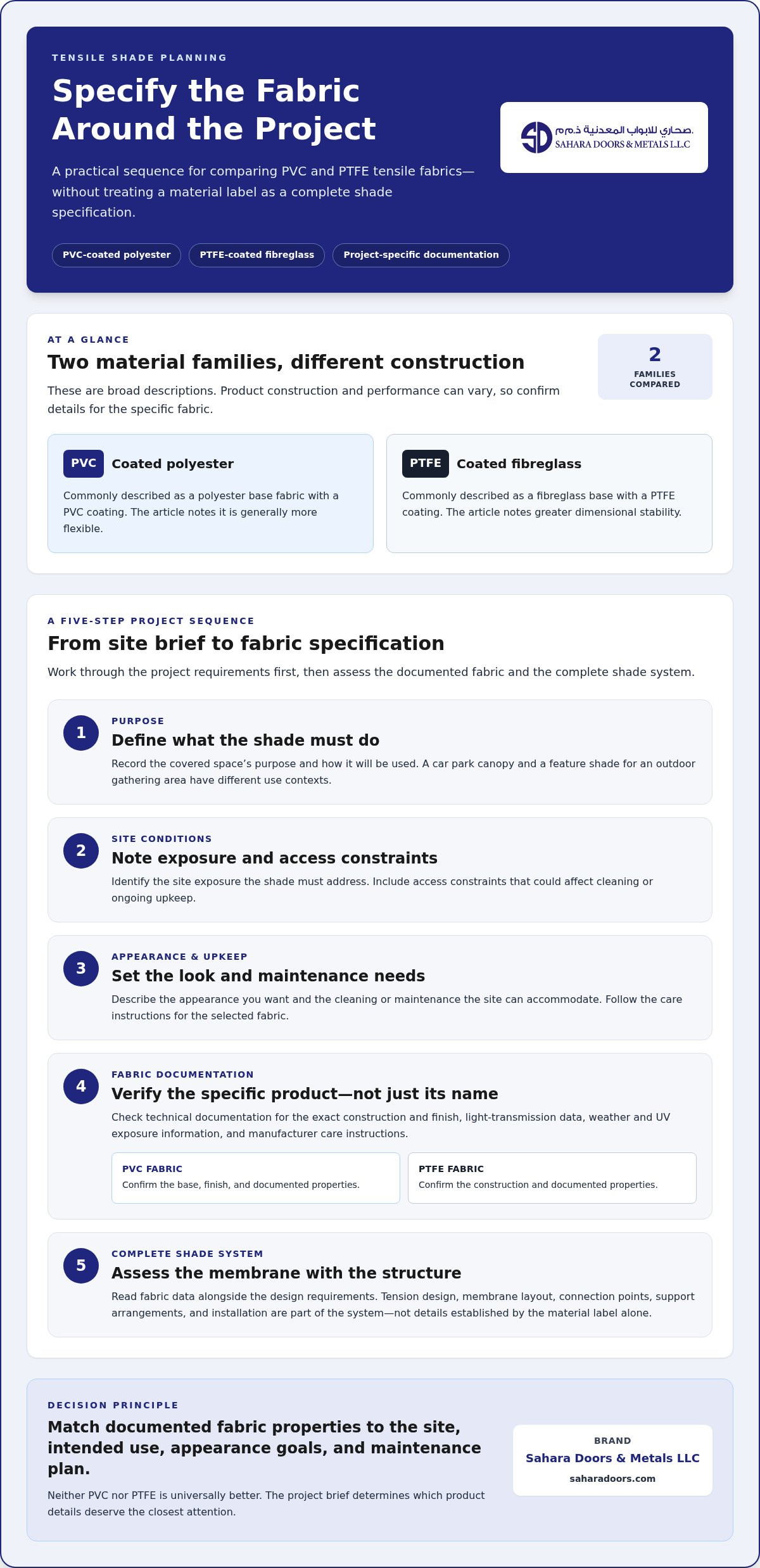
A clear project brief turns the pvc vs ptfe tensile fabric comparison into a practical specification. Start with how the space will be used, then record the site conditions and priorities the fabric must address. Keep unknowns visible so the material decision follows from project needs and product-specific documentation, not assumptions about a broad material category.
Prepare a clear tensile shade project brief
Describe the area to be covered, its intended use, and the visual outcome you want. Note relevant site exposure and practical access for inspection, cleaning, and maintenance. Separate essential requirements, such as the shade’s purpose, from preferences that can be refined during design. This helps the project team focus first on what the shade must do, then on how it should look.
- Define the use. Record what needs shade, who will use the space, and how the covered area functions.
- Describe the site. Document exposure conditions and any physical or access constraints that may influence the design.
- Set shade goals. State the coverage needs and desired appearance, including any preferences for light beneath the membrane.
- Plan for upkeep. Describe expected cleaning and maintenance practices, along with how the installed structure can be accessed.
- Separate must-haves from preferences. Mark non-negotiable project requirements clearly and leave adaptable design choices open for planning.
For car park shade projects, Sahara Doors & Metals LLC offers HDPE/PVC fabric options and tailors solutions to site requirements. Reviewing the car park shade options can help connect your brief with a relevant shade application.
Review fabric data before final selection
Once the brief is clear, compare the proposed fabric’s technical documentation against each requirement. Check that stated characteristics apply to the exact fabric and finish, not simply to PVC or PTFE as a category. If a document doesn’t address a priority, mark that information as outstanding instead of treating an assumption as a specification.
- Match each required property to product-specific documentation.
- Keep fabric information distinct from structure design and installation details.
- Record unanswered questions for resolution during project planning.
A complete specification considers the membrane alongside the supporting design, site conditions, installation, and maintenance plan. This gives you a sounder basis for comparing options and identifying where customization may be needed. Sahara Doors & Metals LLC provides site surveys and customized shading solutions to inform project planning.
Plan a customized car park shade around your site requirements.
Plan a Custom Car Park Shade with Sahara Doors & Metals
Once you’ve identified your site requirements, plan a shade system around the space and its intended use. Sahara Doors & Metals LLC supplies and installs Car Park Shades using HDPE/PVC fabrics. Use the PVC and PTFE comparison to understand the material categories and identify which product information matters to your project.
What Sahara’s car park shade offering includes
The available shade formats include High Cantilever, Low Cantilever, Umbrella, Pyramid, and GRP/Fibre Glass options. These provide starting points for discussing the area to be covered and the layout you have in mind. The right direction depends on the site conditions and shade goals, not the format name alone.
- High Cantilever and Low Cantilever options
- Umbrella and Pyramid options
- GRP/Fibre Glass options
HDPE/PVC fabric options give the material discussion a practical next step for car park planning. Explore Sahara’s Car Park Shades, and consider the site requirements alongside the shade format so the plan reflects the space, not just a material label.
Move from material comparison to project planning
A site survey helps inform a solution tailored to project conditions. Share the area that needs shade, how it will be used, your preferred appearance, and any practical maintenance or access considerations. These inputs help shape a customized solution and clarify requirements before installation.
Sahara’s project support includes site surveys, customized solutions, installation, and post-handover support. This connects early planning with the installed shade and handover. It also creates a clear path from defining requirements to choosing among the listed options, without relying on unsupported performance claims about a fabric category.
If you’re weighing PVC and PTFE, bring the site needs and relevant product documentation into the discussion. For a car park shade, align the selected HDPE/PVC option and shade format with the project brief. Clear requirements make it easier to plan a solution that fits the site and its intended use.
Discuss your project goals, site conditions, preferred appearance, and maintenance expectations as the basis for customized planning. Sahara Doors & Metals LLC can help turn those requirements into a car park shade solution.
Turn Your Shade Brief into a Confident Next Step
Keep the project brief, selected fabric documentation, and agreed maintenance expectations together as references for design coordination and future care. This helps everyone understand what the shade was planned to meet, rather than relying on memory or a material label. Keep open questions visible so details about the fabric, structure, and maintenance are resolved before they become assumptions in the final specification.
The pvc vs ptfe tensile fabric question is most useful when it leads to a practical next step: defining what your car park shade needs to accomplish and aligning the plan with those priorities. If your requirements are still taking shape, start with the intended use, site conditions, and the outcome you want from the covered space.
With a clear brief, your shade project can move forward with a solution planned around the site.
Frequently Asked Questions
Is PVC tensile fabric suitable for an outdoor shade structure?
It can be suitable if the specific fabric is designed for the intended outdoor use and its documented properties match the project. Before selecting it, review product information for the relevant exposure, finish, and care requirements. A shade exposed to direct weather, for example, needs an assessment based on actual site conditions, not simply the word “PVC.” The membrane must also be specified as part of the complete shade design.
Can PTFE tensile fabric be used for a car park shade?
PTFE fabric can be considered for a car park shade if the specified product and overall structure meet the project requirements. The material name alone doesn’t establish that fit. Review applicable product documentation alongside the proposed design, site conditions, and maintenance plan. Account for the required coverage and layout so the fabric choice is evaluated in context, not as a stand-alone decision.
How do you compare PVC and PTFE fabric specifications?
For a useful pvc vs ptfe tensile fabric comparison, line up the technical documents for the exact products being considered. Check that each stated property refers to the fabric and finish in the proposal, then compare the information against written project needs. If controlling daylight is a priority, for example, look for product-specific light-transmission data. Mark missing or differently measured information as unresolved rather than assuming the specifications are directly comparable.
What happens if the tensile fabric specification does not match the site conditions?
A mismatch can leave the shade poorly suited to its intended use or make it harder to meet project expectations. For example, if access for cleaning is limited but the maintenance plan assumes frequent hands-on care, ongoing upkeep may be impractical. Gaps between the site brief and selected product can also complicate design decisions. Identify exposure, access, and use requirements before final selection so the specification reflects actual conditions.
Can PVC and PTFE tensile fabrics be cleaned using the same methods?
Don’t assume they can. Cleaning methods should follow the instructions for the specific fabric, coating, and finish, since a method suitable for one product may not be recommended for another. Before maintenance, check the manufacturer’s guidance for approved cleaning materials and procedures. If a shade is difficult to reach, include access and safe maintenance arrangements in the project plan rather than relying on a cleaning approach that may not be practical.
Are PVC and PTFE tensile fabrics recyclable?
Recyclability can’t be determined from the PVC or PTFE label alone. A tensile membrane combines a base material with coatings or other components, and end-of-life options depend on the specific product. Look for product-specific information from the manufacturer about material composition and available recovery routes. If that information isn’t provided, treat recyclability as an open question rather than assuming the fabric can enter a standard recycling stream.