What if a noisy rolling shutter needs a simple check, not immediate replacement? Rattling, scraping, or squealing can be worrying, especially when you’re unsure whether the sound signals a fault. Knowing how to reduce noise from rolling shutters starts with noting what the sound is like and when it happens.
A shutter may rattle as it vibrates, or scrape if something is interfering with its movement. Squealing can indicate contact between moving parts, but sound alone cannot confirm the cause. A new or worsening noise deserves attention. Avoid adjusting springs, the barrel assembly, or motor housing, as these parts can be hazardous to handle.
This guide explains common causes of rolling shutter noise, safe surface checks, and when professional assessment or maintenance is sensible. It also explains how the opening, how the shutter is used, and the features you need can inform a different solution, without assuming replacement is the answer.
Key Takeaways
- Use the sound as a clue when considering how to reduce noise from rolling shutters, not as a definite diagnosis.
- Friction, vibration, and wear may contribute to operating noise, but an inspection is needed to identify the source.
- If operation changes, respond cautiously. Keep clear of moving parts and do not attempt adjustments while the shutter is running.
- Compare observation, professional maintenance, and replacement according to the shutter’s condition and intended use.
- Sahara Doors & Metals LLC offers site surveys, maintenance, and technical support to help guide the next step.
Why Is Your Rolling Shutter Noisy? Start by Noticing the Sound
A rolling shutter can make noise for several reasons, and the sound rarely reveals which part needs attention. Before deciding what to do, note what you hear and when it happens. A brief rattle at startup, a scrape as the curtain moves, a squeal during travel, and a hum from a motor are useful observations to share during an inspection, not diagnoses.
Friction and vibration can make shutter operation noisier.
Rolling shutters have moving parts, including horizontal slats and, on motorized models, a mechanism that raises and lowers the curtain. The arrangement varies by shutter. The components and mechanics of a roller shutter provide general context for how it moves, but do not identify the cause of a particular sound. Listen from a safe distance. Don’t touch the curtain or try to locate a noise by hand.
What can rattling, scraping, and squealing suggest?
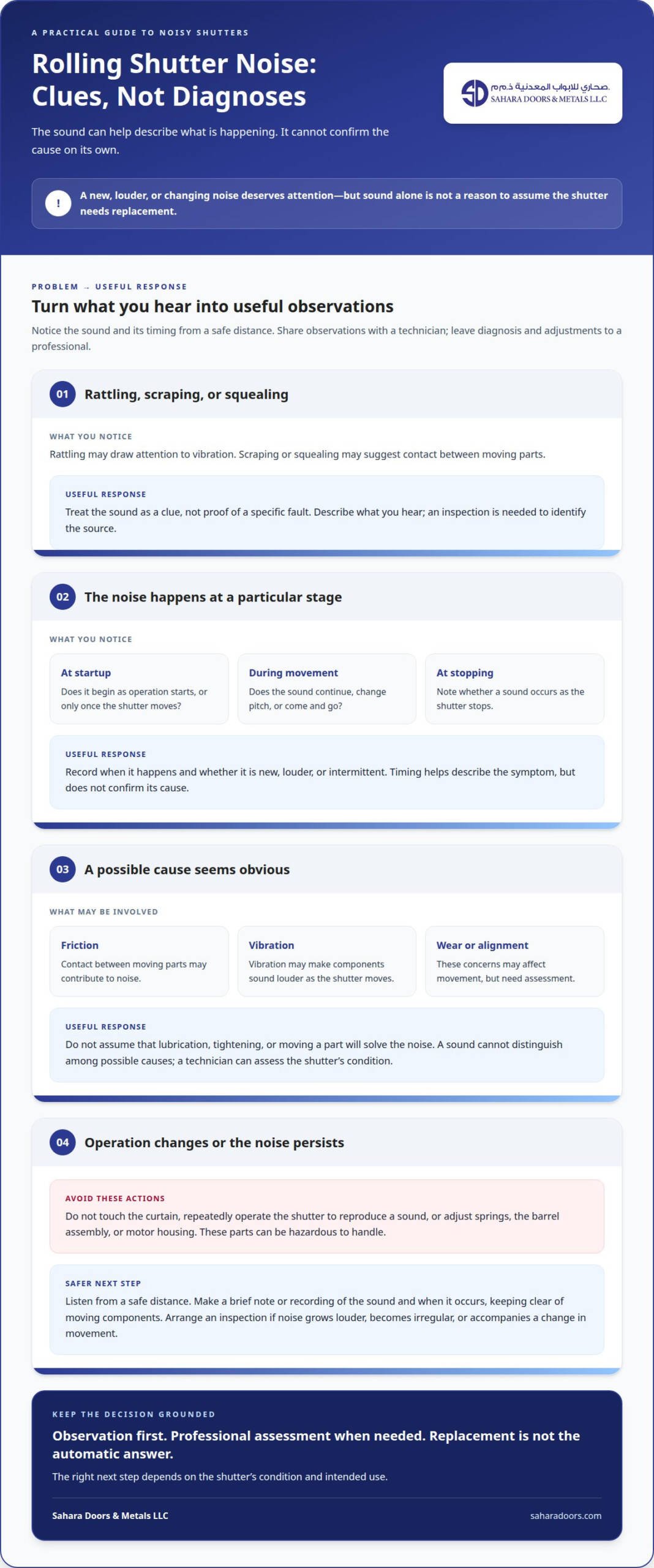
Treat each sound as a clue rather than proof of a specific fault. Rattling may draw attention to vibration; scraping or squealing may suggest contact between moving parts. A technician can use those observations to guide an inspection, but the sound alone cannot establish the cause.
Note whether the sound is new, growing louder, or intermittent. Does it happen each time the shutter operates, or only occasionally? “A rattle during movement that has become louder” is more useful than “it’s noisy.” Avoid assuming the shutter needs replacement based on sound alone. Its condition and intended use matter too.
When does the noise happen?
Noting the stage of operation can make your observations more useful. Listen for a change at startup, while the curtain is moving, as it stops, or throughout the full cycle. Timing helps describe the symptom, but does not confirm its cause. A noise at startup, for example, does not by itself identify a motor or shutter fault.
- At startup: Note whether the sound begins as soon as operation starts or only after the shutter begins moving.
- During movement: Record whether the sound continues, changes in pitch, or comes and goes as the curtain travels.
- At stopping: Notice whether the sound occurs as the shutter stops, without trying to adjust its settings.
If the shutter is manual, note the sound during normal manual operation. If it’s motorized, describe what you hear during powered operation. If the noise occurs in both modes, include that in your notes. Don’t operate the shutter repeatedly just to reproduce a sound, especially if its movement has changed.
A brief written note or recording made from a safe distance can help a technician understand the sound and its timing. Keep clear of moving components while recording. These observations are a practical first step in understanding how to reduce noise from rolling shutters, while leaving diagnosis and adjustments to a professional.
Common Rolling Shutter Noise Causes: Friction, Vibration, and Wear
A rolling shutter’s noise may relate to how moving parts meet, vibration in the assembly, or changes in the shutter’s condition over time. These are possibilities, not a diagnosis. A technician needs to assess the shutter to identify the source and decide whether maintenance, adjustment, or another response is appropriate.
A possible cause is not a confirmed fault. A sound can help direct an inspection, but it does not prove that a particular component has failed or that one simple fix will resolve the noise.
Friction and contact between moving parts
As a rolling shutter opens and closes, its curtain rolls and unrolls while moving through guides. Friction is resistance between surfaces that move against or contact one another. Depending on the shutter’s condition and movement, contact between parts may contribute to noise. That does not mean every metallic sound is unusual, or that lubrication alone will solve it. The source and condition of the parts need to be considered together.
Dust, an obstruction, wear, or alignment concerns may also warrant professional assessment. An obstruction or a part that no longer travels smoothly may affect movement, but a sound by itself cannot distinguish among these possibilities. Avoid applying products or trying to move parts into position without knowing what the shutter requires.
Loose parts, vibration, and changing operation
Vibration can make components sound louder as the shutter moves, and a loose component is one possible reason for rattling. The noise alone does not identify which part, if any, is loose. OSHA describes source-level machinery controls, including maintenance and vibration reduction, in its guidance on engineering noise controls. This is general technical context, not a shutter diagnosis or a substitute for assessing the shutter itself.
Pay attention to changes in the noise pattern. A sound that grows louder, becomes irregular, or occurs alongside a change in movement is a sensible reason to arrange an inspection. Wear and alignment issues cannot be confirmed safely by tightening, adjusting, or dismantling components yourself. Leave those checks to a technician.
The next step depends on what an inspection finds, how often the shutter operates, and what the opening needs. For a window opening, Sahara Doors & Metals LLC’s window rolling shutters are described as providing noise reduction. Results depend on the application, so this feature is not a guaranteed outcome for every window. If noise persists or operation changes, professional maintenance and technical support can help determine whether the existing shutter needs attention.
Compare Noise-Reduction Options Before You Choose a Fix
The right response depends on what the shutter is doing, how the noise has changed, and what the opening needs. If a familiar sound occurs without a change in operation, keep an eye on whether its pattern changes. Persistent noise or altered movement calls for professional assessment before you choose maintenance or consider a different shutter. Replacement is not the automatic answer.
Compare options by suitability, not by assuming a guaranteed noise outcome. A shutter used frequently for a commercial entrance may have different operational requirements from one fitted to a window. Construction and application matter too. Reviewing the range of GI rolling shutters can help you consider shutter type in relation to the opening and its use, rather than treating material alone as a noise fix.
When maintenance may be the sensible first step
If the noise persists, becomes irregular, or comes with changed operation, arrange a professional assessment before deciding what repair is needed. A technician can assess the shutter’s condition and determine whether maintenance is appropriate. Sahara Doors & Metals LLC provides rolling shutter maintenance and technical support, helping property owners make a considered decision without assuming replacement is necessary.
Give the assessment useful context: describe the sound, the shutter’s movement, how often it operates, and the demands placed on it. This information can help determine whether maintenance may address the issue or whether a broader solution should be considered. A quick adjustment or an unverified repair method is not a substitute for an inspection.
When a different shutter solution may be worth considering
A different shutter may be worth exploring if the existing one’s condition or the opening’s requirements make it a poor fit. Before making that decision, consider the intended use, operating pattern, and features needed. Sahara Doors & Metals LLC describes its window rolling shutters as providing noise reduction. That feature may be relevant to selection, but it does not guarantee a particular result in every building or situation.
Noise-control guidance also discusses managing sound at its source and addressing vibration. OSHA’s technical material on vibration isolation and damping provides broader context, though it is not a shutter-specific assessment. The practical point is to identify the source and application before selecting a solution.
As you compare options, consider what an inspection indicates, whether the shutter still suits its use, and whether maintenance or a different configuration better fits the opening. Sahara Doors & Metals LLC’s site surveys and technical support can help inform that decision. This measured approach can help avoid unnecessary replacement while keeping the opening’s operational needs in view.
Safe Steps to Take When Your Rolling Shutter Makes Noise
Use a measured approach. If the shutter’s movement changes or the noise becomes sudden and severe, stop operating it and keep clear. Don’t try to diagnose the mechanism by touching it. Careful observations can help a technician understand what’s happening without risking further damage or injury.
Have unusual operation assessed before continuing to use the shutter. Follow these steps:
- Pause operation if movement changes. Stop if the curtain moves irregularly, becomes stuck, or makes a sudden severe noise. Don’t keep cycling it to test whether the sound goes away.
- Observe from a safe distance. Look for visible obstructions near the opening without reaching into the guide channels or going near moving parts.
- Record what you notice. Note the sound, when it occurs, whether it is intermittent, and whether it has changed. A short recording from a safe position may help describe the symptom.
- Arrange a professional assessment. Share your observations and whether the shutter is manual or motorized. A technician can assess the cause before recommending a next step.
A simple observation checklist
Keep your notes factual and brief. Describe whether you hear rattling, scraping, squealing, or motor noise, and whether it happens at startup, during movement, or as the shutter stops. Note whether the sound is new, worsening, or occasional. Record whether the shutter is operated manually or by motor and whether the symptom occurs consistently. These details help focus an inspection without turning a sound into a diagnosis.
If you can see an object near the opening, don’t reach into the guides or try to clear anything close to the curtain. A view from a safe position is enough to report what you see. Keep your hands away from moving parts, and never attempt an adjustment while the shutter is operating.
When to stop and arrange professional attention
Stop using the shutter if it becomes stuck, moves unevenly, or makes a sudden severe noise. If you’re unsure whether it’s safe to operate, don’t force it. Noise can have more than one possible explanation, and adjusting or dismantling components without knowing the cause can create additional risk. Arrange an inspection when operation is irregular or the source remains unclear.
Avoid applying oils, sprays, or other products as a guess, and don’t push or pull the shutter to overcome resistance. These actions may not address the source and could affect movement. Sahara Doors & Metals LLC provides site surveys, maintenance, and technical support for rolling shutters. Clear observations help the team assess the issue and guide the next step.
Get Persistent Rolling Shutter Noise Assessed and Choose the Right Next Step
If a rolling shutter continues to make noise or its movement changes, use your observations to guide the next step: avoid unsafe intervention and arrange a professional assessment. A sound can help describe the problem, but it cannot confirm whether maintenance, a different shutter, or another response is appropriate. An assessment helps make the decision practical instead of jumping straight to replacement.
What a professional assessment can help clarify
A site survey can consider the shutter, the opening it serves, and how the shutter is used. Its operating pattern and intended application help inform which options make sense. Sahara Doors & Metals LLC provides site surveys, installation, maintenance, and technical support for rolling shutters. An assessment can help guide maintenance or replacement considerations without promising a diagnosis or result in advance.
Share what you have noticed, including when the noise occurs, whether it has changed, and whether operation is manual or motorized. These details give the assessment useful context. If the shutter is stuck or moving irregularly, don’t continue operating it just to gather more information. A professional can evaluate its condition and help identify a sensible course of action.
Discuss a suitable rolling shutter solution
If the existing shutter no longer suits the opening or its requirements, a different option may be worth discussing. Sahara Doors & Metals LLC offers GI, aluminium, perforated, polycarbonate, and insulated rolling shutters, with manual and motorized options. Selection can be tailored to the project and intended application. These options are not noise guarantees; suitability depends on the opening, its use, and the features required.
A shutter for a frequently used entrance may have different operational requirements from one serving a window. Window rolling shutters are described as providing noise reduction, but a specific outcome should not be assumed for every installation. Start by considering the opening and the purpose the shutter needs to serve, then assess whether the current unit remains suitable.
The aim of learning how to reduce noise from rolling shutters is not to silence every sound at any cost. It is to understand what may be happening, avoid risky adjustments, and choose a proportionate next step. If maintenance is appropriate, Sahara Doors & Metals LLC can support that work. If the application calls for a different solution, the available shutter options can be considered in context.
Bring your observations and intended use into the conversation. Discuss the noise, how the shutter operates, and what the opening needs from a maintained or replacement unit. This gives the assessment a clear, practical starting point.
Make Your Next Shutter Decision With Confidence
A rolling shutter should suit the way your space is used, not just address a sound in isolation. Consider what you need from the opening over time, including how the shutter operates and the role it plays in your property. This broader view is more useful than trying a quick fix without understanding the issue.
If you’re considering how to reduce noise from rolling shutters, use the assessment to discuss both the current concern and the shutter’s intended use. A clear conversation about your priorities can help frame suitable options, whether the focus is continued use or a change in requirements.
With clear information about the sound, operation, and opening, you can make a considered choice for your space. Discuss your rolling shutter requirements with Sahara Doors & Metals LLC to plan the next step.
Frequently Asked Questions
Is a noisy rolling shutter dangerous?
Noise by itself doesn’t establish that a shutter is unsafe. A quiet rattle with unchanged movement is different from a curtain that sticks or travels unevenly. If it stalls or appears unstable, stop using it and keep people clear of its path. Don’t inspect inside the guides or test it by hand. Note what changed and arrange a professional assessment; sound alone cannot confirm the cause.
Can I use WD-40 to quiet a rolling shutter?
Don’t treat WD-40 or any spray as a default fix when considering how to reduce noise from rolling shutters. A squeal doesn’t establish that lubrication is needed, and a product applied in the wrong place may leave the underlying issue untouched. Keep hands and spray away from the moving curtain and guides. Note the sound and timing, then arrange an assessment if it persists or affects normal travel.
Why does my rolling shutter make noise in only one direction?
A direction-specific sound is useful information, but it doesn’t identify a failed part. Note whether it occurs only as the curtain lowers, only as it rises, or at a particular point in either movement. Observe during normal operation rather than repeatedly cycling the shutter. Share this detail with a technician, especially if movement also feels uneven or becomes less reliable.
Can heat make a rolling shutter noisier?
Heat may coincide with a change in noise, but the sound alone cannot establish temperature as the cause. Note whether the noise appears under particular conditions and whether the shutter’s movement changes at the same time. Avoid changing how you operate it based on an assumption about temperature. If the noise continues, grows louder, or accompanies sticking, arrange an assessment of the shutter and its operation.
Should I replace a rolling shutter because it is noisy?
Not necessarily. Noise alone isn’t enough to decide that replacement is needed. Consider whether the shutter still moves normally, how its condition has changed, and whether it suits the opening’s current use. A change in how often an entrance is used, for example, may affect what the opening needs from a shutter. An assessment can help compare maintenance with another solution before you decide.
Can a window rolling shutter help reduce outside noise?
Yes. Window rolling shutters are described as providing noise reduction, though the result can vary with the window arrangement and surrounding conditions. If outside noise is a concern, consider the whole opening rather than expecting the shutter alone to deliver a particular reduction. Discuss the window’s intended use and desired features during product selection, so the shutter can be considered as part of the wider setup.