A shutter’s security depends on how well it resists lifting and forced movement. A closed roller shutter covers a window or sliding glass door, while features such as anti-lift devices, secure side guides and a bottom-bar lock can make it harder to force open. These details matter when preventing break-ins with security shutters.
Look beyond the shutter material. For a wide sliding glass door, consider how the shutter closes and locks, as well as whether manual or motorized operation suits the space. The right combination adds a practical layer of protection while keeping everyday use convenient.
This guide explains how anti-lift devices and bottom-bar locks work, what to consider when choosing a shutter, and how manual and motorized operation suit different routines. It also covers the security needs of sliding glass doors, helping you assess key features before choosing a shutter.
Key Takeaways
- Anti-lifting devices and secure side guides help resist attempts to raise or force a shutter curtain out of place.
- Assess the full barrier, including how the shutter closes and locks, rather than choosing by material alone.
- Choose manual or motorized operation according to how you use the property and manage shutters when away.
- For sliding glass doors, consider the opening’s width and how the shutter’s guides and bottom bar secure the full span.
- GI, motorized, polycarbonate and perforated rolling shutters offer different options to match a property’s needs.
1. How anti-lifting devices prevent shutters from being raised
Anti-lift devices help prevent someone from raising a roller shutter curtain from outside. When the shutter is closed, they strengthen the connection between the curtain and its supporting mechanism. This resistance matters at ground-floor windows, shopfronts and other accessible openings. Without it, upward force may move the curtain enough to create a gap. When assessing security, consider how the closed shutter responds to lifting, not just how it looks.
Common shutter weaknesses include poor installation, neglected maintenance and components that do not hold the curtain securely in its guides. Poor installation or neglected maintenance can reduce the effectiveness of security features. A shutter with misaligned guides, for example, may not close or move as intended. These risks make correct fitting and working locks as important as the shutter curtain itself.
An anti-lift mechanism resists upward movement when the shutter is closed. The exact design varies, but the principle is the same: force applied from outside should not easily raise the curtain. At a window facing a public walkway, this feature helps counter a direct lifting attempt. It contributes to preventing break-ins with security shutters while allowing normal operation when the shutter is open.
Anti-tamper considerations extend beyond lifting. Look at how the curtain sits in its side guides, whether the bottom edge closes evenly, and whether moving parts work smoothly. For example, a gap along one guide can leave a potential weak point, even if the shutter curtain appears sturdy. Commercial shutters should be maintained every 6 to 12 months to help keep locks and moving parts working smoothly. Maintenance helps identify wear, misalignment or damage before these issues affect operation.
Vandalism can also affect shutters, particularly when windows face public areas. Anti-graffiti coatings can make school shutters easier to clean after vandalism. They address surface markings, not lifting or forced entry, so they serve a different purpose from anti-lift features. In some cases, damage may be confined to an exterior panel, which can be easier and less expensive to clean or replace than damaged storefront glass.
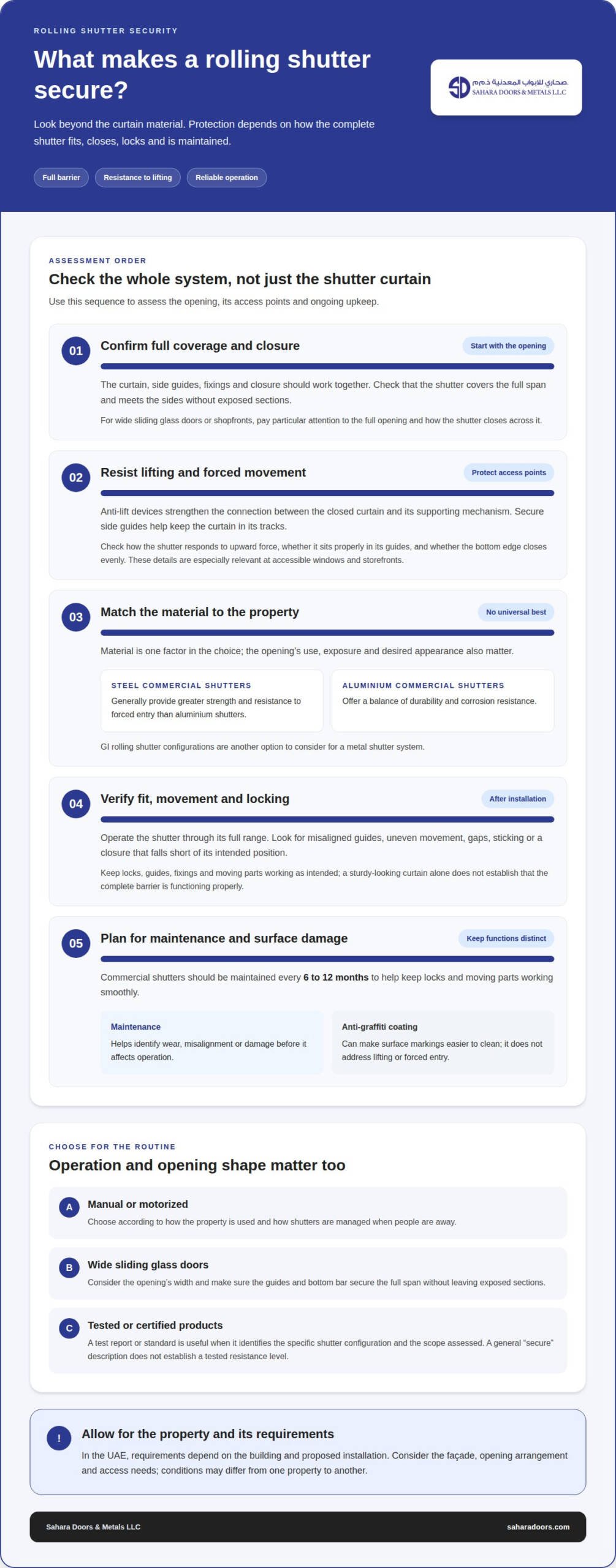
Assess protection by considering the opening, closure and upkeep together. First, confirm that the shutter closes fully and sits properly in its guides. Then consider whether anti-lift and anti-tamper features address likely access points, such as a reachable window or storefront. Finally, plan for routine maintenance and suitable surface protection where vandalism is a concern. No single feature replaces a sound, properly functioning shutter system.
2. What Makes a Rolling Shutter “The Best” for Security?
A suitable security shutter should match the opening, its exposure and how people use the property. A street-facing shop window, for example, needs a different arrangement from a residential balcony door. Start by identifying the opening to protect, how much of it needs covering, and how the shutter will fit into normal business or home routines.
A closed roller shutter adds a physical layer over glazing, making direct access more difficult. Its effectiveness depends on the complete installation, not just the curtain material. The curtain, guides, fixings and closure must work together and suit the opening. For a wide shopfront, check that the system covers the full span and meets the sides without leaving exposed sections.
Material affects the choice, but there is no universal “best” option for every property. Steel commercial roller shutters generally provide greater strength and resistance to forced entry than aluminium shutters. Aluminium commercial shutters offer a balance of durability and corrosion resistance. The decision should reflect the opening’s use, exposure and desired appearance. GI rolling shutter configurations are one option to consider for a metal shutter system.
Security shutters may be tested or certified to recognized standards when the specific product has undergone an applicable assessment. A standard or test report is useful only if it identifies the shutter configuration and the scope assessed. A general description such as “secure” does not establish a particular tested resistance level.
In the UAE, shutter requirements depend on the building requirements that apply to the property and the proposed installation. Treat the façade, opening arrangement and access needs as design considerations, and don’t assume the same conditions apply to every building.
Installation should leave the shutter aligned with its opening and able to close evenly. A guide positioned out of line, for example, can affect the curtain’s travel. After installation, operate the shutter through its full range and look for uneven movement, gaps or a closure that falls short of its intended position. These checks help identify fit problems early.
Maintenance supports reliable operation over time. Keep the guides, locks, fixings and moving parts in working condition, and address sticking, unusual noise or visible damage. A shutter that no longer closes evenly may not cover the opening as intended. Maintaining the complete assembly helps preserve its function, rather than relying on the curtain alone.
Closed rolling shutters form a physical barrier over windows and glass doors, making forced access more difficult. Exterior roller shutters can add a security layer to help deter intruders at schools, while shutters can help prevent vandals from accessing school property. Strong side guides help keep a curtain from being forced out or lifted from its tracks, making them an important part of the installation.
Rolling shutters can shield windows, signage and merchandise from spray paint, blunt force or etching. They can also provide a visible security deterrent for homes, offices and retail storefronts. These benefits complement the checks on fit, closure and upkeep: a shutter is most useful when it covers the intended opening and continues to operate as designed.
3. Manual and automated shutters when away
A shutter protects an opening only when it is closed. Before leaving home or a shop, include accessible windows and doors in the closing routine. With a manual shutter, lower the curtain fully and engage its locking mechanism if fitted. For example, don’t leave a ground-floor window partly open simply because the room is unoccupied.
Manual operation suits openings that someone can easily reach and operate. The routine is straightforward: close each shutter before leaving and confirm it sits in its guides. The trade-off is practical. A property with several windows or a wide storefront requires a separate action for each manual shutter. Forgetting one can leave part of the opening uncovered.
Motorized shutters can make it more convenient to close multiple openings. They may be operated remotely or set on a timer to simulate occupancy. For instance, a timer can raise or lower a shutter at chosen times while residents are away. This pattern can make a home appear occupied, but it does not replace locking entrance doors or securing other access points.
Operation and locking are related but distinct. A motor moves the curtain, but the closed shutter still needs to sit correctly and engage its locking features. Don’t assume automation alone secures an opening. Before a planned absence, operate each shutter through a complete cycle. Confirm that the curtain closes evenly and the lock engages as intended. If it stops short or moves unevenly, part of the opening may remain exposed.
For commercial premises, an alarm connection can add another layer. A roller shutter connected to an alarm system can trigger an alert when someone attempts forced entry. This can help staff respond to an incident, while the closed shutter remains the physical barrier over the window or door. Alarm integration differs from scheduling: a timer controls operation, while an alarm connection reports a forced-entry attempt.
Choose controls around the property’s daily routine. A small home with one accessible window may be well served by manual operation, while a shop with several shutters may benefit from motorized control. Consider who will close each opening, whether a timer suits the absence pattern, and how the locking mechanism works after closure. In UAE homes and businesses, the useful choice is the one occupants can operate consistently.
Aluminium and other roller shutters can be operated manually or automatically, depending on the system. Match the control method to the opening and the people who use it. Whatever the operating mode, follow a simple departure routine: close the shutters, confirm they are fully closed, check the locks, then activate the alarm system if one is connected.
4. Bottom-bar locks with bolts that engage the side guides
A bottom-bar lock secures a shutter at its lower edge. In one design, two latches extend from the bottom bar into escutcheons on the side guides when the shutter closes. This connects the curtain’s base to both sides of the opening. If someone pushes or lifts from outside, the engaged latches help resist movement where the force meets the shutter.
The side guides are essential to this mechanism. Each guide has a receiving point for a latch, so the latches need to meet their escutcheons as the bottom bar reaches its closed position. If the shutter stops short or the bar sits unevenly, the lock may not engage as intended. A secure fit on both sides matters more than a lock that catches on only one.
During installation, the opening, guides and bottom bar need to align as a working assembly. If one side guide sits out of position, for example, its latch may miss the escutcheon. The shutter may appear closed even though the lower edge is not secured on both sides. Correct positioning gives the latches a clear path into their receiving points as the curtain descends.
The locking sequence should be easy to understand. Close the shutter fully, then confirm the bottom bar has reached its intended position and the lock has engaged. Don’t assume that motor noise or a lowered curtain proves the lock has caught. With a manual shutter, follow the same steps: lower the curtain completely and check that the bottom-bar lock is engaged.
Maintenance helps preserve the connection between the latches and side guides. Keep the locking points clear of debris, and pay attention if a latch sticks or fails to engage. If the bottom bar closes unevenly or the lock behaves differently than usual, have the shutter attended to before relying on it to secure the opening. Damage to a guide can also affect how the latch meets its escutcheon.
A bottom-bar lock adds a physical restraint at the shutter’s base, but it works alongside the curtain, guides and installation. On a wide shopfront, for instance, the bottom bar needs to meet both guides evenly. The lock cannot compensate for a damaged curtain or misaligned assembly. Assess how the complete shutter closes, whether both latches engage and whether each moving part operates smoothly.
Make bottom-bar engagement part of the daily closing routine. Check that both sides are secure rather than assuming one catch secures the full width. If the shutter is automated, confirm that its closing cycle brings the bar to the correct position. A properly engaged two-latch arrangement can make upward movement harder while allowing the shutter to open normally when unlocked.
5. Security shutters for sliding glass doors
A sliding glass door can create a broad glazed opening across a room or balcony. A security shutter needs to cover the entire opening, not just the moving glass panel. If the shutter stops short of the fixed panel, for example, that uncovered section remains exposed.
Start by considering the opening as a complete assembly. The shutter curtain, side guides and lower edge should span the door area and fit correctly around its frame. The installation also needs to account for the sliding door’s handle, threshold and everyday access. A shutter that obstructs normal passage may be left open, reducing the protection it is meant to provide.
Intruders may target the glass, frame or space beside a door panel. A closed shutter adds a physical layer across the glazed area, making direct access more difficult. For a villa opening onto a garden, covering the full span helps protect both the fixed glass and the sliding panel.
Security shutters, grilles, reinforced doors and window film serve different purposes. A shutter covers the opening with a movable barrier; a grille provides a fixed barrier, while a reinforced door focuses on the door leaf and frame. Window film treats the glass itself, so it does not cover the opening in the same way as a closed shutter.
In the UAE, shutters can be fitted to existing windows and doors when the opening and fixing surfaces suit the installation. Key considerations include the frame’s condition, space for the guides, shutter coverage and access needs. For an existing sliding door, these details determine how the shutter can be positioned and operated.
Consider how the household uses the doorway before selecting an arrangement. A family that uses a patio door throughout the day needs convenient access when the shutter is raised. At closing time, the shutter should cover the entire opening without interfering with the sliding panel, its handle or the threshold. Check that the curtain moves evenly and the bottom edge reaches its intended closed position.
Material choice matters, but the curtain alone does not determine security. A polycarbonate rolling shutter is one available category; the complete installation still needs suitable coverage and secure guides. Measure and plan around the full glazed span, then match the operation to the door’s daily use.
For sliding glass doors, consider window rolling shutters as a way to cover a glazed opening.
to provide coverage while the property is unoccupied. Rolling shutters can be operated manually or automatically to cover windows and doors when no one is home.
Sahara Doors & Metals LLC
Sahara Doors & Metals LLC helps UAE property owners choose rolling shutters suited to their openings and security priorities. Options include GI, motorized, polycarbonate and perforated rolling shutters for residential and commercial settings.
For a sliding glass door or accessible window, consider full coverage, guide alignment, closure and everyday operation. Sahara Doors & Metals LLC can help match a shutter type to the property and install a system suited to its needs. This is a practical next step when you’re ready to plan a shutter for your space.
Contact Sahara Doors & Metals LLC to discuss a rolling shutter for your property.
Plan the Next Step for Your Property
Turn your security priorities into a shutter plan for the specific opening. Consider which windows or doors need coverage, how the shutter will be used each day, and which features matter most for your property. This gives you a practical starting point for discussing preventing break-ins with security shutters.
Sahara Doors & Metals LLC offers GI Rolling Shutter, Motorized Rolling Shutter and Polycarbonate Rolling Shutter options for residential and commercial needs. Share the opening you want to secure and your preferred operating method to help shape a suitable direction for your project.
A considered choice can make security part of a more comfortable, confident space.
Frequently Asked Questions
What Makes a Rolling Shutter “The Best” for Security?
The right shutter suits the opening and has a construction and operating method appropriate to its use. For a shopfront, consider how it covers the glazing and how it will be secured after closing. For a home, appearance and ease of everyday use may also matter. Review the complete installed system, not just its material, and look for documentation describing any relevant security testing.
How effective are security shutters at preventing break-ins?
Security shutters add a physical obstacle over windows and doors, making direct access more difficult. Their practical value depends on whether they cover vulnerable openings and are easy enough to use consistently. For example, a shutter over a shop window can reduce direct access to the glazing and merchandise behind it. Treat shutters as one part of property security, alongside sound doors and appropriate access controls.
What types of security shutters offer the best burglary protection?
No single shutter type is right for every opening. GI rolling shutters suit properties seeking a durable metal curtain, while polycarbonate shutters suit situations where visibility through the shutter matters. Motorized operation can simplify use, but the motor alone does not determine resistance to break-ins. Consider the opening, desired visibility, daily use and overall construction, then choose a system that fits.