

Article by
Sahara Doors & Metals LLC
Leaders in rolling shutters
Did you know that sales for acoustic-insulated systems have surged by 23% annually as urban noise thresholds become strictly enforced legal mandates? It’s frustrating when industrial noise leaks through standard entryways, disrupting your operations and risking non-compliance with the latest Dubai Building Code standards. Investing in high-performance soundproof rolling shutters is no longer just about comfort; it’s a strategic engineering decision for your facility’s longevity and regulatory standing.
This 2026 guide explores how precision-fabricated systems achieve a measurable reduction of up to 57dB while simultaneously managing thermal transfer. You’ll discover the technical specifications of insulated double-skin slats, the impact of Law No. (3) on mechanical maintenance, and why structural density is the secret to true acoustic isolation. We’ll provide the technical roadmap you need to select a durable, multi-functional door system that meets the rigorous EN ISO 717-1:2013 standards for professional-grade protection. Whether you’re managing a commercial development or an industrial plant, understanding these decibel-reduction capabilities is essential for maintaining a productive, compliant environment.
Key Takeaways
- Differentiate between sound absorption and transmission loss to select the most effective acoustic barrier for your facility’s infrastructure.
- Analyze the dampening properties of high-density polyurethane and mineral wool infills used in professional-grade soundproof rolling shutters.
- Master the logarithmic nature of decibels to understand how a 10dB reduction results in a 50% perceived drop in ambient industrial noise.
- Identify strategic applications for acoustic door systems in the UAE, from isolating heavy-duty fabrication zones to managing hospitality loading bays.
- Explore how bespoke lath profiles and precision engineering allow for customized solutions tailored to meet specific decibel reduction targets.
Understanding the Role of Soundproof Rolling Shutters in Modern Infrastructure
In the context of industrial architecture, soundproof rolling shutters represent a sophisticated evolution of the traditional entry system. These are not merely heavy doors; they’re multi-layered acoustic barriers engineered to interrupt the path of sound waves through a combination of mass, dampening, and decoupling. Effective Soundproofing requires a clear distinction between sound absorption and sound transmission loss. While internal absorption reduces echo within a room, transmission loss refers to the barrier’s ability to prevent noise from penetrating from one side to the other. This distinction is vital when specifying systems for high-noise environments like manufacturing plants or loading bays.
The 2026 market in the UAE has seen a decisive shift toward these specialized systems. Driven by Dubai’s Law No. (2) of 2026, which classifies excessive noise as auditory overexposure, developers now prioritize acoustic-rated industrial doors. These systems offer a dual benefit that standard shutters can’t match: high-level physical security paired with significant noise mitigation. By integrating soundproof rolling shutters into a facility’s design, operators address regulatory requirements while enhancing the structural integrity of their building’s envelope.
Acoustic vs. Standard Shutters: The Critical Differences
Structural density is the foundation of acoustic performance. In physics, mass is the primary enemy of sound transmission. Soundproof rolling shutters utilize heavier gauge materials and specialized infills to maximize density, ensuring that sound waves are reflected rather than transmitted. Precision engineering also dictates the use of advanced sealing technology. We implement perimeter gaskets that eliminate air gaps, as even a minor leak can compromise the entire system’s decibel-reduction rating. Additionally, the lath design is crucial; interlocking joints are engineered to minimize vibration transfer between slats, preventing the door itself from becoming a sounding board during operation.
The Growing Need for Noise Mitigation in Industrial Zones
Regulatory compliance is a major driver for modern facilities. With Dubai’s 2026 laws setting residential noise limits as low as 30-40 dBA at night, industrial sites near mixed-use zones must adapt. Failure to comply can lead to fines starting at AED 5,000. Beyond legal requirements, protecting employee well-being is a priority. High-machinery environments often reach 90-100dB, making it vital to isolate fabrication areas from administrative offices. Using specialized door systems creates effective sound breaks in multi-functional warehouses, allowing for diverse operations to coexist without compromising productivity or safety standards.
The Engineering Behind Noise Reduction: How Acoustic Shutters Work
Achieving significant decibel reduction requires more than just a thick barrier; it demands a system designed to disrupt sound waves through mechanical decoupling and mass. High-performance soundproof rolling shutters utilize a double-skin lath design to create a specialized sound-dampening cavity. This hollow space between the metal skins acts as a buffer zone where sound waves lose intensity before reaching the secondary layer. To prevent the door from acting as a giant diaphragm, we incorporate decoupling techniques that break the physical path of vibration. This involves using synthetic gaskets and specialized lath connectors that isolate the external face from the internal structure, effectively “killing” the sound energy within the assembly.
Precision in the guide rail design is equally critical. In standard industrial doors, mechanical rattle can contribute to the overall ambient noise floor. Professional-grade acoustic systems feature heavy-duty guide rails with integrated brush seals and rubber inserts. These components ensure a tight, airtight seal along the entire vertical perimeter while eliminating the metal-on-metal contact that causes vibration during high winds or mechanical operation. By neutralizing these gaps, the system maintains its rated transmission loss across the entire opening.
Material Science: GI Steel vs. Aluminium for Sound Control
Choosing the right substrate is a balance between mass and frequency targeting. A gi rolling shutter is often the preferred choice for industrial environments because its superior density provides the necessary mass to block low-frequency noise, such as the deep thrum of heavy machinery. Steel’s high Sound Transmission Class (STC) makes it an excellent choice for preventing structural noise bleed. Conversely, aluminium shutters are highly effective at dampening high-frequency sounds and offer the added benefit of corrosion resistance in the UAE’s humid coastal climates. For many commercial projects, we specify specialized alloys that combine these properties to ensure a broad spectrum of noise control.
The Impact of High-Density Insulating Cores
The effectiveness of double skin insulated shutters depends heavily on the core material’s density, typically measured in kg/m³. High-density polyurethane (PU) foam or mineral wool infills are injected into the lath cavity to provide both thermal and acoustic resistance. This is particularly vital for meeting Occupational Noise Exposure standards in facilities where machinery noise must be kept below 85-90dB to protect workers. The cellular structure of the insulating core effectively transforms kinetic sound energy into microscopic amounts of heat, neutralizing the noise before it enters your space. If you are designing a facility with specific decibel targets, you might consult our engineering team to determine the optimal foam density for your project’s requirements.
Decibels and Performance: Evaluating Soundproof Shutter Specifications
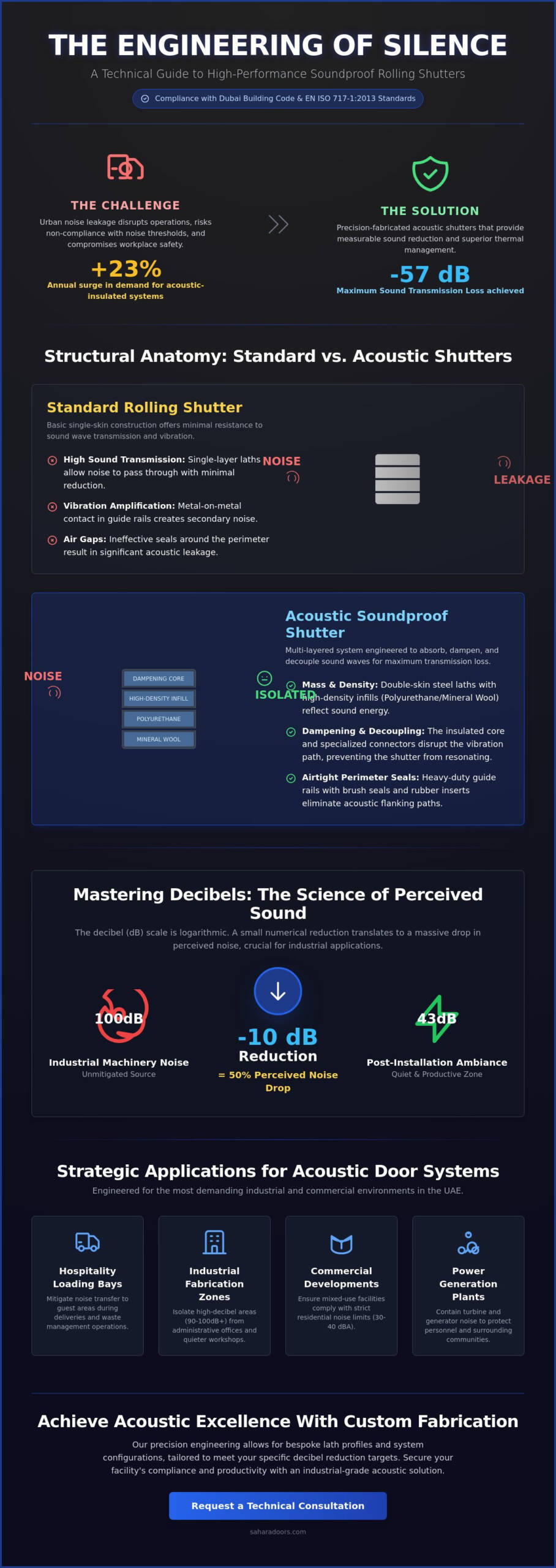
Understanding the technical data behind acoustic barriers requires a grasp of the decibel (dB) scale, which is logarithmic rather than linear. This means that sound intensity doesn’t increase in a straight line. A 10dB reduction represents a 50% drop in perceived noise levels to the human ear. When evaluating soundproof rolling shutters, this distinction is critical for project managers aiming to meet specific environmental targets. For example, reducing a 90dB industrial environment to 70dB isn’t a minor tweak; it’s a 75% reduction in perceived loudness, transforming a hazardous noise zone into a manageable workspace.
Real-world benchmarks help put these specifications into perspective. Industrial machinery typically operates between 90-100dB, while heavy street traffic in urban UAE areas averages 70-80dB. To comply with Dubai’s 2026 noise regulations, which mandate nighttime residential limits of 30-40 dBA, a shutter system must bridge a significant gap. Achieving this requires adherence to international testing standards like EN ISO 717-1:2013, ensuring that the laboratory-rated transmission loss translates to field performance.
Even the highest-rated shutter follows the “Weakest Link” theory of acoustics. Sound behaves like water; it finds the smallest opening and pours through. Professional installation is mandatory to maintain the integrity of the dB rating. If a shutter has a high-performance lath but lacks a precision-fitted bottom seal, the effective noise reduction can plummet. We focus on ensuring that every component, from the side guides to the headbox, maintains an airtight seal to prevent sound flanking.
Decibel Reduction Ratings by Shutter Type
Performance varies significantly based on the material composition and lath profile. Standard single-skin shutters offer a negligible 5-8 dB reduction, providing security but minimal acoustic benefit. Moving to an insulated double-skin system typically yields a 15-22 dB drop, which is suitable for most commercial applications where moderate noise dampening is required. For maximum isolation, specialized acoustic lath profiles are engineered to achieve 25dB to as high as 57dB reduction. These high-end systems utilize multi-density infills and reinforced structural skins to block the most aggressive industrial frequencies.
Factors That Compromise Soundproofing Performance
Several variables can undermine your investment in acoustic technology. Air gaps in the bottom seal or side guides are the most common culprits, as sound waves bypass the barrier entirely through these leaks. Improperly balanced motors are another factor. If the drive system causes operational vibration, the shutter slats may rattle, creating secondary noise that negates the dampening effects of the core. Finally, while a perforated rolling shutter is excellent for ventilation, it’s incompatible with high-level soundproofing. Any opening in the shutter surface creates a direct path for sound transmission, making solid, double-skin profiles the only viable choice for strict noise control.
Strategic Applications for Acoustic Door Systems in the UAE
The strategic deployment of acoustic barriers is essential for maintaining operational efficiency in the UAE’s dense urban and industrial sectors. As residential and commercial zones increasingly overlap, the ability to contain noise within a specific footprint becomes a legal and functional necessity. In hospitality, soundproof rolling shutters are frequently utilized to isolate ballroom events from the disruptive noise of service corridors and loading bays. This allows for seamless back-of-house operations without compromising the guest experience. Similarly, in retail environments and high-end showrooms, these systems block exterior traffic noise, creating a premium, quiet atmosphere that encourages longer customer engagement.
In the manufacturing sector, the priority shifts to internal isolation. High-decibel fabrication zones, where machinery can exceed 90dB, must be separated from administrative offices to ensure employee safety and focus. By installing specialized door systems, facility managers can create effective sound breaks within a single warehouse structure. For luxury residential projects, these shutters provide quiet operation for garage doors, ensuring that the mechanical movement of the door doesn’t disturb the peace of the villa or neighboring properties, aligning with the strict 30-40 dBA nighttime limits enforced in 2026.
Integrating Acoustic Control with Thermal Efficiency
Acoustic performance and thermal regulation are deeply interconnected in the Middle Eastern climate. Sound waves, much like heat, exploit air gaps and structural weaknesses. By implementing insulated rolling shutter uae solutions, you solve two critical engineering challenges simultaneously. These systems utilize high-density infills that dampen vibration while providing a robust thermal break. Sealing acoustic leaks naturally prevents the ingress of 50°C summer heat, significantly reducing the HVAC load on your facility. In a warehouse environment, this dual-action protection ensures that climate-controlled goods remain stable while machinery noise is contained, maximizing both energy savings and regulatory compliance.
High-Speed Acoustic Solutions for Logistics
Modern logistics hubs require a balance between rapid access and noise control. We often integrate soundproofing capabilities with the rapid cycles of high speed doors uae to prevent noise pollution from escaping busy distribution centers. These systems utilize soft-start and soft-stop motor technology, which minimizes the mechanical “clatter” typically associated with high-frequency operation. For added isolation, secondary acoustic baffles like PVC strip curtains can be installed to provide a multi-layered defense against sound transmission during peak traffic hours. If you’re looking to optimize your facility’s noise profile, you can request a technical consultation with our fabrication experts today.
Custom Fabrication: The Sahara Doors Approach to Acoustic Excellence
Standard supply-and-fit services often lack the technical depth required for high-decibel industrial environments. At Sahara Doors & Metals LLC, we treat noise control as a specialized discipline of custom metalwork. We don’t rely on off-the-shelf components; instead, we manufacture soundproof rolling shutters designed to address the specific acoustic profile of your site. By manipulating the lath geometry and the density of the internal dampening materials, our engineers create a barrier that targets the exact frequencies generated by your facility’s operations. This bespoke approach ensures that the energy of the sound waves is effectively neutralized before it can penetrate the secondary skin.
The fabrication of insulated double skin rolling shutter uae systems at our facility follows a rigorous precision engineering workflow. To ensure compliance with Law No. (3) of 2026 regarding building quality and maintenance, we provide specialized industrial technicians for every installation. These experts focus on eliminating flanking paths and structural resonance that can often bypass the primary barrier. After the installation is complete, we offer post-delivery testing and long-term maintenance services to ensure the system’s noise transmission loss remains consistent throughout its lifecycle, preventing the degradation that often occurs with standard door systems.
The Sahara Doors Manufacturing Advantage
Managing the entire production cycle in-house allows us to maintain absolute quality control over every component, from the initial metallurgy to the final mechanical assembly. We utilize industrial-grade materials that provide the structural integrity needed for large-scale commercial openings while ensuring high-end aesthetic finishes that complement modern architecture. Our direct-to-client consultation model gives contractors and architects immediate access to our technical experts. This transparent approach ensures that the final product aligns perfectly with the project’s architectural requirements, safety standards, and environmental goals, making us a dependable partner in the UAE’s construction sector.
Requesting a Technical Consultation
Our engagement process is built for efficiency and professional clarity. To begin a customized quote for soundproof rolling shutters, provide our team with your project’s technical specifications, including the required decibel reduction and the specific mounting conditions of the site. For complex, noise-sensitive developments, we conduct on-site assessments to evaluate potential acoustic leaks and structural vibrations that might require unique fabrication adjustments. This methodical approach minimizes risk and guarantees a high-performance outcome for every client. Contact Sahara Doors & Metals LLC today to review our recent project portfolios or to schedule a meeting with our engineering team for your bespoke soundproof solutions.
Advancing Your Facility’s Acoustic and Thermal Performance
Implementing a robust acoustic strategy is a vital investment in your facility’s long-term operational viability. As we’ve explored, the effectiveness of soundproof rolling shutters relies on more than just material thickness; it’s about the precision of the final assembly and the total elimination of mechanical vibration. By choosing a system that integrates thermal resistance with decibel control, you’re securing a multi-functional entryway that meets the rigorous demands of modern urban and industrial zones. This synthesis of engineering and material science is what distinguishes a standard door from a professional-grade acoustic barrier.
Sahara Doors & Metals LLC has been a leader in UAE-based precision manufacturing since 2010. We specialize in industrial-grade insulated double-skin systems that deliver consistent, measurable results for contractors and developers alike. Our team handles everything from bespoke fabrication to expert installation, ensuring that your project’s technical specifications are met without compromise. It’s about more than just a door; it’s about providing a dependable, seasoned partner for your infrastructure needs.
Request a Technical Quote for Soundproof Rolling Shutters today to speak with our engineering experts. We’re ready to help you optimize your facility’s performance and ensure your space remains quiet, secure, and compliant.
Frequently Asked Questions
Do rolling shutters really block noise?
Yes, professional grade soundproof rolling shutters are engineered to block noise through a combination of mass and mechanical decoupling. Unlike standard single skin models, these systems use multi layered laths to disrupt sound transmission. When properly installed with precision fitted gaskets, they significantly reduce ambient noise from industrial machinery or urban traffic, ensuring compliance with strict 2026 auditory exposure standards.
What is the highest decibel reduction possible with a rolling shutter?
High performance acoustic shutters can achieve a sound reduction of up to 57dB. This level of isolation is achieved through specialized double skin lath profiles and high density mineral wool or polyurethane infills. Reaching these maximum ratings depends on rigorous adherence to EN ISO 717-1:2013 testing standards and an airtight installation that prevents sound flanking through the perimeter of the opening.
Are soundproof rolling shutters also insulated for heat?
Yes, acoustic shutters provide a dual benefit of sound mitigation and thermal insulation. The high density infill materials used to dampen sound vibrations also act as a robust thermal break. This is particularly valuable in the UAE climate; it reduces the HVAC load by preventing heat transfer through the entryway, creating a more energy efficient and comfortable interior environment for commercial facilities.
Can I install soundproof shutters on an existing commercial building?
Retrofitting acoustic shutters onto existing commercial structures is entirely possible and a common practice for facilities needing to meet new noise regulations. Our engineering team assesses the existing structural integrity to ensure the header and side supports can handle the increased mass of a soundproof system. We then customize the fabrication to fit the specific dimensions of your current openings without requiring extensive modifications.
How much maintenance do acoustic shutters require compared to standard ones?
Maintenance requirements for acoustic systems are similar to standard motorized shutters, with an added focus on the integrity of the seals. Because soundproofing relies on an airtight environment, you should periodically inspect the perimeter gaskets and bottom seals for wear. Ensuring the motor remains balanced is also critical; operational vibrations can create secondary noise that undermines the system’s rated decibel reduction capabilities.
Are these shutters fire rated as well as soundproof?
Fire rated capabilities depend on the specific material composition and infill used during fabrication. While many soundproof rolling shutters utilize mineral wool, which is naturally fire resistant, you must specify fire rating requirements during the consultation phase. We ensure that specialized door systems meet the necessary UAE Fire and Life Safety Code standards while maintaining their rated acoustic performance across industrial applications. For projects in Dubai, Sharjah, or across the wider Gulf region that require dedicated containment systems, our fire rated rolling shutters UAE are engineered to meet Civil Defense codes alongside your acoustic requirements.
What is the best material for a soundproof rolling shutter?
Galvanized Iron (GI) steel is generally considered the best material for blocking low frequency industrial noise due to its superior mass. However, aluminium is highly effective for high frequency dampening and offers essential corrosion resistance in coastal UAE environments. The optimal material choice often involves a double skin combination of these metals tailored to the specific noise profile and environmental conditions of your project site.
How does motorization affect the noise level of the shutter itself?
Modern motorization actually assists in noise control by providing smoother, more controlled movement. High quality drive systems utilize soft start and soft stop technology to eliminate the mechanical clatter often found in manual systems. When paired with precision engineered guide rails and brush inserts, the operational noise of the shutter itself remains minimal, preventing it from contributing to the facility’s overall ambient noise floor.
3 Comments