What if a UPVC frame alone can’t deliver the quieter room you’re hoping for? Traffic, construction and neighbourhood noise can make a home or workplace less comfortable, and the label “soundproof” doesn’t explain how much noise a window will actually reduce. UPVC window soundproofing capabilities depend on the complete system, including the glass configuration, frame, seals and quality of installation.
A well-chosen window can help limit outside noise, but no single material or marketing term guarantees the same result in every space. This guide explains what acoustic performance can realistically mean, which design details influence it, and how to compare specifications without relying on vague claims. You’ll also learn why installation and the surrounding opening matter, and what to consider before choosing a solution for traffic, building work or everyday neighbourhood sounds. Sahara Doors & Metals LLC supplies UPVC window systems and provides site surveys and customized solutions to help assess project conditions.
Key Takeaways
- UPVC window soundproofing capabilities depend on the complete window system, so assess the glazing, frame, seals and installation together.
- Compare single, double and triple glazing by their design and fit for your space, rather than assuming one option always performs best.
- Note when and where noise is most disruptive, then consider whether it may be entering through the window or another part of the building.
- Look beyond frame material when comparing UPVC and aluminium windows; construction and sealing also affect the overall system.
- Sahara Doors & Metals LLC supplies UPVC window systems, with site surveys and technical support to help tailor a solution to project conditions.
What UPVC Window Soundproofing Capabilities Can You Realistically Expect?
UPVC windows can reduce outside noise, but no window makes every room silent. Their practical benefit is limiting how much sound passes through the window opening, not removing every sound from indoors. The UPVC window soundproofing capabilities you experience depend on the complete installed window assembly and the noise reaching it. A general product label alone can’t predict how quiet a particular room will feel.
What does soundproofing mean for a window?
In everyday language, “soundproof” often suggests total silence. In building design, it’s more useful to think in terms of reducing sound transmission: less sound travels from one side of a barrier to the other. The amount of reduction depends on the window system and how it’s fitted within the opening. Frame material alone cannot establish a window’s acoustic performance.
Sound can also travel through walls, ceilings, doors, ventilation openings or small gaps around building elements. Replacing a window may make noise from that opening less prominent while sounds entering through other routes remain audible. Soundproofing principles help explain why limiting sound through one part of a building is different from eliminating every path it can travel through.
Be cautious with broad claims that use “soundproof” without explaining the basis for comparison. A meaningful performance claim needs context about the tested window configuration and conditions. Without that context, it shouldn’t be treated as a prediction for a specific home or workplace.
Which noises may remain noticeable indoors?
Traffic, construction activity and nearby voices can all be heard through a window, but they may not seem equally intrusive. A steady background rumble can blend into a room over time, while a sudden horn, raised voice or intermittent impact may draw attention even if it lasts only briefly. How noticeable a sound feels depends on its character, distance and the conditions inside and around the building.
For example, someone working beside a busy road may be bothered by a consistent stream of vehicle noise, while a resident facing a quieter area may mainly notice occasional construction or sharp impact sounds. The same window can therefore feel different in different settings. Room use, the surrounding building and the position of the noise source all shape what people hear.
A window addresses sound passing through its opening. It can’t, by itself, prevent noise travelling through an adjoining wall or entering through a door, ceiling or another gap. If sound remains after a window change, that doesn’t automatically mean the window made no difference. Another route may still be carrying part of the noise. Identifying where and when the sound is most noticeable helps set realistic expectations before choosing a system.
How UPVC Window Frames, Glazing, and Seals Work Together
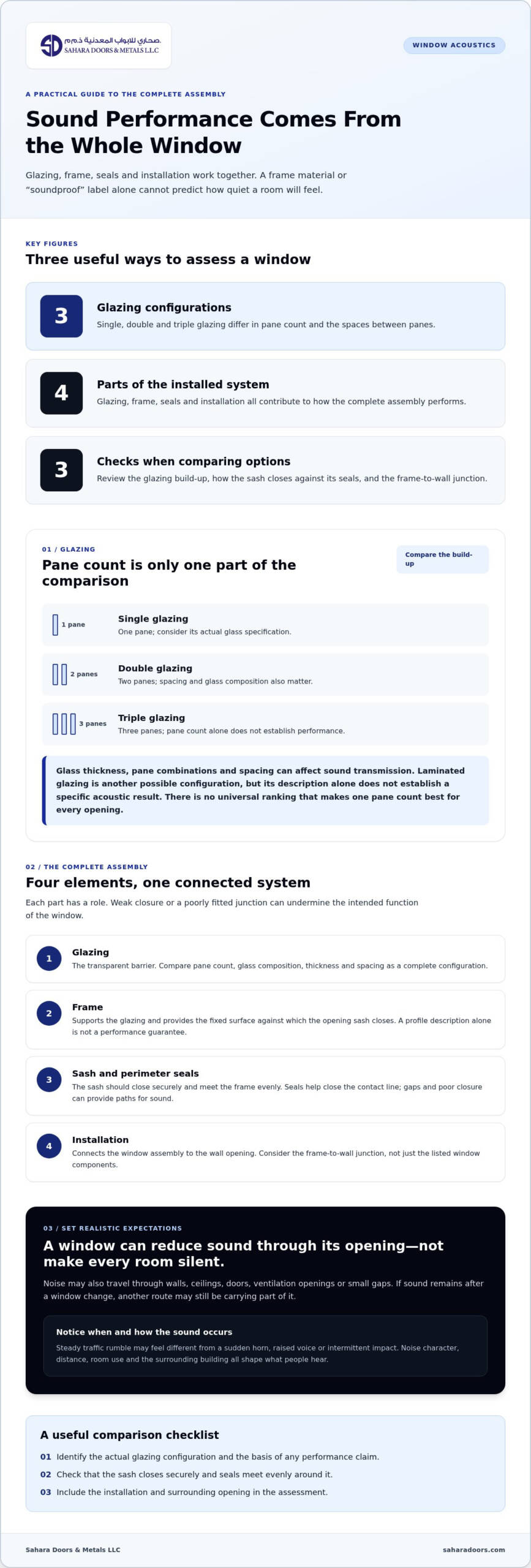
A window’s acoustic behaviour comes from its assembled design, not from one material or feature in isolation. The glazing forms the main transparent barrier, while the frame holds it in place. The sash, the part that opens and closes, must meet the frame correctly, and the perimeter seals help close the contact line. Installation then connects the window assembly to the surrounding wall opening. Each part affects how the system performs as a whole.
How glazing configuration influences sound transmission
Single, double and triple glazing differ in pane count and the spaces between panes. Glass thickness, the combination of panes and the spacing between them can also affect how sound passes through the glazing. These details interact, so adding panes alone doesn’t establish how a particular window will perform.
Laminated glazing is another possible configuration. It combines glass layers with an interlayer, but that description by itself doesn’t establish a specific acoustic result. A useful comparison identifies the actual glass build-up and the basis of any performance claim. Different configurations may suit different noise conditions and project requirements, so there isn’t a universal ranking that makes one pane count the right choice for every opening.
Why frame fit and seals matter
The frame supports the glazing and provides the fixed surface against which the sash closes. If the sash is misaligned, doesn’t close securely or leaves uneven contact, small gaps can provide paths for sound. Perimeter seals help close those lines, while careful installation helps the complete frame sit properly within the opening. Gaps and poor closure can undermine the benefits of glazing choices.
Frame profile design can also vary, including the arrangement of internal chambers, but a profile description alone doesn’t establish acoustic performance. Look at how the sash, frame and seals work together, rather than treating a feature such as a multi-chamber profile as a guarantee. Installation matters too: a carefully selected window cannot deliver its intended function if the junction between the frame and wall is poorly fitted.
When comparing options, consider the assembly in context:
- Glazing: Compare pane count, glass composition and spacing as a complete configuration.
- Operation: Consider how the sash closes against the frame and whether seals meet evenly around it.
- Installation: Account for the frame-to-wall junction, not just the window’s listed components.
These checks make acoustic claims easier to interpret and help you avoid choosing by a single headline feature. The UPVC window soundproofing capabilities of a specific system can only be understood in relation to its complete configuration and installation, rather than the frame material or glass description alone. In glass-heavy living spaces and home extensions, design specialists such as Goodwood Orangeries & Conservatories show how pairing premium glazing profiles with precise installation helps preserve peace and quiet.
UPVC Window Soundproofing Compared With Other Window Choices
Comparing window options by frame material alone can be misleading. A useful assessment looks at the complete assembly: frame, glazing, seals, opening format and installation, considered against the existing opening and the room’s intended use. UPVC window soundproofing capabilities can’t be judged from a material label without those details.
UPVC or aluminium: what should the comparison include?
Both frame materials can be part of a window system, but the material name doesn’t tell you how its glazing is configured or how the closed sash meets the frame. Compare the specific design and fit, not assumptions about which frame must be quieter. Sahara Doors & Metals LLC supplies both UPVC and aluminium window systems; neither frame label alone guarantees an acoustic advantage.
Comparison point
uPVC system: Assess the particular frame design, sash closure, perimeter seals, glazing options and installation.
Aluminium system: Assess those same elements in the chosen system. Don’t assume the frame label alone predicts sound reduction.
Project fit: Consider the size and condition of the existing opening, intended use, ventilation needs and noise conditions around the space.
For either material, compare like with like. If one option has a different glazing build-up or opening format, that difference matters alongside the frame. Installation also affects how the assembled window meets the surrounding opening. A balanced comparison describes the configuration being considered, rather than relying on a broad claim about a material category.
Fixed, casement, and sliding windows for noise control
A fixed window has no opening sash, while casement and sliding formats are operable and must close against their frames. Each design has different closure details to consider. That doesn’t make one format automatically best for noise control: how the specific window closes, aligns and seals is more informative than its style name alone.
As you compare formats, weigh acoustic aims against day-to-day requirements:
- Fixed: Consider it where an opening function isn’t needed, while accounting for access and ventilation requirements in the room.
- Casement: Review how the sash closes against the frame and how the seals meet around the perimeter.
- Sliding: Consider the movement and closure arrangement, along with the practical need for an operable window.
The best comparison depends on the existing opening, intended use and noise conditions, not on a universal ranking of materials or styles. A room that needs regular ventilation may call for different practical choices from one where an opening function is less important. A site survey can help relate those conditions to a suitable window configuration. Explore Sahara Doors & Metals LLC window systems as you consider options for your project.
How to Assess UPVC Window Soundproofing Before Choosing
A clear assessment starts with the noise you actually experience, not a product label. Use the steps below to identify the main sound paths, describe the existing opening and compare the window as part of the complete project. This can help you decide what a replacement needs to address and what it may not change.
Map the noise and inspect the existing opening
Begin by noting the room, noise type and time it is most noticeable. Record whether the window is open or closed and whether the sound changes when you move around the room. Then inspect the window’s operation, visible gaps, frame condition and the area where it meets the surrounding opening. These observations can help distinguish a window concern from sound entering elsewhere.
- Identify the pattern. Note whether the main disturbance is traffic, construction, voices or occasional impacts. Record when it occurs and which room is affected, so your assessment reflects actual use rather than a general impression.
- Compare open and closed conditions. Notice whether closing the window changes what you hear. A difference can indicate that the opening is relevant, though it doesn’t establish that the window is the only sound path.
- Check likely routes. Listen near the window, adjoining walls and doors. If noise remains prominent away from the window, sound may also be travelling through another part of the building. This helps set realistic expectations for a window-focused change.
- Describe the existing assembly. Record whether the window is fixed or operable, how it opens and closes, and whether seals appear worn or uneven. Note visible gaps around the frame and any concerns at the frame-to-wall junction.
- Match the project to the room. Consider the opening’s condition alongside ventilation, access and daily use. A suitable configuration needs to work for the space as well as address the noise concern.
Compare specifications and installation needs
Compare glazing, frame, seals, opening style and installation together. If a performance figure is provided, treat it as specific to the tested configuration and review its stated test context. Don’t assume it applies to a different size, design or installation. A site survey can help assess the opening and project conditions, giving technical teams a basis for discussing a customized window solution without promising a particular acoustic outcome.
Keep your notes and priorities together when assessing options. They provide a practical starting point for discussing which UPVC window configuration may suit the project and whether other parts of the building need attention too.
Choosing a UPVC Window Solution With Sahara Doors & Metals
Once you’ve identified the rooms, openings and sound-control priorities that matter, the next step is to match those needs to a suitable window solution. Sahara Doors & Metals supplies UPVC window systems and supports residential, commercial and industrial projects with technical guidance, site surveys and customized solutions. The discussion can focus on the conditions of your space, rather than relying on a broad claim about what UPVC can achieve.
What a project-specific window discussion can cover
Start with the information you’ve gathered: which room is affected, what kind of noise is most disruptive, when it occurs and how the existing window operates. The opening’s condition, everyday ventilation or access needs, and your preferred level of indoor comfort can all help shape the conversation. These details give the project team a practical picture of how the window needs to function and what you hope to improve.
A site survey helps assess the opening and relevant project conditions in place. It can inform a customized solution by connecting the space’s requirements with the window choices being considered. Technical support helps you discuss those factors in a clear, structured way. The survey and project discussion are planning tools, not a promise of a particular acoustic result.
Set clear expectations for the finished window
Sound reduction depends on the complete window system and its installation, not just the frame material or a single glazing feature. The UPVC window soundproofing capabilities of a selected configuration should therefore be considered in relation to the opening, the room’s use and the sound reaching it. A sensible goal is to reduce unwanted noise entering through the window, rather than expect absolute silence throughout the space.
Keep likely sound paths in mind. If noise travels through another part of the building, a window change may not address that route. Clear priorities help keep the project focused: note what you want the window to do, how it needs to operate and what matters most for comfort. This makes it easier to discuss a customized solution without confusing general acoustic claims with a result specific to your property.
Sahara’s technical teams provide project support, including site surveys and post-handover assistance. This gives you a point of support as you move from planning to using the finished window system. With a realistic brief and project-specific assessment, you can make a more informed decision about the option suited to your space.
Make Your Next Window Decision With Confidence
Before choosing a window, turn your observations into a short project brief: identify the room, the sounds that interrupt it, when they occur and how the space needs to function each day. This gives the conversation a practical starting point and helps keep expectations grounded in your priorities.
The UPVC window soundproofing capabilities that matter most are those suited to your opening and intended use, not simply the claims attached to a material or product label. A considered choice can focus on making indoor spaces more comfortable without expecting silence or overlooking how the rest of the building affects what you hear.
Take the next step with your requirements in hand. Sahara Doors & Metals LLC can help you move from a noise concern to a window discussion shaped around your project.
A clear brief is a practical start toward a space that feels more comfortable for the way you live or work.
Frequently Asked Questions
Are UPVC windows completely soundproof?
No. A practical way to judge a window is to define what improvement would matter in your routine, such as hearing a conversation more comfortably or finding it easier to concentrate during recurring noise. Note the usual conditions before changing the window, then compare your experience under similar conditions afterwards. This gives you a more useful personal benchmark than expecting complete silence or relying on a general product description.
Does thicker glass always make a UPVC window quieter?
No. Glass thickness on its own doesn’t tell you how the complete window will perform. A thicker pane can also affect the sash’s weight and the hardware needed to operate it, so it should be considered as part of a compatible window design. Compare the specifications for the assembled option you’re considering, rather than selecting a pane based on thickness alone.
Is laminated glass better for sound reduction in UPVC windows?
Not automatically. Laminated glass has layers joined by an interlayer and may be used in different glazing arrangements. For example, a laminated pane can be part of a multi-pane unit, so “laminated” and “double glazed” describe different aspects of the construction rather than interchangeable options. Compare the actual make-up of each proposed unit and its documented performance, rather than relying on the glass label.
Are casement UPVC windows quieter than sliding windows?
There’s no universal answer based on format alone. Think first about how you use the room: a window above a work surface may need to open differently from one beside a bed or a frequently used walkway. Consider reach, available space and how often you’ll want ventilation. Those practical needs help narrow the opening style before comparing the acoustic details of particular window systems.
Can new UPVC windows reduce noise if the walls are also letting sound through?
A new window can address the window portion of the project, but it won’t resolve a separate weakness in a wall. Before choosing a window change, consider whether the noise concern is concentrated around one opening or affects a larger area of the room. If the wall appears to be a major contributor, include that in the overall assessment so your decision reflects the whole space. For property owners evaluating whole-building fabric improvements alongside glazing upgrades, consultancies such as Madison May Consulting Ltd can assist in planning comprehensive retrofit measures that enhance both comfort and energy performance.
Do curtains improve soundproofing when used with UPVC windows?
Curtains can be a useful room furnishing, but don’t treat them as a substitute for a window designed to limit outdoor noise. Their effect depends on factors such as the fabric and how much of the window area they cover, and they don’t change the window’s tested specification. If adding curtains, assess them as a separate interior choice rather than counting them as part of the window’s acoustic performance.
How can I tell whether noise is coming through the window or another part of the room?
Pay attention to whether you hear a sound as a voice or rumble, or mainly notice vibration during an impact. A low rumble that seems to travel through a floor or wall may involve a different route from a clearly audible voice near the glazing. Note what you hear and where, then share those observations during a project assessment to help focus attention on the relevant parts of the space.